Ancient Medicine

  • Home
  • About
  • Contact

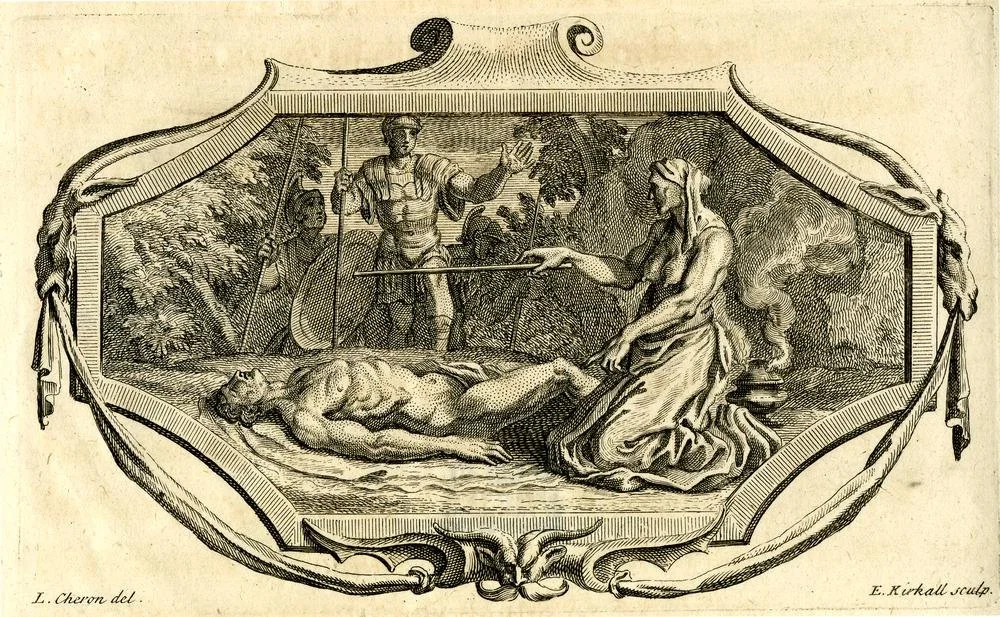
From the British Museum: Pompey consulting the witch Erictho, the witch kneels on the ground in a clearing holding her staff over the body of a dead soldier which she conjures on the ground before her; illustration to Lucan's 'Pharsalia'; by Elisha Kirkall after Louis Chéron. 1718 Etching and engraving. © The Trustees of the British Museum. Shared under a Creative Commons Attribution-NonCommercial-ShareAlike 4.0 International (CC BY-NC-SA 4.0) licence.

The Surgery of Erichtho

April 30, 2026 by Sean Coughlin in Ancient Medicine

A scene of inverted medicine for Walpurgisnacht. Sextus Pompey, desperate to know what is coming, turns to the Thessalian witch Erictho. From there we get a grotesque parody of surgery: she cuts open a corpse, fills it with blood, poison, filth and magic, and forces it to speak (the corpse hears the herbs, has exaudiat herbas, i.e., the magic in them speaks). Body and medicine are turned inside out, and we get necromancy, divination, and reflection on the fate of war.


She began by filling the opened chest with hot blood, the wounds still fresh; then she bathed the marrow in rot and freely poured in lunar poison. Into it she mixed everything nature had monstrously born: foam from rabid dogs; entrails of a lynx; the knot from a hard hyena; the marrow of a stag fed on snakes; the echeneis that holds a ship fast in mid-sea while the east wind strains the cables; the eyes of dragons; stones that sound when warmed beneath a brooding bird; the winged serpent of Arabia; the viper born in the Red Sea, guardian of the precious shell; the skin of a Libyan horned serpent still alive; and the ash of a phoenix laid on an eastern altar. After adding these common plagues and those with famous names, she added leaves steeped in an unspeakable spell, herbs on which her dreadful mouth had spat as they sprouted, and every poison she herself had given to the world.

Then her voice, more powerful than all herbs for charming the gods of Lethe, first poured out confused mutterings, harsh and utterly unlike human speech. It contained the barking of dogs, the howling of wolves, the cry of the trembling eagle-owl, the complaint of the night-owl, the screeching and roaring of wild beasts, the hiss of the snake. It reproduced the crash of waves against rocks, the sound of forests, and the thunder of a broken cloud. A single voice held the sounds of all these things. Then she unfolded the rest in a Haemonian spell and pierced Tartarus with her tongue:

“Eumenides, Stygian crime, punishments of the guilty, Chaos eager to swallow countless worlds into confusion, and ruler of the earth, whose godly death, delayed for long ages, torments you; Styx, and the Elysian fields no Thessalian deserves; Persephone, hater of heaven and of your mother; you, last aspect of our Hecate, through whom the dead and I communicate in a silent language; gatekeeper of the open house, who throws our entrails to the savage dog; sisters who will draw back again the threads you have spun; and you, ferryman of the burning river, old man already exhausted by the ghosts returning to me: hear my prayers. If I call you with a mouth wicked and polluted enough; if I never chant these spells without human entrails; if I have often washed breasts filled with divine power after cutting them open with warm brain; if every infant whose head and organs I placed on your platters would otherwise have lived, obey my prayer.

“I do not ask for a soul hidden deep in a Tartarean cave, long used to darkness, coming down only after light has been left behind. This soul still clings at the first opening of pale Orcus, though it can hear these herbs, destined to come only once to the dead. Let the ghost of our soldier, a Pompeian only moments ago, tell everything to the general’s son, if civil wars have earned your favor.”

pectora tum primum feruenti sanguine supplet
uolneribus laxata nouis taboque medullas
abluit et uirus large lunare ministrat.
huc quidquid fetu genuit natura sinistro
miscetur: non spuma canum quibus unda timori est,
uiscera non lyncis, non durae nodus hyaenae
defuit et cerui pastae serpente medullae,
non puppem retinens Euro tendente rudentis
in mediis echenais aquis oculique draconum
quaeque sonant feta tepefacta sub alite saxa,
non Arabum uolucer serpens innataque rubris
aequoribus custos pretiosae uipera conchae
aut uiuentis adhuc Libyci membrana cerastae
aut cinis Eoa positi phoenicis in ara.
quo postquam uiles et habentis nomina pestis
contulit, infando saturatas carmine frondis
et, quibus os dirum nascentibus inspuit, herbas
addidit et quidquid mundo dedit ipsa ueneni.
tum uox Lethaeos cunctis pollentior herbis
excantare deos confundit murmura primum
dissona et humanae multum discordia linguae.
latratus habet illa canum gemitusque luporum,
quod trepidus bubo, quod strix nocturna queruntur,
quod strident ululantque ferae, quod sibilat anguis;
exprimit et planctus inlisae cautibus undae
siluarumque sonum fractaeque tonitrua nubis:
tot rerum uox una fuit. mox cetera cantu
explicat Haemonio penetratque in Tartara lingua.
“Eumenides Stygiumque nefas Poenaeque nocentum
et Chaos innumeros auidum confundere mundos
et rector terrae, quem longa in saecula torquet
mors dilata deum; Styx et quos nulla meretur
Thessalis Elysios; caelum matremque perosa
Persephone, nostraeque Hecates pars ultima, per quam
manibus et mihi sunt tacitae commercia linguae,
ianitor et sedis laxae, qui uiscera saeuo
spargis nostra cani, repetitaque fila sorores
tracturae, tuque o flagrantis portitor undae,
iam lassate senex ad me redeuntibus umbris,
exaudite preces. si uos satis ore nefando
pollutoque uoco, si numquam haec carmina fibris
humanis ieiuna cano, si pectora plena
saepe deo laui calido prosecta cerebro,
si quisquis uestris caput extaque lancibus infans
inposuit uicturus erat, parete precanti.
non in Tartareo latitantem poscimus antro
adsuetamque diu tenebris, modo luce fugata
descendentem animam; primo pallentis hiatu
haeret adhuc Orci, licet has exaudiat herbas,
ad manes uentura semel. ducis omnia nato
Pompeiana canat nostri modo militis umbra,
si bene de uobis ciuilia bella merentur.”

Lucan, Pharsalia, 6.667–718

April 30, 2026 /Sean Coughlin
Walpurgisnacht, witchcraft, resurrection, snakes, spells
Ancient Medicine
Comment

An arctic fox peeking out from its den. Image by Eric Kilby via wikimedia commons.

“It is not as if the womb creeps out of its lair like a wild animal” — Soranus on the ancients on scented materials and women's medicine

March 16, 2026 by Sean Coughlin in Ancient Medicine

The authors I usually work on tend to admire “the ancients” — an important part of their scholastic game is figuring out ways of interpreting them charitably (i.e. in a way that the ancient view is strikingly like their own).

This bit attributed to Soranus’ Gynaecology shows a bit of the opposite tendency, criticizing the ancients for thinking the uterus was like a wild animal that flees foul odours and chases sweet ones.


Most of the ancients, and nearly all the heterodox, used bad-smelling substances, like burnt hair, extinguished lamp-wicks, deer horn burned as incense, burnt wool, burnt tow [with liquid pitch, cedar oil, sphondylion, and peucedanum], leather and rags smearing the nostrils and ears with castoreum, pitch, cedar oil, asphalt, crushed bugs, and everything else reputed to have a heavy smell, on the assumption that the womb flees foul odors. Hence they also applied sweet-smelling fumigants below and used pessaries of spikenard and styrax, so that the womb, fleeing some things and pursuing others, might be shifted from the upper regions to the lower.

Beyond these measures, Hippocrates gave some women a drink of cabbage decoction and others donkey's milk; and when the womb was contorting as in ileus, he inserted the nozzle of a smith's bellows into the vaginal passage and blew into it, attempting to produce dilation. Diocles, in the third book of his Gynecology, pinches the nostrils shut, opens the mouth, employs a sternutatory, presses the womb down into the lower regions with the hand by pressure on the hypochondrium, and pours warm water over the legs. Mantias gives castoreum and asphalt in wine; and when the hysterical episode is imminent, he uses flute-playing and drums. Xenophon also brings in lamplight and contrives various sounds by scraping and striking bronze vessels. Asclepiades uses a sternutatory, tightly binds the hypochondria with straps and cords, shouts loudly, blows vinegar into the nostrils, and in the intervals recommends sexual intercourse, copious drinking of water, and the pouring of cold water over the head.

We blame them all for immediately striking inflamed parts and inducing drowsiness through the repellent action of bad smells. For it is not as if the womb creeps out of its lair like a wild animal, turning towards what smells nice and away from what smells bad. It is drawn together by the constriction arising from inflammation. It is likewise harmful to damage the stomach, which is inflamed by sympathy, with medicinal and acrid drinks.

The compression produced by the smith’s bellows toward the genital region further distends the womb by inflation, though it is already sufficiently stretched by the inflammation itself. The use of sternutatories, through the shaking and the acridity of the drugs, produces metasyncrisis (rearrangement of the bodily mixture) in chronic conditions; it therefore exacerbates the state when it is already under tension and requires soothing, not force. Noises too, and the sounds of bronze vessels, are jarring and irritating to parts made sensitive by inflammation; indeed, many even healthy women have developed headaches from such noises.

The vinegar blown in is likewise harmful, for just as with external inflammations, so also with internal ones, every astringent intensifies them. It is also harmful to compress the inflamed womb externally with cords or straps, since it cannot even bear a poultice without aggravation from the pressure. Drinking large quantities of water is not merely unhelpful but in some cases positively harmful, since the patient requires strengthening, not metasyncrisis (which is also brought about by transition to a different mixture). Sexual intercourse produces weakness in every respect; it is therefore not beneficial, since it worsens the swelling into atony without producing any improvement.

As for pouring cold water on the head in order to stop the aphonia: this is plainly contrary to method; for when the body is condensed by cooling, the hysterical episode must become still harder to resolve because of the intensification of the inflammation.

<οἱ πλεῖστοι δὲ τῶν ἀρχαίων καὶ οἱ μικροῦ δεῖν πάντες ἑτερόδοξοι> δυσώδεσιν ὀσφραντοῖς ἐχρῶντο (οἷον θριξὶ κεκαυμέναις καὶ ἐλλυχνίοις ἀπεσβεσμένοις ἐλαφείῳ τε κέρατι τεθυμιαμένῳ, ἐρίῳ κεκαυμένῳ, κναφάλλοις κεκαυμένοις [πίσσῃ ὑγρᾷ, κεδρίᾳ, σφονδυλίῳ, πευκεδάνῳ] δέρματί τε καὶ ῥάκεσι, καστορίῳ διαχρίοντες τὰς ῥῖνας καὶ τὰ ὦτα, πίσσῃ, κεδρίᾳ, ἀσφάλτῳ, κόρεσι τεθλασμέναις καὶ πᾶσιν ἤδη τοῖς βαρυόσμοις εἶναι νομιζομένοις) ὡς τῆς ὑστέρας ἀπὸ τῶν δυσωδῶν φευγούσης· ἔνθεν καὶ κάτωθεν ἐπεθυμίασαν τὰ εὐώδη καὶ πεσσοὺς παρέλαβον διὰ νάρδου στάχυος <καὶ> στύρακος πρὸς τὸ τὴν μήτραν ἃ μὲν φεύγουσαν, ἃ δὲ διώκουσαν ἐκ τῶν ὑπερκειμένων τόπων εἰς τοὺς ὑποκειμένους μεταστῆναι.

ἔξωθεν δὲ τούτων Ἱπποκράτης τὰς μὲν ἀφεψήματι κράμβης ἐπότισε, τὰς δὲ ὀνείῳ γάλακτι, καὶ ὡς εἰλεωδῶς στροφουμένης τῆς μήτρας αὐλίσκον ἐνθεὶς χαλκευτικῆς φύσης εἰς τὸν γυναι|κεῖον κόλπον ἐφύσα διαστολὴν ἐπιτηδεύων. Διοκλῆς δὲ ἐν τῷ τρίτῳ τῶν Γυναικείων συνάγει μὲν τὰ πτερύγια τῆς ῥινός, ἀνοίγει δὲ τὸ στόμα καὶ πταρμικῷ χρῆται καὶ τῇ χειρὶ τὴν ὑστέραν εἰς τοὺς ὑποκειμένους ἀποθλίβει τόπους διὰ τῆς εἰς τὸ ὑποχόνδριον ἐπερείσεως καὶ τὰ σκέλη θερμῷ καταντλεῖ. Μαντίας δὲ καστορίῳ καὶ ἀσφάλτῳ ποτίζει δι' οἴνου, μελλούσης δὲ τῆς καταφορᾶς καταυλήσει χρῆται καὶ τυμπάνοις. Ξενοφῶν δὲ καὶ φῶς τὸ ἀπὸ λαμπτήρων εἰσφέρει καὶ ἤχους ἐπιτηδεύει πλείονας ἀκονῶν καὶ τύπτων χαλκώματα. Ἀσκληπιάδης δὲ πταρμικῷ χρῆται καὶ τὰ ὑποχόνδρια τελαμῶσι καὶ χορδαῖς διασφίγγει καὶ ἐμβοᾷ καὶ ταῖς ῥισὶν ὄξος ἐμφυσᾷ, κατὰ δὲ τὸ διάλειμμα συνουσίαν δοκιμάζει καὶ ὑδροποσίαν <καὶ διὰ τοῦ ψυχροῦ τῆς κεφαλῆς καταιόνησιν>.

μεμφόμεθα δὲ πάντας εὐθέως πλήσσοντας τὰ φλεγμαίνοντα καὶ κάρους κατασκευάζοντας [τῆς] διὰ τῆς ἐκ τῶν δυσωδῶν ἀποφορᾶς. οὐ γὰρ ὡς θηρίον ἐκ φωλεῶν ἡ μήτρα προέρπει, τερπομένη μὲν τοῖς εὐώδεσι, φεύγουσα δὲ <τὰ> δυσώδη, διὰ δὲ τὴν ἐκ τῆς φλεγμονῆς σφίγξιν συνολκοῦται. χαλεπὸν δὲ καὶ τὸ φλεγμαίνοντα κατὰ συμπάθειαν τὸν στόμαχον ποτήμασιν κακοῦν φαρμακώδεσι καὶ δριμέσιν.

ἡ δὲ ὑπὸ τῆς χαλκευτικῆς φύσης ἔκθλιψις εἰς τὸ αἰδοῖον τῇ πνευματώσει προσδιατείνει τὴν ὑστέραν ἱκανῶς ἤδη τῷ λόγῳ τῆς φλεγμονῆς διατεταμένην. ἡ δὲ τῶν πταρμικῶν χρῆσις τῷ τιναγμῷ καὶ τῇ δριμύτητι τῶν φαρμάκων μετασυγκρίνει τὰ χρονίσαντα, διόπερ παροξύνει τῆς ἐν ἐπιτάσει τὴν διάθεσιν οὐ βίας δεομένης, ἀλλὰ πραϋσμοῦ. πληκτικοὶ δὲ καὶ οἱ ψόφοι καὶ οἱ τῶν χαλκωμάτων ἦχοι καὶ τῶν διὰ τὴν φλεγμονὴν εὐπαθῶν ἐρεθιστικοί· πολλαὶ γοῦν καὶ τῶν ὑγιαινουσῶν ἀπὸ τοιούτων ψόφων ἐκεφαλάργησαν.

ἐπιβλαβὲς δὲ καὶ τὸ ἐμφυσηθὲν ὄξος· ὡς γὰρ τὰς ἔξωθεν φλεγμονάς, οὕτω καὶ τὰς ἔνδοθεν πᾶν τὸ στῦφον ἐπιτείνει. βλαβερὸν δὲ καὶ τὸ διὰ χορδῶν ἢ τελαμώνων περισφίγγειν φλεγμαίνουσαν ἔξωθεν τὴν ὑστέραν οὐδὲ κατάπλασμα φέρειν ἀβαρῶς δυναμένην διὰ τὴν ἐκ τῆς περιθλάσεως ἐπίτασιν. τὸ δὲ ὑδροποτεῖν οὐκ ἀσύμφορον <μόνον>, ἔσθ' ὅπου δὲ καὶ βλαβερόν ἐστι, ῥώσεως δεομένης τῆς καμνούσης, οὐ μετασυγκρίσεως, <ἣ> γίνεται καὶ διὰ τῆς ἐπὶ τὸ κρᾶμα μετελεύσεως. συνουσία δὲ παρασκευαστικὴ πᾶσιν ἀτονίας, διὰ τοῦτο οὐ συμφέρει μηδενὸς προσγινομένου βελτίονος κακοῦσα τὸν ὄγκον εἰς ἀτονίαν.

ἡ μέντοι διὰ τοῦ ψυχροῦ τῆς [δὲ] κεφαλῆς καταιόνησις ἕνεκα τοῦ παύσασθαι τὴν ἀφωνίαν καταφανῶς ἐστιν ἄτεχνος· τῇ ψύξει γὰρ ἐπιπυκνουμένου τοῦ σώματος διὰ τὴν ἐπίτασιν τῆς φλεγμονῆς δυσανακλητοτέραν δεῖ γίνεσθαι τὴν καταφοράν.

Soranus, Gynaecology, 3.29.1.1–3.29.11.5 (112,4-113,27 Ilberg)

March 16, 2026 /Sean Coughlin
Soranus, gynaecology, aromatherapy
Ancient Medicine
Comment
 

CATEGORIES

  • Ancient Medicine
  • Botany
  • Events
  • Philosophy

SEARCH


RECENT POSTS

Featured
April 30, 2026
Ancient Medicine
The Surgery of Erichtho
April 30, 2026
Ancient Medicine
April 30, 2026
Ancient Medicine
March 16, 2026
Ancient Medicine
“It is not as if the womb creeps out of its lair like a wild animal” — Soranus on the ancients on scented materials and women's medicine
March 16, 2026
Ancient Medicine
March 16, 2026
Ancient Medicine
December 31, 2025
Botany, Philosophy
Concerning a Variant in the de Fuentes Manuscript
December 31, 2025
Botany, Philosophy
December 31, 2025
Botany, Philosophy
December 25, 2025
Ancient Medicine
How to smell nice: Galen's advice for doctors
December 25, 2025
Ancient Medicine
December 25, 2025
Ancient Medicine
December 23, 2025
Ancient Medicine
More on how not to talk to patients
December 23, 2025
Ancient Medicine
December 23, 2025
Ancient Medicine