Ancient Medicine

  • Home
  • About
  • Contact

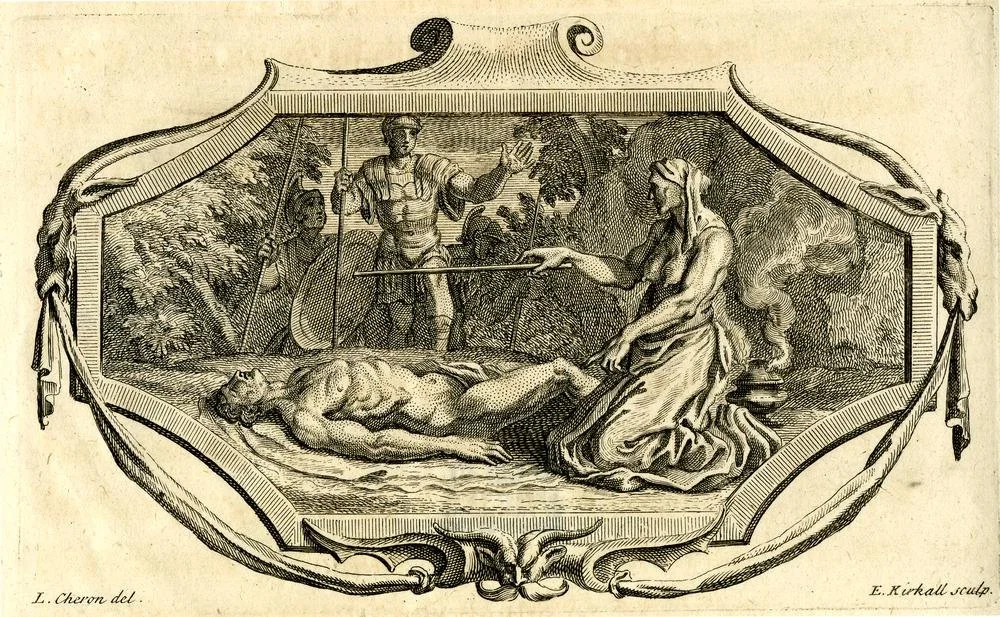
From the British Museum: Pompey consulting the witch Erictho, the witch kneels on the ground in a clearing holding her staff over the body of a dead soldier which she conjures on the ground before her; illustration to Lucan's 'Pharsalia'; by Elisha Kirkall after Louis Chéron. 1718 Etching and engraving. © The Trustees of the British Museum. Shared under a Creative Commons Attribution-NonCommercial-ShareAlike 4.0 International (CC BY-NC-SA 4.0) licence.

The Surgery of Erichtho

April 30, 2026 by Sean Coughlin in Ancient Medicine

A scene of inverted medicine for Walpurgisnacht. Sextus Pompey, desperate to know what is coming, turns to the Thessalian witch Erictho. From there we get a grotesque parody of surgery: she cuts open a corpse, fills it with blood, poison, filth and magic, and forces it to speak (the corpse hears the herbs, has exaudiat herbas, i.e., the magic in them speaks). Body and medicine are turned inside out, and we get necromancy, divination, and reflection on the fate of war.


She began by filling the opened chest with hot blood, the wounds still fresh; then she bathed the marrow in rot and freely poured in lunar poison. Into it she mixed everything nature had monstrously born: foam from rabid dogs; entrails of a lynx; the knot from a hard hyena; the marrow of a stag fed on snakes; the echeneis that holds a ship fast in mid-sea while the east wind strains the cables; the eyes of dragons; stones that sound when warmed beneath a brooding bird; the winged serpent of Arabia; the viper born in the Red Sea, guardian of the precious shell; the skin of a Libyan horned serpent still alive; and the ash of a phoenix laid on an eastern altar. After adding these common plagues and those with famous names, she added leaves steeped in an unspeakable spell, herbs on which her dreadful mouth had spat as they sprouted, and every poison she herself had given to the world.

Then her voice, more powerful than all herbs for charming the gods of Lethe, first poured out confused mutterings, harsh and utterly unlike human speech. It contained the barking of dogs, the howling of wolves, the cry of the trembling eagle-owl, the complaint of the night-owl, the screeching and roaring of wild beasts, the hiss of the snake. It reproduced the crash of waves against rocks, the sound of forests, and the thunder of a broken cloud. A single voice held the sounds of all these things. Then she unfolded the rest in a Haemonian spell and pierced Tartarus with her tongue:

“Eumenides, Stygian crime, punishments of the guilty, Chaos eager to swallow countless worlds into confusion, and ruler of the earth, whose godly death, delayed for long ages, torments you; Styx, and the Elysian fields no Thessalian deserves; Persephone, hater of heaven and of your mother; you, last aspect of our Hecate, through whom the dead and I communicate in a silent language; gatekeeper of the open house, who throws our entrails to the savage dog; sisters who will draw back again the threads you have spun; and you, ferryman of the burning river, old man already exhausted by the ghosts returning to me: hear my prayers. If I call you with a mouth wicked and polluted enough; if I never chant these spells without human entrails; if I have often washed breasts filled with divine power after cutting them open with warm brain; if every infant whose head and organs I placed on your platters would otherwise have lived, obey my prayer.

“I do not ask for a soul hidden deep in a Tartarean cave, long used to darkness, coming down only after light has been left behind. This soul still clings at the first opening of pale Orcus, though it can hear these herbs, destined to come only once to the dead. Let the ghost of our soldier, a Pompeian only moments ago, tell everything to the general’s son, if civil wars have earned your favor.”

pectora tum primum feruenti sanguine supplet
uolneribus laxata nouis taboque medullas
abluit et uirus large lunare ministrat.
huc quidquid fetu genuit natura sinistro
miscetur: non spuma canum quibus unda timori est,
uiscera non lyncis, non durae nodus hyaenae
defuit et cerui pastae serpente medullae,
non puppem retinens Euro tendente rudentis
in mediis echenais aquis oculique draconum
quaeque sonant feta tepefacta sub alite saxa,
non Arabum uolucer serpens innataque rubris
aequoribus custos pretiosae uipera conchae
aut uiuentis adhuc Libyci membrana cerastae
aut cinis Eoa positi phoenicis in ara.
quo postquam uiles et habentis nomina pestis
contulit, infando saturatas carmine frondis
et, quibus os dirum nascentibus inspuit, herbas
addidit et quidquid mundo dedit ipsa ueneni.
tum uox Lethaeos cunctis pollentior herbis
excantare deos confundit murmura primum
dissona et humanae multum discordia linguae.
latratus habet illa canum gemitusque luporum,
quod trepidus bubo, quod strix nocturna queruntur,
quod strident ululantque ferae, quod sibilat anguis;
exprimit et planctus inlisae cautibus undae
siluarumque sonum fractaeque tonitrua nubis:
tot rerum uox una fuit. mox cetera cantu
explicat Haemonio penetratque in Tartara lingua.
“Eumenides Stygiumque nefas Poenaeque nocentum
et Chaos innumeros auidum confundere mundos
et rector terrae, quem longa in saecula torquet
mors dilata deum; Styx et quos nulla meretur
Thessalis Elysios; caelum matremque perosa
Persephone, nostraeque Hecates pars ultima, per quam
manibus et mihi sunt tacitae commercia linguae,
ianitor et sedis laxae, qui uiscera saeuo
spargis nostra cani, repetitaque fila sorores
tracturae, tuque o flagrantis portitor undae,
iam lassate senex ad me redeuntibus umbris,
exaudite preces. si uos satis ore nefando
pollutoque uoco, si numquam haec carmina fibris
humanis ieiuna cano, si pectora plena
saepe deo laui calido prosecta cerebro,
si quisquis uestris caput extaque lancibus infans
inposuit uicturus erat, parete precanti.
non in Tartareo latitantem poscimus antro
adsuetamque diu tenebris, modo luce fugata
descendentem animam; primo pallentis hiatu
haeret adhuc Orci, licet has exaudiat herbas,
ad manes uentura semel. ducis omnia nato
Pompeiana canat nostri modo militis umbra,
si bene de uobis ciuilia bella merentur.”

Lucan, Pharsalia, 6.667–718

April 30, 2026 /Sean Coughlin
Walpurgisnacht, witchcraft, resurrection, snakes, spells
Ancient Medicine
Comment
Moses’ fiery, winged serpent. Image from here.

Moses’ fiery, winged serpent. Image from here.

More on Providential Ecology from Herodotus and Plato

Humboldt-Universität zu Berlin
February 23, 2020 by Sean Coughlin in Philosophy

Yes, more providential ecology. Herodotus and Plato explain why some animals have many babies, others do not. Also, flying snakes.

Wise Gods

“And, it’s reasonable to suppose that divine providence, since it is wise, set things up so that all the timid and edible animals produce many offspring in order that they would not go extinct by all being eaten up; while all the savage and violent animals are able to produce only a few offspring.”

καί κως τοῦ θείου ἡ προνοίη, ὥσπερ καὶ οἰκός ἐστι, ἐοῦσα σοφή, ὅσα μὲν ψυχήν τε δειλὰ καὶ ἐδώδιμα, ταῦτα μὲν πάντα πολύγονα πεποίηκε, ἵνα μὴ ἐπιλίπῃ κατεσθιόμενα, ὅσα δὲ σχέτλια καὶ ἀνιηρά, ὀλιγόγονα.

Herodotus, Histories, 3.108.2

“[Epimetheus] devised these things, taking care that no animal species goes extinct: when he had provided them a way to avoid destroying each other, he devised protection from the seasonal weather sent by Zeus, by clothing them in thick hair and solid hides, which are enough to keep off the winter cold, and also able to ward off burning heat; and, when they go home to their lairs, these same clothes serve as a proper and natural bed-cushion for them all. And to some he gave hooves, to others claws and thick, bloodless hides. Then, he provided them with various foods: to some, grass from the earth; others, fruits from trees; others, roots. There are also those to whom he gave other animals to eat as food, and to them he bestowed few offspring, while to those consumed by them, many offspring, ensuring the survival of the species.”

ταῦτα δὲ ἐμηχανᾶτο εὐλάβειαν ἔχων μή τι γένος ἀϊστωθείη· ἐπειδὴ δὲ αὐτοῖς ἀλληλοφθοριῶν διαφυγὰς ἐπήρκεσε, πρὸς τὰς ἐκ Διὸς ὥρας εὐμάρειαν ἐμηχανᾶτο ἀμφιεννὺς αὐτὰ πυκναῖς τε θριξὶν καὶ στερεοῖς δέρμασιν, ἱκανοῖς μὲν ἀμῦναι χειμῶνα, δυνατοῖς δὲ καὶ καύματα, καὶ εἰς εὐνὰς ἰοῦσιν ὅπως ὑπάρχοι τὰ αὐτὰ ταῦτα στρωμνὴ οἰκεία τε καὶ αὐτοφυὴς ἑκάστῳ· καὶ ὑποδῶν τὰ μὲν ὁπλαῖς, τὰ δὲ <ὄνυξι> καὶ δέρμασιν στερεοῖς καὶ ἀναίμοις. τοὐντεῦθεν τροφὰς ἄλλοις ἄλλας ἐξεπόριζεν, τοῖς μὲν ἐκ γῆς βοτάνην, ἄλλοις δὲ δένδρων καρπούς, τοῖς δὲ ῥίζας· ἔστι δ᾽ οἷς ἔδωκεν εἶναι τροφὴν ζῴων ἄλλων βοράν· καὶ τοῖς μὲν ὀλιγογονίαν προσῆψε, τοῖς δ᾽ ἀναλισκομένοις ὑπὸ τούτων πολυγονίαν, σωτηρίαν τῷ γένει πορίζων.

Plato, Protagoras, 321A–B

The Mating Habits of Vipers and the Winged Snakes of Arabia*

“As for vipers and the winged snakes of Arabia, if they came about as their nature would have it, living would be impossible for human beings; in fact, however, when the vipers mate, at the very moment when the male ejaculates, once he emits the seed, the female grabs his throat, bites down, and does not let go until she has eaten through. And while the male dies in the way we just described, the female gets paid back for it by the male. Seeking revenge for their father, the offspring, while they are still in the belly, chew through their mother and eat through her womb, thus making their escape. The other snakes, however, since they are not harmful to people, lay eggs and hatch a great clutch of offspring.”

ὣς δὲ καὶ οἱ ἔχιδναί τε καὶ οἱ ἐν Ἀραβίοισι ὑπόπτεροι ὄφιες εἰ ἐγίνοντο ὡς ἡ φύσις αὐτοῖσι ὑπάρχει, οὐκ ἂν ἦν βιώσιμα ἀνθρώποισι: νῦν δ᾽ ἐπεὰν θορνύωνται κατὰ ζεύγεα καὶ ἐν αὐτῇ ᾖ ὁ ἔρσην τῇ ἐκποιήσι, ἀπιεμένου αὐτοῦ τὴν γονὴν ἡ θήλεα ἅπτεται τῆς δειρῆς, καὶ ἐμφῦσα οὐκ ἀνιεῖ πρὶν ἂν διαφάγῃ. ὁ μὲν δὴ ἔρσην ἀποθνήσκει τρόπῳ τῷ εἰρημένῳ, ἡ δὲ θήλεα τίσιν τοιήνδε ἀποτίνει τῷ ἔρσενι: τῷ γονέι τιμωρέοντα ἔτι ἐν τῇ γαστρὶ ἐόντα τὰ τέκνα διεσθίει τὴν μητέρα, διαφαγόντα δὲ τὴν νηδὺν αὐτῆς οὕτω τὴν ἔκδυσιν ποιέεται. οἱ δὲ ἄλλοι ὄφιες ἐόντες ἀνθρώπων οὐ δηλήμονες τίκτουσί τε ᾠὰ καὶ ἐκλέπουσι πολλόν τι χρῆμα τῶν τέκνων.

Herodotus, Histories, 3.108.2–3

“Megasthenes says that in India there are winged scorpions of immense size, and that their sting is similar to that of European ones. And that in the same place, there are also snakes with wings, and that they come around not during the day but at night, and they emit from themselves a urine, which, immediately produces decay when it falls on someone’s body.”

Μεγασθένης φησὶ κατὰ τὴν Ἰνδικὴν σκορπίους γίνεσθαι πτερωτοὺς μεγέθει μεγίστους, τὸ κέντρον δὲ ἐγχρίμπτειν τοῖς Εὐρωπαίοις παραπλησίως. γίνεσθαι δὲ καὶ ὄφεις αὐτόθι καὶ τούτους πτηνούς· ἐπιφοιτᾶν δὲ οὐ μεθ' ἡμέραν ἀλλὰ νύκτωρ, καὶ ἀφιέναι ἐξ αὑτῶν οὖρον, ὅπερ οὖν ἐὰν κατά τινος ἐπιστάξῃ σώματος, σῆψιν ἐργάζεται παραχρῆμα.

Aelian, Nature of Animals, 16.41

*So, I guess winged serpents are more like cobras, less like flying snakes? More curious is the contrast Herodotus implies between what an animal does by its own nature, and what it does because of divine providence. Is the idea that the divine intervenes in how animals act and interact, but doesn’t make them what they are?

Via getty images

Via getty images

February 23, 2020 /Sean Coughlin
providential ecology, providence, Plato, Herodotus, Aelian, snakes, Epimetheus, biology
Philosophy
Comment
Deer and snake. From this 15th century herbal: British Library, Sloane ms. 4016, fol. 30v.

Deer and snake. From this 15th century herbal: British Library, Sloane ms. 4016, fol. 30v.

Some fumigations for lizards, snakes and scorpions

Humboldt-Universität zu Berlin
September 11, 2019 by Sean Coughlin in Ancient Medicine, Botany

Philumenus’ On poisonous animals and their remedies is only available in one manuscript, Vat. gr. 284. A friend at the CMG has been working on a new edition of the text and hopefully it will be published soon. For now, the manuscript is digitized and available at the Vatican Library (with snake drawings in the margins).

Here is chapter six: on fumigations against snakes (and other things), which includes one recipe from Archigenes.

Fumigations for snakes

From Archigenes' works:

Hooves and hair of goats burnt at a distance. Snakes are repelled by their smell.

A compound incense of Philinus, the Theriac:

Of galbanum, root of kakhru, horn of deer, cumin, one ounce each

Grind all the ingredients, mix with vinegar and make them into tablets.

To use, the incense is soaked in oil and placed in the middle of the house, or if you are out in the open, in the middle of your bed.

Another:

of galbanum, of fat of the Egyptian mongoose, one ounce each.

Dissolve them together and store.

To use, fumigate in the same way as before.

Another one, Egyptian:

an old asp, soaked in oil.

[Place the] incense close to the snake's den and it will immediately come out.

Another, bringing down scorpions and every snake and driving them away from the house:

incense of equal amounts of galbanum, realgar, butter, bryony, fat of goat.

θυμιάματα ἑρπετῶν

ἐκ τῶν Ἀρχιγένους· ὁπλαὶ αἰγῶν καὶ τρίχες θυμιώμεναι πόρρωθεν· ἀναστέλλεται <γὰρ> τὰ ἑρπετὰ τῇ τούτων ὀσμῇ. σύνθετον θυμίαμα Φιλίνου <τοῦ> θηριακοῦ· χαλβάνης, κάχρυος τῆς ῥίζης, κέρατος ἐλαφείου, μελανθίου ἀνὰ 𐆄 α. λεάνας πάντα ἀναλάμβανε <ὄξει>, ποιῶν τροχίσκους. ἐπὶ δὲ τῆς χρείας ἀποβρέξας εἰς ἔλαιον θυμία κατὰ μέσον τῆς οἰκίας, ἐὰν δὲ ἐν ὑπαίθρῳ ᾖς, κατὰ μέσον τῆς κοίτης. ἄλλο· χαλβάνης, στέατος ἰχνεύμονος ἀνὰ 𐆄 α τήξας ἀπόθου· ἐπὶ δὲ τῆς χρείας θυμίασον ὁμοίως. ἄλλο Αἰγύπτιον· γῆρας ἀσπίδος βρέξας εἰς ἔλαιον [ἄλλο] θυμία ἐγγὺς τῶν φωλεῶν καὶ εὐθέως ἀναβήσονται. <ἄλλο> καταφέρον καὶ σκορπίους καὶ πᾶν ἑρπετὸν <ἀπελαῦνον> ἐξ οἰκίας· χαλβάνην, σανδαράκην, βούτυρον, βρυωνίαν, στέαρ αἴγειον ἐξ οἰκίς· χαλβάνην, σανδαράκην, βούτυρον, βρυωνίαν, στέαρ αἴγειον ἐξ ἴσου θυμία.

Philumenus, De venenatis animalibus eorumque remediis (On poisonous animals and their remedies), chapter 6 (p. 10,16-28 Wellmann)

Vat.gr.284_0569_fa_0279r_m.jpg
September 11, 2019 /Sean Coughlin
snakes, pest control, Archigenes, Philumenus, materia medica, aromatherapy
Ancient Medicine, Botany
Comment
 

CATEGORIES

  • Ancient Medicine
  • Botany
  • Events
  • Philosophy

SEARCH


RECENT POSTS

Featured
April 30, 2026
Ancient Medicine
The Surgery of Erichtho
April 30, 2026
Ancient Medicine
April 30, 2026
Ancient Medicine
March 16, 2026
Ancient Medicine
“It is not as if the womb creeps out of its lair like a wild animal” — Soranus on the ancients on scented materials and women's medicine
March 16, 2026
Ancient Medicine
March 16, 2026
Ancient Medicine
December 31, 2025
Botany, Philosophy
Concerning a Variant in the de Fuentes Manuscript
December 31, 2025
Botany, Philosophy
December 31, 2025
Botany, Philosophy
December 25, 2025
Ancient Medicine
How to smell nice: Galen's advice for doctors
December 25, 2025
Ancient Medicine
December 25, 2025
Ancient Medicine
December 23, 2025
Ancient Medicine
More on how not to talk to patients
December 23, 2025
Ancient Medicine
December 23, 2025
Ancient Medicine