Ancient Medicine

  • Home
  • About
  • Contact

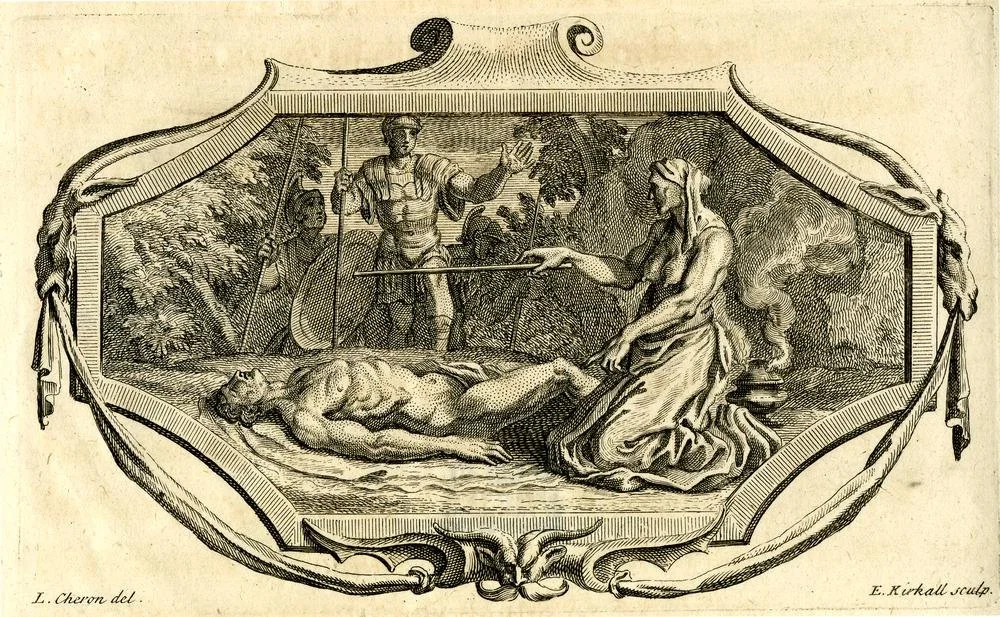
From the British Museum: Pompey consulting the witch Erictho, the witch kneels on the ground in a clearing holding her staff over the body of a dead soldier which she conjures on the ground before her; illustration to Lucan's 'Pharsalia'; by Elisha Kirkall after Louis Chéron. 1718 Etching and engraving. © The Trustees of the British Museum. Shared under a Creative Commons Attribution-NonCommercial-ShareAlike 4.0 International (CC BY-NC-SA 4.0) licence.

The Surgery of Erichtho

April 30, 2026 by Sean Coughlin in Ancient Medicine

A scene of inverted medicine for Walpurgisnacht. Sextus Pompey, desperate to know what is coming, turns to the Thessalian witch Erictho. From there we get a grotesque parody of surgery: she cuts open a corpse, fills it with blood, poison, filth and magic, and forces it to speak (the corpse hears the herbs, has exaudiat herbas, i.e., the magic in them speaks). Body and medicine are turned inside out, and we get necromancy, divination, and reflection on the fate of war.


She began by filling the opened chest with hot blood, the wounds still fresh; then she bathed the marrow in rot and freely poured in lunar poison. Into it she mixed everything nature had monstrously born: foam from rabid dogs; entrails of a lynx; the knot from a hard hyena; the marrow of a stag fed on snakes; the echeneis that holds a ship fast in mid-sea while the east wind strains the cables; the eyes of dragons; stones that sound when warmed beneath a brooding bird; the winged serpent of Arabia; the viper born in the Red Sea, guardian of the precious shell; the skin of a Libyan horned serpent still alive; and the ash of a phoenix laid on an eastern altar. After adding these common plagues and those with famous names, she added leaves steeped in an unspeakable spell, herbs on which her dreadful mouth had spat as they sprouted, and every poison she herself had given to the world.

Then her voice, more powerful than all herbs for charming the gods of Lethe, first poured out confused mutterings, harsh and utterly unlike human speech. It contained the barking of dogs, the howling of wolves, the cry of the trembling eagle-owl, the complaint of the night-owl, the screeching and roaring of wild beasts, the hiss of the snake. It reproduced the crash of waves against rocks, the sound of forests, and the thunder of a broken cloud. A single voice held the sounds of all these things. Then she unfolded the rest in a Haemonian spell and pierced Tartarus with her tongue:

“Eumenides, Stygian crime, punishments of the guilty, Chaos eager to swallow countless worlds into confusion, and ruler of the earth, whose godly death, delayed for long ages, torments you; Styx, and the Elysian fields no Thessalian deserves; Persephone, hater of heaven and of your mother; you, last aspect of our Hecate, through whom the dead and I communicate in a silent language; gatekeeper of the open house, who throws our entrails to the savage dog; sisters who will draw back again the threads you have spun; and you, ferryman of the burning river, old man already exhausted by the ghosts returning to me: hear my prayers. If I call you with a mouth wicked and polluted enough; if I never chant these spells without human entrails; if I have often washed breasts filled with divine power after cutting them open with warm brain; if every infant whose head and organs I placed on your platters would otherwise have lived, obey my prayer.

“I do not ask for a soul hidden deep in a Tartarean cave, long used to darkness, coming down only after light has been left behind. This soul still clings at the first opening of pale Orcus, though it can hear these herbs, destined to come only once to the dead. Let the ghost of our soldier, a Pompeian only moments ago, tell everything to the general’s son, if civil wars have earned your favor.”

pectora tum primum feruenti sanguine supplet
uolneribus laxata nouis taboque medullas
abluit et uirus large lunare ministrat.
huc quidquid fetu genuit natura sinistro
miscetur: non spuma canum quibus unda timori est,
uiscera non lyncis, non durae nodus hyaenae
defuit et cerui pastae serpente medullae,
non puppem retinens Euro tendente rudentis
in mediis echenais aquis oculique draconum
quaeque sonant feta tepefacta sub alite saxa,
non Arabum uolucer serpens innataque rubris
aequoribus custos pretiosae uipera conchae
aut uiuentis adhuc Libyci membrana cerastae
aut cinis Eoa positi phoenicis in ara.
quo postquam uiles et habentis nomina pestis
contulit, infando saturatas carmine frondis
et, quibus os dirum nascentibus inspuit, herbas
addidit et quidquid mundo dedit ipsa ueneni.
tum uox Lethaeos cunctis pollentior herbis
excantare deos confundit murmura primum
dissona et humanae multum discordia linguae.
latratus habet illa canum gemitusque luporum,
quod trepidus bubo, quod strix nocturna queruntur,
quod strident ululantque ferae, quod sibilat anguis;
exprimit et planctus inlisae cautibus undae
siluarumque sonum fractaeque tonitrua nubis:
tot rerum uox una fuit. mox cetera cantu
explicat Haemonio penetratque in Tartara lingua.
“Eumenides Stygiumque nefas Poenaeque nocentum
et Chaos innumeros auidum confundere mundos
et rector terrae, quem longa in saecula torquet
mors dilata deum; Styx et quos nulla meretur
Thessalis Elysios; caelum matremque perosa
Persephone, nostraeque Hecates pars ultima, per quam
manibus et mihi sunt tacitae commercia linguae,
ianitor et sedis laxae, qui uiscera saeuo
spargis nostra cani, repetitaque fila sorores
tracturae, tuque o flagrantis portitor undae,
iam lassate senex ad me redeuntibus umbris,
exaudite preces. si uos satis ore nefando
pollutoque uoco, si numquam haec carmina fibris
humanis ieiuna cano, si pectora plena
saepe deo laui calido prosecta cerebro,
si quisquis uestris caput extaque lancibus infans
inposuit uicturus erat, parete precanti.
non in Tartareo latitantem poscimus antro
adsuetamque diu tenebris, modo luce fugata
descendentem animam; primo pallentis hiatu
haeret adhuc Orci, licet has exaudiat herbas,
ad manes uentura semel. ducis omnia nato
Pompeiana canat nostri modo militis umbra,
si bene de uobis ciuilia bella merentur.”

Lucan, Pharsalia, 6.667–718

April 30, 2026 /Sean Coughlin
Walpurgisnacht, witchcraft, resurrection, snakes, spells
Ancient Medicine
Comment

Not the papyrus the spell is from. This one is Papyrus 122 at the British Museum. You can look at it here.

Spell for unknown effect

December 14, 2022 by Sean Coughlin in Ancient Medicine

Take the blood of an owl and myrrh ink, mix the two together, and, using a new reed, draw the figure as appended* on a clean tablet. And having stared simultaneously at a clean wall, while glancing to the east, having fixed the image to a pure linen cloth using thorns from a male date palm, veil the image completely. Then after stepping back from it six cubits, once you have veiled it, count to fifty-nine three times while walking backwards, stopping at the six-cubits-mark.

Λαβὼν αἷμα νυκτιβαοῦτος καὶ ζμυρνομέλαν, ὁμοῦ τὰ δύο μίξας γράφε καινῷ καλάμῳ τὸ ζῴδιον, καθὼς περιέχι, εἰς πιττάκιον καθαρόν, καὶ ἅμ' ἀτενίσας εἰς τοῖχον καθαρόν, εἰς ἀνατολὴν βλέπων, πήξας εἰς σουδάριον ὁλόλινον σκόλοψιν ἀρρενικοῦ φοίνικος συνκάλυπτε τὸ ζῴδιον καὶ ἀποστὰς ἀπ' αὐτο̣ῦ̣ πήχεις ἕξ, συνκαλύψας μέτρησον πεντήκοντα ἐννέα ἐπὶ τρὶς ἀναποδίζων, στήκων ἐπὶ τὸ σημῖον τῶν ἓξ πηχῶν.

Magical Greek Papyri 36.264–274

*The image is not appended. No purpose is given.

December 14, 2022 /Sean Coughlin
Magic, spells, ink, myrrh, PGM
Ancient Medicine
Comment

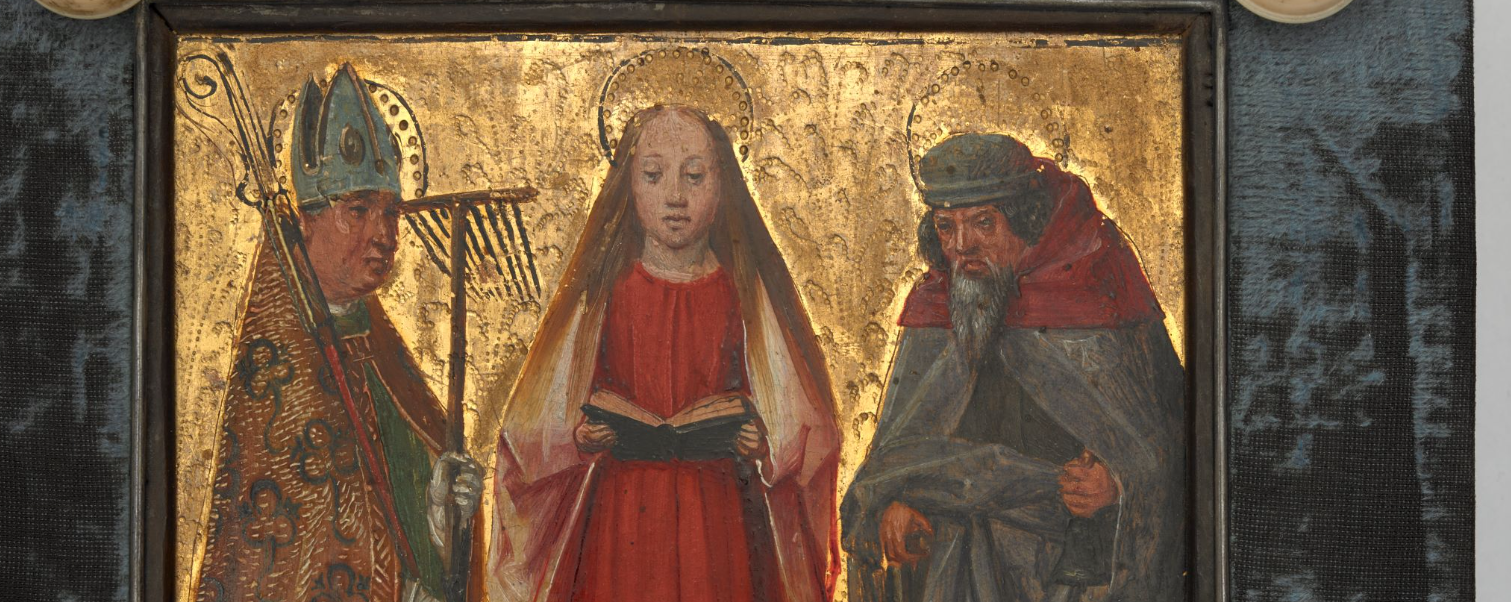
Likely St. Blaise, St. Agnes and St. Antony, at least according to this discussion on twitter. Blue silk binding with painting on wood. Egerton MS 809/1. 15th century. Front cover, inside. Via British Library.

Aetius of Amida on the Choking Cure of St. Blaise

Institute of Philosophy, Czech Academy of Sciences
February 03, 2022 by Sean Coughlin in Ancient Medicine

“[Treatment] for swallowing of a bone and for removing things that are stuck in the throat. Hold on to the patient with them sitting opposite you, and make them hold on to you. Say: ‘Come up, bone—whether you are a bone or a twig or anything else—just like Jesus Christ brought Lazarus up from the grave, and like Jonah was brought up out of the sea monster.’ Another. Cover the throat of the patient. Say: ‘Blaise, the martyr, the servant of god, says, ‘either rise up, bone, or go down.’”

Πρὸς ὀστοῦ κατάποσιν καὶ πρὸς ἀναβολὴν τῶν καταπειρομένων εἰς τὰ παρίσθμια. προσέχων τῷ πάσχοντι ἀνθρώπῳ ἄντικρυς καθεζομένῳ καὶ ποιήσας αὐτὸν προσέχειν σοι λέγε· ἄνελθε, ὀστοῦν, εἴτε ὀστοῦν ἢ κάρφος [<ϛ>] ἢ ἄλλο ὁτιοῦν, ὡς Ἰησοῦς Χριστὸς Λάζαρον ἀπὸ τοῦ τάφου ἀνήγαγε, καὶ ὡς Ἰωνᾶν ἐκ τοῦ κήτους. Ἄλλο. κατέχων τὸν λάρυγγα τοῦ πάσχοντος λέγε· Βλάσιος ὁ μάρτυς ὁ δοῦλος τοῦ θεοῦ λέγει· ἢ ἀνάβηθι, ὀστοῦν, ἢ κατάβηθι.

Aetius of Amida, Libri Medicinales 8.54

February 03, 2022 /Sean Coughlin
Aetius of Amida, spells, magic, religious therapy
Ancient Medicine
Comment
Mouse eating a walnut. Time of Hardian. Vatican Museum. Image from here.

Mouse eating a walnut. Time of Hardian. Vatican Museum. Image from here.

Dream Spells: a spell from Pachrates given to Emperor Hadrian

Humboldt-Universität zu Berlin
November 03, 2020 by Sean Coughlin in Ancient Medicine

“Pachrates, the prophet of Heliopolis, who exhibited the power of his divine magic to the Emperor Hadrian. For it caused attraction in one hour; it caused illness in two hours; it caused destruction in seven hours; and it sent dreams to the Emperor himself while he was testing the complete truth of his magic. And because he was amazed at the prophet, he ordered that twice the pay be given to him.

“Take a field-mouse that’s been made divine with spring water; and take two moon beetles made divine with river water; also: a river crab, the fat of a spotted virgin goat, feces of a dog-faced baboon, two ibis eggs, two drachms of storax, two drachms of myrrh, two drachms of saffron, four drachms of Italian sedge, four drachms of unbroken frankincense, a single onion.

“Throw all these into a mortar with the field-moue and the rest, and having ground them up well keep them ready for use by storing them in a lead box. And whenever you want to perform [sc. the magic rite], take a little bit, light a coal, climb up on the roof, and burn the offering while saying this spell as [the moon] is rising, and immediately she will come.

“Spell: [i’ve omitted it]

“Therefore, let this not be done heedlessly, unless it is necessary that you perform it. It also has a protective charm against you falling, for the goddess is accustomed to make those who perform this spell without a protective charm airborne and throw them from the roof to the ground. For this reason, then, I figured it necessary that a precaution be made in the form of a protective charm, so that you can perform it without hesitation. Keep it secret.”

Παχράτης, ὁ προφήτης Ἡλιουπόλεως, Ἁδριανῷ βασιλεῖ ἐπιδεικνύμενος τὴν δύναμιν τῆς θείας αὑτοῦ μαγείας. ἦξεν γὰρ μονόωρον, κατέκλινεν ἐν ὥραις βʹ, ἀνεῖλεν ἐν ὥραις ζʹ, ὀνειροπόμπησεν δὲ αὐτὸν βασιλέα ἐκδο<κ>ιμ<ά>ζοντος αὐτοῦ τὴν ὅλην ἀλήθειαν τῆς περὶ αὐτὸν μαγείας· καὶ θαυμάσας τὸν προφήτην διπλᾶ ὀψώνια αὐτῷ ἐκέλευσεν δίδοσθαι.

λαβὼν μυγαλὸν ἐκθέωσον πηγαίῳ ὕδατι καὶ λαβὼν κανθάρους σεληνιακοὺς δύο ἐκθέωσον ὕδατι ποταμίῳ καὶ καρκίνον ποτάμιον καὶ στῆρ ποικίλης αἰγὸς παρθένου καὶ κυνοκεφάλου κόπρον, ἴβεως ὠὰ δύο, στύρακος δραχμὰς βʹ, ζμύρνης δραχμὰς βʹ, κρόκου δραχμὰς βʹ, κυπέρεως Ἰταλικῆς δραχμὰς δʹ, λιβάνου ἀτμήτου δραχμὰς δʹ, μονογενὲς κρόμμυον·

ταῦτα πάντα βάλε εἰς ὅλμον σὺν τῷ μυγαλῷ καὶ τοῖς λοιποῖς καὶ κόψας καλλίστως ἔχε ἐπὶ τῶν χρειῶν ἀποθέμενος εἰς πυξίδα μολιβῆν. καὶ ὅταν βούλῃ πράττειν, ἀνελόμενος ὀλίγον καὶ ποιήσας ἀνθρακιὰν ἀναβὰς ἐπὶ δώματος ὑψηλοῦ ἐπίθυε λέγων τὸν λόγον τοῦτον ἀνατολῆς οὔσης, καὶ παραχρῆμα ἥξει. λόγος· […]

μὴ οὖν εὐχερῶς πράσσῃς, εἰ μὴ ἀνάγκη σοι γένηται. ἔχει δὲ φυλακτήριον πρὸς τὸ μή σε καταπεσεῖν· εἴωθεν γὰρ ἡ θεὸς τοὺς ἀφυλακτηριαστοὺς τοῦτο πράσσοντας ἀεροφ<ερ>εῖς ποιεῖν καὶ ἀπὸ τοῦ ὕψους ἐπὶ τὴν γῆν ῥῖψαι. διὸ οὖν ἀναγκαῖον ἡγησάμην καὶ τοῦ φυλακτηρίου τὴν πρόνοιαν ποιήσασθαι, ὅπως ἀδιστάκτως πράσσῃς. κρύβε.

PGM IV 2443–2508

November 03, 2020 /Sean Coughlin
dreams, spells, hadrian, magic, magic animals, materia medica, recipe, dream spells
Ancient Medicine
Comment
A red jasper hippo from between 1550 and 1070 BCE. At the Metropolitan Museum of Art, New York. Public domain via the Met website.

A red jasper hippo from between 1550 and 1070 BCE. At the Metropolitan Museum of Art, New York. Public domain via the Met website.

More dream spells

Humboldt-Universität zu Berlin
November 18, 2019 by Sean Coughlin in Ancient Medicine

A Dream-Sender. Make a hollow hippopotamus out of red wax. Into this hippopotamus’* belly, place gold, silver and the ‘Ballatha’ of the Jews. Dress it in clean linen and set it on a clean windowsill. Then, take a piece of hieratic papyrus and with myrrh-ink and the blood of a baboon write on it what you want to send. Roll it up into a wick and use it to light a new, clean lamp. Put the foot of the hippopotamus onto the lamp, say the name, and it sends the dream.

ὀνειροπομπόν· ποίησον ἱπποπόταμον ἐκ κηροῦ πυρροῦ κοῖλον καὶ ἔνθες εἰς τὴν κοιλίαν αὐτοῦ τοῦ βιεβετνεησι καὶ χρυσὸν καὶ ἄργυρον καὶ τὸ καλούμενον βαλλαθὰ τὸ τῶν Ἰουδαίων καὶ στόλισον αὐτὸν λίνῳ καθαρῷ καὶ θὲς ἐπὶ θυρίδος καθαρᾶς καὶ λαβὼν χάρτην ἱερατικὸν γράψον εἰς αὐτὸν ζμυρνομέλανι καὶ αἵματι κυνοκεφάλου, ἃ βούλει πέμψαι, καὶ εἰλήσας εἰς ἐνλύχνιον καὶ ἐνλυχνιάσας λύχνον καθαρὸν καινὸν ἐπίθες ἐπὶ τὸν λύχνον τὸν πόδα ἱπποποταμίου καὶ λέγε τὸ ὄνομα, καὶ πέμπει.

PGM XIII, col. vii 47 - viii 7 (lines 312-319)

Annotation 2019-11-18 023424.png

*alternatively, going with what comes next, ‘from the metals of the miners’, following a note in the scanned copy at Heidelberg. See right: βιεβεσνεητι “Metall des Erzarbeiter”, but I cannot make out the reference.

November 18, 2019 /Sean Coughlin
spells, dreams, magic animals, magic, dream spells
Ancient Medicine
Comment
Hermes and an Ibis on a magic charm. Item CBd-437 at the Campbell Bonner Magical Gems Database (2010-), developed at the Museum of Fine Arts, Budapest, editor-in-chief: Á. M. Nagy.

Hermes and an Ibis on a magic charm. Item CBd-437 at the Campbell Bonner Magical Gems Database (2010-), developed at the Museum of Fine Arts, Budapest, editor-in-chief: Á. M. Nagy.

Dream spells

Humboldt-Universität zu Berlin
October 11, 2019 by Sean Coughlin in Ancient Medicine

Here are some dream spells from the collection of magical Greek papyri: one in case you want someone else to have a dream, one in case you want to have a dream.

“If you wish to appear to someone in dreams during the night, say to the lamp that gets used every day, say to it often: Cheiamôpsei, Erpebôth: Let so-and-so, daughter of so-and-so, see me in her dreams, now, now, quickly, quickly. Then the usual, whatever you’d like.”

Ἐάν τινι ἐθέλῃς [ἐ]μφανῆναι διὰ νυκτὸς ἐν ὀνείροις, λέγε πρὸς τὸν λύχνον τὸν καθημερινόν, λέγε πολλάκις· ‘χειαμωψει: ερπεβωθ: ἰδέτω με ἡ δεῖνα, ἣν ἡ δεῖνα, ἐν τοῖς ὕπνοις, ἤδη ἤδη, ταχὺ ταχύ.’ καὶ κοινά, ὅσ’ ἂν βούλῃ.

PGM VII 405-411

“Request for a dream. Draw the god Hermes, upright and Ibis-faced, as accurately as possible on a scrap of linen cloth using quail’s blood, then, using myrrh, write his name above and say the words: Come to me, here, quickly, you who have the power. I call to you, the god of gods who is set over the spirits, to show me this in my dreams. By your father Osiris and Isis, your mother, I summon you to show me some image of you and reveal what I wish to know. By your name, Êiiouathi, Psrêpnousa Nertêr, Diokhasbara, Zarakhô, whom they call Balkham, reveal this, reveal everything that I ask.”

Ὀνείρου αἴτησις· Ἀκριβὴς εἰς πάντα γράψον εἰς βύσσινον ῥάκος αἵματι ὀρτυγίου θεὸν Ἑ[ρ]μῆν ὀρ[θ]όν, ἰβιοπρόσωπον, ἔπειτα ζμύρνῃ ἐπίγραψον καὶ τὸ ὄνομα καὶ ἐπίλεγε τὸν [λό]γον· ‘ἔρχου μοι ὡδὶ αἶψα, ὁ ἔχων τὴν ἐξουσίαν. ἐπικαλοῦμαί σε τὸν ἐπὶ τῶν [πν]ευμάτων τεταγμένον θεὸν θ(εῶν), δεῖξαί μοι καθ’ ὕπνους τόδε. ἐξορκίζω [σε]κατὰ [τ]οῦ πατρός σου Ὀσίριδος καὶ Ἴσιδος, τῆς μητρός σου, δεῖξαί μοί τι[να] μορφήν σου, καὶ περὶ ὧν θέλω, χρημάτισον. ὄνομά σοι· ‘ηιιουαθι, ψρηπνου̣α̣ νερτηρ, διοχασβαρα, Ζαραχω’, ὃν καλοῦσι Βαλχάμ· χρημάτισον περὶ τοῦδε, περ[ὶ π]άντων, <ὧν> πυνθάνω.’

PGM XII  144-152

October 11, 2019 /Sean Coughlin
spells, papyri, dreams, magic, dream spells
Ancient Medicine
Comment
 

CATEGORIES

  • Ancient Medicine
  • Botany
  • Events
  • Philosophy

SEARCH


RECENT POSTS

Featured
April 30, 2026
Ancient Medicine
The Surgery of Erichtho
April 30, 2026
Ancient Medicine
April 30, 2026
Ancient Medicine
March 16, 2026
Ancient Medicine
“It is not as if the womb creeps out of its lair like a wild animal” — Soranus on the ancients on scented materials and women's medicine
March 16, 2026
Ancient Medicine
March 16, 2026
Ancient Medicine
December 31, 2025
Botany, Philosophy
Concerning a Variant in the de Fuentes Manuscript
December 31, 2025
Botany, Philosophy
December 31, 2025
Botany, Philosophy
December 25, 2025
Ancient Medicine
How to smell nice: Galen's advice for doctors
December 25, 2025
Ancient Medicine
December 25, 2025
Ancient Medicine
December 23, 2025
Ancient Medicine
More on how not to talk to patients
December 23, 2025
Ancient Medicine
December 23, 2025
Ancient Medicine