Ancient Medicine

  • Home
  • About
  • Contact

Tile mosaic with rabbit, lizard and mushroom. 19th or 20th c. via Metropolitan Museum of Art.

Oribasius and Rufus treat men's sexual health

August 16, 2023 by Sean Coughlin in Ancient Medicine

Rufus of Ephesus was likely practicing in ancient Alexandria or in ancient Ephesus. Some of his writings are preserved by Oribasius and Aetius, and in some of those, Rufus preserves patient concerns. Here, he records his interactions with several young men who are concerned about their sexual health, and the testimony provides some examples of how Rufus thinks through diagnosis and treatment. The text is part of a larger section in book 11 of Aetius on drugs related to sexual health and well-being.

Oribasius’ Sexual Stimulants

Equal parts of pepper, parsley, filings from dried deer’s testicle, and terebinth. Combine with honey and give with wine to drink.

Another. Burn a gecko, grind, then add it to oil. Rub the oil onto the big toe of your right foot and have sexual intercourse. If you want to stop the effects, wash your toe.

Another from the same. Rub hare’s suet or lion’s lard onto your genitals. Then take three grains of pepper together with juice of tragacanth gum, and apply to your testicles, perineum, and lower back.

From the works of Rufus, an effective ointment that excites the genitals.

Take one drachma of myrrh, unburnt sulphur, and the inner part of the knēkō plant, two obols of pyrethrum, two drachmas of melanthinon, thirty grains of pepper, and twenty grains of nettle, cleaned. Chop them up and grind with one drachma of squill, melt one ounce of wax and with eight ounces of castor oil; add also three ounces of honey and use [1]. After intercourse, the areas are wiped clean with a cloth. Some also apply this ointment to their buttocks.

Rufus also adds the following: “it is easy,” he says, “to find a therapy here for those who are unable to engage in sexual activity. A youth came to me once and said that he really wanted to have sex, but when he enaged in it, he could not ejaculate and lost a great deal of breath. I took this as an indication of dryness of the spermatic vessels and the treatment showed that I was right. For by using a moist diet productive of good humours, he was able to ejaculate. Another twenty-year-old youth said that when he had sex with a woman, he was not able to ejaculate, but when he was asleep, he frequently had wet dreams. It seemed to me that the spermatic parts we not being heated during intercourse due to the excessive moisture accompanied by cooling [2], since the heat is being dissipated along the surface of the body. During sleep, on the other hand, they become hotter, because dreams are able to heat the inside parts of the body and cool the outside parts. So I recommended that this man exercise his lower parts and ride horses, drink castoreum, and adopt a diet that was wholly warm and dry.”

Ὀριβασίου ἐντατικόν.

Πεπέρεως, πετροσελίνου, ἐλαφείου αἰδοίου ῥινίσματος ξηροῦ, τερεβινθίνης ἴσα· μέλιτι ἀναλάμβανε καὶ δίδου πίνειν μετ' οἴνου.

Ἄλλο· Ἀσκαλαβώτην καύσας, λεάνας, εἶτα ἐπιβαλὼν ἔλαιον, χρίσον τοῦ δεξιοῦ ποδὸς τὸν μεγαδάκτυλον καὶ συγγίνου· εἰ δὲ βούλει παύσασθαι, ἀπόπλυνε τὸν δάκτυλον.

Ἄλλο τοῦ αὐτοῦ. Λαγωοῦ πιτύαν ἢ λέοντος στέαρ χρίε τὸ αἰδοῖον· εἶτα τρία ἅμα πεπέρεα μετὰ χυλοῦ τραγακάνθης, χρίε τοὺς διδύμους καὶ περίναιον καὶ ὀσφῦν.

Ἐκ τῶν Ῥούφου χρίσμα ἐνεργὸν, ἐντεῖνον τὸ αἰδοῖον.

Σμύρνης, θείου ἀπύρου, κνήκου τοῦ ἐντὸς ἀνὰ 𐅻 αʹ, πυρέθρου ὀβολοὺς βʹ, μελάνθιον 𐅻 βʹ, πεπέρεως κόκκοι λʹ, κνίδιοι κόκκοι κεκαθαρμένοι κʹ· κόψας καὶ λεάνας ἅμα σκίλλης 𐅻 αʹ, καὶ τήξας κηροῦ οὐγγ. αʹ μετὰ ἐλαίου κικίνου οὐγγ. ηʹ ἐπίβαλε καὶ μέλιτος οὐγγ. γʹ, καὶ χρῶ· μετὰ δὲ τὴν μίξιν ὀθονίῳ ἀκριβῶς ἐκμασσέσθωσαν οἱ τόποι· ἔνιοι δὲ καὶ τῷ χρίσματι τούτῳ τῆς ἕδρας προσάπτονται.

Προστίθησι δὲ ὁ Ῥοῦφος καὶ ταῦτα· εὔκολον δέ φησι κἀντεῦθεν θεραπείας εὑρίσκεσθαι τοῖς οὐ δυναμένοις ἀφροδισιάζειν· νεανίσκος γάρ τις ἀφικόμενος πρὸς ἡμᾶς ἔφη, καὶ πάνυ μὲν ἐφίεσθαι μιγῆναι, μισγόμενος δὲ γονὴν μὲν μὴ ἀφιέναι, πνεύματα δὲ πολλὰ ἀπολλύειν. Τούτῳ ἐτεκμαιρόμην ξηρότητα εἶναι τῶν σπερματικῶν ἀγγείων, καὶ ἔδειξεν ἡ ἴασις· ὑγρᾷ γὰρ καὶ εὐχύμῳ διαίτῃ χρησάμενος ἐξέκρινε τὴν γονήν. Ἕτερος δὲ νεανίσκος εἰκοσαέτης ἔλεγεν, εἰ μὲν μίσγοιτο γυναικὶ, μὴ δύνασθαι γονὴν ἀφιέναι, καθεύδοντι δὲ πολὺ ὑπέρχεσθαι τοῦ σπέρματος. Ἐδόκει δέ μοι διὰ πολλὴν ὑγρότητα μετὰ ψύξεως μὴ θερμαίνεσθαι τὰ σπερματικὰ μόρια, ἐν ταῖς μίξεσι χεομένης περὶ τὴν τοῦ σώματος ἐπιφάνειαν τῆς θερμασίας, ἐν τοῖς ὕπνοις δὲ θερμαίνεσθαι πλέον, καθότι δύνανται ὕπνοι τὰ μὲν ἔσωθεν θερμαίνειν, τὰ δὲ ἔξωθεν ψύχειν. Ἐκέλευσα δὲ τοῦτον γυμνάζεσθαι τὰ κάτω μέρη καὶ ἱππάζεσθαι, καστόριον δὲ πίνειν καὶ διαίτῃ πάσῃ κεχρῆσθαι θερμῇ καὶ ξηρᾷ.

Aetius of Amida, Medical Books XI.35, p. 581 & 126 Rouelle

[1] It is not stated explicitly when the ingredients are mixed in with the oil.

[2] The word can also mean “embarassment,” but I’m wary to read it this way.

August 16, 2023 /Sean Coughlin
Rufus of Ephesus, Oribasius, sex, Doctors
Ancient Medicine
Comment

Fresco depicting the reading of the rituals of the bridal mysteries. From the Villa of the Mysteries, Pompeii, painted c. mid-1st century BCE. Image via wikimedia commons thanks to the donation of The Yorck Project Gesellschaft für Bildarchivierung GmbH.

Galen, Simple Drugs, Book 7, Preface

August 14, 2023 by Sean Coughlin in Ancient Medicine

Galen’s Simple Drugs 7 preface

As I am writing this seventh book of comments on the capacity of simple drugs, I think it is necessary to preface it by saying that it will be clear only to those who were not casual in their study of the previous books. I think others are likely to misunderstand rather than learn something from what will be said in it, and that they will not only confuse themselves but might also accuse me of describing things inaccurately. Therefore, those who are wise, I know that they will be persuaded and if they are really concerned about the preceding theory, they will revisit the whole treatise from the beginning. However, those who are more curious than scholarly will disregard this preface. Perhaps this is not surprising, since even some of the uninitiated dare to read books of mysteries. But neither were those works written for the profane, nor these treatises of mine for those without an elementary training in the subject.

In this book and the one after it, the primary capacities of the remaining plants will be discussed, and the order of instruction will follow the order of the letters of the alphabet from which I began. In the book before this, therefore, I got up to the letter ‘iota.’ In this book, I will begin with the letter ‘kappa,’ after I have reminded the reader as much as I have that I will refer everything back to the principles previously demonstrated. For the differences in the individual actions of each drug arise from the degree to which the drug is hot, cold, wet, dry, and composed of fine or coarse parts. It is, however, impossible to express in words how far the aforementioned qualities extend in each case, at least with respect to the most precise level of truth. So instead, I have attempted to demarcate them with clear boundaries adequate for the needs of the art, showing that there is one kind of drug which attains a mixture similar to our bodies when it undergoes a certain change and transformation due to the heat within them, and another that becomes warmer relative to us. For this, I thought it appropriate to produce four orders: the first is unclear to perception and needs reason to discover it; after it, the second is somewhat clear to the senses; and a third strongly warms, but not yet to the point of burning; after which the fourth and last is caustic. In the same way in the case of cooling agents, the first order includes those that require reason to demonstrate their ability to cool, second are those that perceptibly cool, third those that cool strongly, and fourth are those that can cause death. There are also corresponding orders of those that moisten and those that dry.

Ἕβδομον τοῦτο περὶ τῆς τῶν ἁπλῶν φαρμάκων δυνάμεως ὑπόμνημα γράφοντες ἀναγκαῖον ἡγούμεθα προειπεῖν ὡς μόνοις ἔσοιτο σαφὲς, ὅσοι τοῖς ἔμπροσθεν ὡμίλησαν οὐκ ἐν παρέργῳ, τοὺς δ' ἄλλους ἡγοῦμαι παρακούσεσθαι μᾶλλον ἢ μαθήσεσθαὶ τι τῶν ἐν αὐτῷ λεχθησομένων καὶ αὐτούς τε σφαλήσεσθαι καὶ ἡμᾶς ἴσως ἐπηρεάσειν, ὡς οὐκ ὀρθῶς τινα γράφοντας. ὅσοι μὲν οὖν σώφρονές εἰσιν οἶδ' ὅτι πεισθήσονται, καὶ εἴπερ ὅλως πεφροντίκασι τῆς προκειμένης θεωρίας, ἀπὸ τῆς ἀρχῆς ἀναλέξονται τὴν ὅλην πραγματείαν· ὅσοι δὲ περίεργοι μᾶλλον ἢ φιλομαθεῖς ὑπάρχουσιν, ἀπειθήσουσι τῇ προσρήσει, καὶ οὐδὲν ἴσως θαυμαστὸν, εἴ γε καὶ μυστηρίων βίβλους ἐτόλμησαν ἔνιοι τῶν ἀμυήτων ἀναγινώσκειν. ἀλλ' οὔτ' ἐκείνας ἔγραψαν οἱ γράψαντες τοῖς βεβήλοις οὔτ' ἐγὼ ταῦτα τοῖς μήπω περὶ τὰ πρῶτα γεγυμνασμένοις.

εἰρήσονται δ' ἐν τούτῳ τῷ βιβλίῳ καὶ τῷ μετ' αὐτὸ τῶν ὑπολοίπων φυτῶν αἱ πρῶται δυνάμεις, τὴν τάξιν τῆς διδασκαλίας κᾀνταῦθα κατὰ τὴν τάξιν τῶν γραμμάτων ποιησαμένων ἡμῶν, ἀφ' ὧν ἄρχονται. ἐν μὲν οὖν τῷ πρὸ τοῦδε μέχρι τοῦ ι προήλθομεν· ἐνταυθοῖ δὲ τὴν ἀρχὴν ἀπὸ τοῦ κ ποιησόμεθα τοσοῦτον ἔτι προαναμνήσαντες, ὡς εἰς τὰς προαποδεδειγμένας ἀρχὰς ἀνάξομεν ἅπαντα· τῷ γάρ ἐπὶ τοσόνδε θερμὸν ἢ ψυχρὸν, ἢ ὑγρὸν ἢ ξηρὸν, ἢ λεπτομερὲς ἢ παχυμερὲς ὑπάρχειν ἕκαστον τῶν φαρμάκων αἱ διαφοραὶ τῶν κατὰ μέρος ἐνεργειῶν αὐτῶν γίγνονται, τὸ δ' ἐπὶ τοσόνδε προήκειν ἐν ἑκάστῳ τῶν προειρημένων ἄρρητόν ἐστι πρός γε τὴν ἀκριβεστάτην ἀλήθειαν. ἀλλ' ἡμεῖς καὶ τοῦτο περιλαβεῖν ἐπειράθημεν ὅροις σαφέσιν, ἱκανοῖς εἰς τὴν χρείαν τῆς τέχνης, ἓν μὲν εἶναι γένος φαρμάκων ἐπιδείξαντες εἰς ὁμοίαν τοῖς σώμασιν ἡμῶν ἀφικνούμενον κρᾶσιν, ἐπειδὰν ὑπὸ τῆς ἐν αὐτοῖς θερμότητος ἀρχήν τινα δέξηται μεταβολῆς τε καὶ ἀλλοιώσεως, ἕτερον δὲ θερμότερον ᾖ καθ' ἡμᾶς γιγνόμενον, οὗ τέτταρας ἔδοξε ποιήσασθαι τάξεις· πρώτην μὲν τὴν ἀσαφῆ πρὸς αἴσθησιν, ὡς λόγου δεῖσθαι τοῦ φωράσαντος, ἑτέραν δ' ἐπ' αὐτῇ δευτέραν, ἤδη πως σαφῆ πρὸς αἴσθησιν, ἄλλην δὲ τρίτην θερμαίνουσαν μὲν ἰσχυρῶς, οὐ μὴν ἤδη γὲ πως καίουσαν, ἐφ' ᾗ τετάρτην τε καὶ ὑστάτην τὴν καυστικήν. οὕτω δὲ καὶ τῶν ψυχόντων πρώτην μὲν τὴν τάξιν τῶν λόγου δεομένων εἰς ἀπόδειξιν τοῦ ψύχειν, δευτέραν δὲ τῶν αἰσθητῶς ψυχόντων, καὶ τρίτην τῶν ἰσχυρῶς, καὶ τετάρτην τῶν νεκρούντων. ἀνάλογον δὲ ταύταις καὶ περὶ τῶν ὑγραινόντων καὶ ξηραινόντων.

Galen, On the Capacities of Simple Drugs, VII. proem, 12.1–4 K.

August 14, 2023 /Sean Coughlin
before we begin, Galen, Simple Drugs, pharmacology
Ancient Medicine
Comment

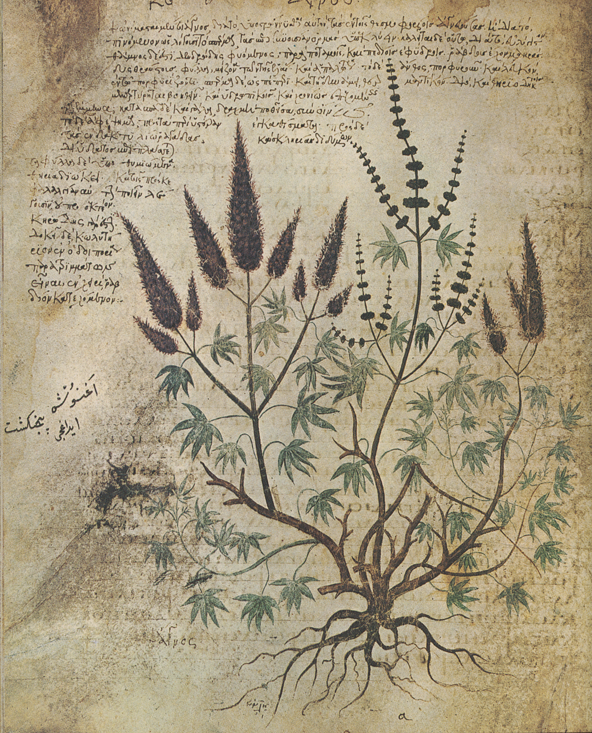
Angos in the Vienna Dioscorides, Codex Vindobonensis Med. Gr. 1 or the Juliana Anicia Codex, fol. 36v. Via Wikimedia commons.

Galen, Simple Drugs, Book 6, Chapter 2: Agnos or Lugos

August 07, 2023 by Sean Coughlin in Ancient Medicine, Botany

Galen’s Simple Drugs 6, Chapter 2

Agnos (= “chaste”), or lugos, the shrubby plant, is hot and drying somewhere in the third degree; however, agnos or lugos is considerably fine-parted and tastes both acrid and at the same time is astringent. The lugoi [i.e., the branches themselves of the agnos bush] are useless as a medical treatment, but the leaves and seeds are dry and hot in capacity and fine-parted in substance; for this is evident from using the leaf, flower or fruit and by their taste which is acrid and at the same time somewhat astringent. The fruit is edible and clearly warms, in addition to inducing headache. If it is roasted, as it is also eaten this way with tragēmata [1], it affects the head less. Unroasted, it is aflatulent [2] in the stomach, and even more so when it has been roasted. Both the roasted and the unroasted fruit inhibit the desire for sex, and the leaves and the flowers of the shrub do this as well, so that not only have they been relied on to promote chastity when eaten and drunk, but also when used as bedding. Thus, the women in Athens spread the whole bush under themselves at the Thesmophoria, and hence its name.

From all of this it is clear, if you remember what I said in my comments above, that agnos is simultaneously warming, drying, and extremely aflatulent. Its capacity is an indication that it is genuinely composed of fine parts. For it is reasonable that it affects the head not by means of generating an abundance of vaporous pneuma, but rather by means of its heat and composition from fine parts. For if it were productive of a flatulent pneuma, it would inflate the belly and stimulate the sexual desire, just like arugula. Since however it not only does not stimulate sexual desire but in fact naturally restrains it, it should be the case that it is especially close to the capacity of rue in heating and drying, although not quite equal to it. For there is a slight deficiency in both, since rue is in fact more heating and more drying. It also differs in the combination of quality and capacity. For the seeds and shoots of agnos bring a certain moderate astringency, while rue, when it is dry, is genuinely bitter and acrid, and when wet, slightly bitter. It does not have any tartness or sourness additional to it, or if it should seem to someone that it does, I know that it will seem very faint and not at all equal to that of agnos. Thus, the seed of agnos rather than rue is suitable for the liver and spleen when they are hardening and obstructed.

However, [a discussion of] these matters belongs to the therapeutic method. It is impossible to assert that [this method] does not have any need of the capacity of drugs at all; to admit this quickly and get back to the task at hand would be the act of a prudent man. I will try to practice this even more on the drugs that follow, by which I mean I will infer (=ἐπιλογίζεσθαι) the general capacity from a few clear examples and not focus on individual actions. For it is sufficient for now to know that agnos is hot and dry, not moderately, but somewhere in the third degree, and it is considerably fine-parted. For knowing this, and then learning the therapeutic method in addition, one will discover how to use it to initiate menstruation, to disperse hardening parts of the body, and to prepare a relieving or warming ointment.

ἄγνος δὲ ἢ λύγος, τὸ θαμνῶδες φυτὸν, θερμὸς μέν ἐστι καὶ ξηραντικὸς κατὰ τὴν τρίτην που ἀπόστασιν, λεπτομερὴς δὲ ἱκανῶς καὶ γευόμενος δριμύς τε ἅμα καὶ στύφων ἄγνος, ἢ λύγος. αὐτὰς μὲν δὴ τὰς λύγους ἀχρήστους ἔχει πρὸς ἰατρείαν, τὰ δὲ φύλλα καὶ τὸ σπέρμα ξηρὰ καὶ θερμὰ τὴν δύναμίν ἐστι καὶ κατὰ τὴν οὐσίαν λεπτομερῆ. καὶ γάρ χρωμένων οὕτω φαίνεται καὶ γευομένων δριμὺ τε ἅμα καὶ ὑποστῦφόν ἐστι καὶ τὸ φύλλον καὶ τὸ ἄνθος καὶ ὁ καρπός. ἔστι δὲ καὶ ἐδώδιμος ὁ καρπὸς καὶ θερμαίνει σαφῶς μετὰ τοῦ κεφαλαλγὴς ὑπάρχειν. εἰ δὲ φρυχθείη, καὶ γάρ καὶ οὕτως ἐσθίεται μετὰ τραγημάτων, ἧττον ἅπτεται τῆς κεφαλῆς. ἄφυσος δὲ κατὰ γαστέρα καὶ ὁ ἄφρυκτος μὲν, ἐπὶ μᾶλλον δὲ πεφρυγμένος. ἐπέχει δὲ καὶ τὰς πρὸς ἀφροδίσια ὁρμὰς ὅ τε πεφρυγμένος καὶ ὁ ἄφρυκτος καρπὸς, καὶ τὰ φύλλα καὶ τὰ ἄνθη τοῦ θάμνου ταὐτὸ τοῦτο δύναται δρᾷν, ὥστε οὐ μόνον ἐσθιόμενα καὶ πινόμενα πρὸς ἁγνείαν πεπίστευται συντελεῖν, ἀλλὰ καὶ ὑποστρωννύμενα. ταῦτ' ἄρα καὶ τοῖς Θεσμοφορίοις αἱ γυναῖκες Ἀθήνῃσιν ὑποστρωννύουσιν ἑαυταῖς ὅλον τὸν θάμνον, ἐντεῦθεν δὲ καὶ τοὔνομα αὐτῷ.

ἐξ ὧν ἁπάντων δῆλον, εἴ γε τῶν ἐν τοῖς ἔμπροσθεν ὑπομνήμασιν εἰρημένων μεμνήμεθα, θερμαίνειν τε ἅμα καὶ ξηραίνειν καὶ ἀφυσότατον ὑπάρχειν ἄγνον. ὅτι δὲ λεπτομερὴς ἀκριβῶς ἐστιν ἡ δύναμις αὐτοῦ τεκμήριον. καὶ γάρ τὸ πρὸς κεφαλὴν ἅπτειν οὐ διὰ πλῆθος ἀτμώδους πνεύματος ὑπ' αὐτοῦ γεννωμένου μᾶλλον ἤπερ διὰ θερμότητα καὶ λεπτομέρειαν εὔλογον γίνεται. εἴ περ γάρ ἦν φυσώδους πνεύματος γεννητικὸν, ἐνεφύσησὲ τε ἂν τὴν γαστέρα καὶ τὰς πρὸς ἀφροδίσια παρώξυνεν ὁρμὰς ὥσπερ εὔζωμον. ἐπεὶ δὲ οὐ μόνον οὐ παροξύνει, ἀλλὰ καὶ καταστέλλειν πέφυκεν, εἴη ἂν κατὰ τὴν πηγάνου μάλιστα δύναμιν ἐν τῷ θερμαίνειν καὶ ξηραίνειν, οὐ μὴν ἶσόν γ' ἐστὶν αὐτῷ. βραχὺ γάρ ἀπολείπεται κατ' ἄμφω· καὶ γάρ θερμαντικώτερον αὐτοῦ καὶ ξηραντικώτερόν ἐστι τὸ πήγανον. διενήνοχε δὲ καὶ τῷ τῆς ποιότητος καὶ δυνάμεως ἐπιμίκτῳ. τὸ γάρ τοῦ ἄγνου σπέρμα καὶ οἱ βλαστοὶ στύψιν τινὰ μετρίαν ἐπεισφέρουσι. τὸ δὲ πήγανον ὅταν μὲν ξηρὸν ᾖ, πικρὸν ἀκριβῶς ἐστι καὶ δριμὺ, ὅταν δὲ ὑγρὸν, ὑπόπικρον. οὐ μὴν αὐστηρόν γε ἢ στρυφνόν τι πρόσεστιν αὐτῷ, ἢ εἰ καὶ προσεῖναὶ τῳ δόξειεν, ἀμυδρὸν παντάπασιν οἶδ' ὅτι δόξει, καὶ οὐδαμῶς ἶσον τῷ τοῦ ἄγνου. ταῦτ' ἄρα καὶ πρὸς ἧπαρ καὶ σπλῆνα σκληρούμενὰ τε καὶ ἐμφραττόμενα τὸ τοῦ ἄγνου σπέρμα μᾶλλον ἢ πήγανον ἁρμόττει.

τῆς θεραπευτικῆς δὲ ἐστιν ἤδη ταῦτα μεθόδου, ἧς τὸ μὲν μηδ' ὅλως προσάπτεσθαι φαρμάκων δυνάμεως ἀποφαινόμενον ἀδύνατόν ἐστι, τὸ δὲ ταχέως ἀπολείποντα πάλιν ἐπανέρχεσθαι πρὸς τὸ προκείμενον ἀνδρὸς ἔργον ἂν εἴη σώφρονος. ἔτι δὲ μᾶλλον ἐπὶ τῶν ἑξῆς φαρμάκων αὐτὸ δὴ τοῦτο πρᾶξαι πειράσομαι, λέγω δὴ τὸ τὴν καθόλου δύναμιν ἔκ τινων ὀλίγων ἐναργῶν ἐπιλογισάμενος ἀποχωρεῖν τῶν κατὰ μέρος ἐνεργειῶν. ἀρκεῖ γάρ τοῦτο μόνον εἰς τὰ παρόντα γινώσκειν, ὡς θερμὸς μὲν καὶ ξηρὸς ἄγνος τὴν δύναμίν ἐστιν οὐ μετρίως, ἀλλὰ κατὰ τὴν τρίτην που τῶν ἀποστάσεων, λεπτομερὴς δὲ ἱκανῶς. ὁ γάρ ταῦτα εἰδὼς, εἶτα προσμαθὼν τὴν θεραπευτικὴν μέθοδον, αὐτὸς ἐξευρήσει πῶς μὲν καταμήνια κινήσει δι' αὐτοῦ, πῶς δὲ τὰ σκληρυνόμενα μόρια διαφορήσει, πῶς δὲ ἄκοπον ἢ θερμαντικὸν ἄλειμμα δι' αὐτοῦ κατασκευάσει.

Galen, On the Capacities of Simple Drugs, VI.2, XI.807–810 K.

[1] τραγήματα: dried fruits eaten as a dessert according to LSJ. I haven’t looked into it more than this.

[2] ἄφυσος: unclear if this means gets rid of flatulence, e.g., by expelling it, or that it prevents it by causing it not to arise in the first place.

August 07, 2023 /Sean Coughlin
before we begin, Galen, pharmacology, Simple Drugs, agnus
Ancient Medicine, Botany
Comment

Abrotano maschino. From Pietro Andrea Mattioli’s Discorsi, assembled and illustrated by Gherardo Cibo, c. 1564–1584. British Library Add MS 22332, fol. 157r.

Galen, Simple Drugs, Book 6, Chapter 1: Abrotonum

July 31, 2023 by Sean Coughlin in Ancient Medicine, Botany

The following is a translation of Galen’s Simple Drugs Book 6, chapter 1, on abrotonum (probably Artemisia abrotanum L.). While not a preface strictly speaking, this chapter (and book 6 chapter 2, up next week) still include useful summaries of what Galen has said he is up to in books 1–5 and also offer examples of his method in practice. It has been translated in part in an important paper, Philip van der Eijk 1997 “Galen’s use of the concept of ‘qualified experience’ in his dietetic and pharmacological works.”

Galen’s Simple Drugs 6, Chapter 1

Concerning abrotonum, it is not necessary to add anything about the form (idea) or particular activities (energeiai) of this herb to what has already been written by so many different men, since they have indicated them, if not distinctly, at least clearly [1]. I will also say more about it in my treatises on Compound Drugs and on Common Medicines (Euporistai), and now and then in the books on The Therapeutic Method when needed. However, I have proposed from the beginning to examine only the universal capacities (dunameis) of all drugs, which I will do in what follows, and, starting with abrotonum, state that it is hot and dry in capacity, placed somewhere in the third order and degree after the moderate ones, possessing a certain diaphoretic and cutting capacity. When taken, its powder has the same capacity as what is flesh-producing and stinging [2].

I have mentioned many times before that this rank is estimated relative to the well-mixed nature. I have discovered its mixture not least by inferring it from its taste, for it is considerably bitter. This kind of flavour, being earthy in substance, was shown to be thinned by abundant heat, so that it heats and dries in no inferior manner. Moreover, after testing it precisely using qualified experience, about which I have spoken many times, I found this drug to be composed from this same mixture [3]. For if you grind the foliage together with the flowers (for the rest of the stalk is useless) and apply it to a clean wound, it is obviously stinging and irritating, and if you soak it in oil and then want to apply it to the head or the belly, it will be found to heat intensely. And also, in the case of those who are seized periodically by shivering, if you rub them with it before the attack, they will shiver less, but the heating is sensed immediately when it is applied. And it is likely that it kills worms because it is bitter and this is clear even before the experience, if we recall my comments in the fourth book where I discussed the nature of the bitter flavour. You will immediately observe that it has a certain diaphoretic and cutting capacity. However, you will also be able to infer primarily from its taste that necessarily it has this quality more than absinth. For abrotonum shares very little in sourness, while absinth shares not a little. Furthermore, abrotonum is bad for the stomach, as seriphon also is, while absinth is good for the stomach. For concerning this point, it has been shown earlier that bitterness per se is completely bad for the stomach, while tartness or sourness or astringency in general is good for the stomach. When these qualities are mixed together with one another, the stronger one prevails.

These things are enough for you to know in this treatise, for I will show you in the books on the Therapeutic Method how someone should best use this kind of a drug. And for this reason, do not additionally seek to hear that when it is used as a poultice with boiled quince, [4] or with bread, it heals inflammations of the eyes, or that when it is boiled smooth with cornmeal it disperses tumours. For neither of these remedies nor any others are appropriate for this treatise. Rather, for those who adopt an Empiricist instruction, they are described in the works on Common Medicines, while those who want to practice the art rationally, they need the Therapeutic Method. For as with other drugs someone might do more harm than good with these kinds of reports.

When Hippocrates writes in the Aphorisms [VI.31, IV.570 L.], “pains of the eyes are resolved by drinking neat wine, bath, vapour baths, phlebotomy, or drugs,” although he did not specify what kinds of pains [are resolved by] drinking neat wine, which by baths, which by vapour baths, which by phlebotomy, which by drugs, I think someone might defer to him for three reasons. For, he composed an aphoristic teaching, in which, because of the succinctness of the form, it was mostly acceptable to write in this way; that he wrote about all cures for pains, even if he did not define which of them is suitable for which pain; and finally, very often in his other writings, he provided us with starting points for the specifications of what has been stated in this way [i.e., aphoristically]. Those, however, who write aphoristically and briefly without having written about those aphorisms in other books or in a long and detailed treatise, or who indicate to people a single drug from among the many available, they do more harm than good. For there are many differences among the kinds of eye diseases, and one of them requires the poultice I mentioned, while for other kinds it is harmful. The person who uses it on everyone indifferently will harm many more people than they will help.

In this way, therefore, we must describe not only abrotonum, but also all the other drugs, discovering their capacities for heating, cooling, moistening, or drying from the methods I have frequently mentioned, and, from experience alone, all those things caused by the specific quality of the whole substance. It has also been shown about the kinds of drugs that are deleterious and that are alexeteria and purgatives of the deleterious ones. For it is not possible to produce a rational discovery of these, while only in some cases is it possible to discover some plausible conjecture, for it surely cannot happen in all cases, as I have shown previously. But concerning the capacities discovered in this way, I will discuss them specifically in what follows, after I have gone through, for each kind of drug, the capacities of heating and cooling, moistening and drying, as well as whatever follows from them.[5]

For now, I will conclude the discussion about abrotonum once I have added this much more. The most marvelous Pamphilus, even though he describes this herb first and maintains that he himself has experienced, if not the ones he discusses later, at least this one, he nevertheless makes significant errors, believing it to be the plant called “santonicum” by the Romans. For abrotonum is different from santonicum, just as Dioscorides most accurately described in his third book On Materials, and as all physicians and dry-goods sellers are aware. For there are two types of abrotonum, the one considered male, the other female, as distinguished by Dioscorides, Pamphilus, and many others. Different from this is absinth, which itself needs to be classified into three types: one is called homonymously with the kind “absinth,” such is especially the Pontic kind; another is called “seriphon;” and another “santonicum.” But if someone calls a different one “absinth,” another one “seriphon,” and another “santonicum,” it would not make any difference to our present discussion. For we have not come to distinguish names; we are rather concerned with the things themselves. Since, then, these substances differ clearly from one another in their forms, tastes, and capacities, let them all be called by a single name if one wishes, but let the capacities be precisely described.

We have already stated that the forms have been adequately addressed by Dioscorides and no few others, so there is no need to write down what has been correctly stated before. However, if there is anything about these properties that they left undefined, I will attempt to add it here in order to come to the end of the discussion. Absinth is less hot than the substances we mentioned, as it possesses an extreme degree of astringency. But even if it is composed of finer parts than those, and for this same reason is less thinning than them, it is surely not less drying. Of the others, santonicum, which takes its name from the country of Santoneia in which it grows, is closest in capacity to seriphon, lacking a little bit in the ability of thinning, heating and drying. And seriphon is less warm than abrotonum, but warmer than absinth, while it is considerably bad for the stomach and gives off a certain saltiness with bitterness and has a slight tartness. So, both abrotonum and santonicum are both considerably bad for the stomach. For among them, only absinth, especially Pontic absinth, is good for the stomach because it shares most in astringency. Burnt abrotonum, on the other hand, is hot and dry in capacity, even more than burnt, dry colocynth and dill root. For these are suitable for weeping ulcers as well as those that are crusted over without inflammation, and for this reason it seems especially suited for those on the foreskin. The ash of abrotonum is stinging for all ulcers. And for this reason, it is also suitable for alopecia when mixed with an oil composed of fine parts, like castor oil, obviously, or radish, Sicyonian, or aged, and especially Sabine oil. It also promotes the growth of slow growing beards when combined with any of the oils just mentioned, and no worse than them when wet with mastic fruit oil. For it is rarefying in addition to being composed of fine parts, biting, and hot. It is also especially necessary to recognize these of its capacities, and with that, none of its particular capacities are yet lacking in this treatise.

ἀβροτόνου ταύτης τῆς πόας οὔτε τὴν ἰδέαν χρὴ γράφειν ἐπὶ τοσούτοις τε καὶ τοιούτοις ἀνδράσιν οὔτε τὰς κατὰ μέρος ἐνεργείας ὡς ἐκεῖνοι, κᾂν εἰ μὴ διωρισμένως, ἀλλὰ σαφῶς γοῦν ἐδήλωσαν. εἰρήσεται δὲ καὶ ἡμῖν ἐπιπλέον ὑπὲρ αὐτῶν ἐν τῇ περὶ συνθέσεως φαρμάκων πραγματείᾳ καὶ τῇ τῶν εὐπορίστων, ἔστι δ' ὅτε κᾀν τοῖς τῆς θεραπευτικῆς μεθόδου γράμμασιν, ὅταν ἡ χρεία καλῇ. μόνον δὲ, ὅπερ ἐξ ἀρχῆς πρόκειται, τὰς καθόλου δυνάμεις ἁπάντων τῶν φαρμάκων ἐπισκέψασθαι, τοῦτο κᾀπὶ τῶν ἄλλων μὲν ἕπεται, καὶ νῦν δὲ ἤδη ποιητέον αὐτὸ καὶ λεκτέον ὡς θερμόν τέ ἐστι καὶ ξηρὸν τὴν δύναμιν τὸ ἀβρότονον, ἐν τρίτῃ που τάξει καὶ ἀποστάσει μετὰ τὰς συμμετρίας τεταγμένον, διαφορητικήν τὲ τινα καὶ τμητικὴν ἔχον δύναμιν. τῆς αὐτῆς δ' ἐστὶ δυνάμεως καὶ ἡ τρίψις αὐτοῦ εἰληφυῖα, ὥσπερ τὸ σαρκωτικόν τε καὶ δακνῶδες. ὅτι δὲ καὶ ὡς πρὸς τὴν εὔκρατον φύσιν ἡ τοιαύτη τάξις ἐξετάζεται πρόσθεν εἴρηται πολλάκις.

ἐξεύρομεν δ' αὐτοῦ τὴν κρᾶσιν οὐχ ἥκιστα μὲν καὶ τῇ γεύσει τεκμηράμενοι, πικρὸν γάρ ἱκανῶς ἐστιν. ὁ δὲ τοιοῦτος χυμὸς ἐδείκνυτο γεώδης μὲν ὢν τὴν οὐσίαν, ὑπὸ θερμότητος δαψιλοῦς λεπτύνεσθαι, ὥστε καὶ θερμαίνειν καὶ ξηραίνειν οὐκ ἀγεννῶς. οὐ μὴν ἀλλὰ καὶ τῇ διωρισμένῃ πείρᾳ, περὶ ἧς ἔμπροσθεν εἴρηται πολλάκις, ἀκριβῶς βασανίσαντες ἐκ τῆς αὐτῆς εὕρομεν τὸ φάρμακον τοῦτο κράσεως. εἴτε γάρ κόψας τὴν κόμην ἅμα τοῖς ἄνθεσιν, ἄχρηστον γάρ αὐτοῦ τὸ λοιπὸν κάρφος, ἐπιπάττοις ἕλκει καθαρῷ, δακνῶδές τε καὶ ἐρεθιστικὸν φαίνεται, εἴτε ἀποβρέξας ἐν ἐλαίῳ καταντλεῖν ἐθελήσαις ἤτοι κεφαλὴν ἢ γαστέρα, θερμαῖνον σφοδρῶς εὑρεθήσεται. καὶ μὲν δὴ καὶ ὅσοι κατὰ περιόδους ἁλίσκονται ῥίγεσιν, εἰ καὶ τούτους ἀνατρίβοις πρὸ τῆς εἰσβολῆς, ἧττον ῥιγῶσιν, ἀλλ' οὐδὲ τὴν αἴσθησιν εὐθὺς ἅμα τῷ προσφέρεσθαι λανθάνει θερμαῖνον. ὅτι δὲ ἕλμινθας ἀναιρεῖν εἰκός ἐστι πικρὸν ὑπάρχον αὐτὸ καὶ πρὸ τῆς πείρας εὔδηλον, εἴ τι μεμνήμεθα τῶν ἐν τῷ τετάρτῳ τῶνδε τῶν ὑπομνημάτων εἰρημένων ὑπὲρ τοῦ πικροῦ χυμοῦ τῆς φύσεως. εἰδήσεις δ' εὐθὺς ὡς καὶ διαφορητικήν τινα καὶ τμητικὴν ἔχει δύναμιν. ἀλλὰ καὶ ὡς μᾶλλον ἀψινθίου τοῦτο ὑπάρχειν ἀναγκαῖον αὐτῷ συλλογίσασθαὶ σοι παρέσται πρῶτον μὲν ἐκ τῆς γεύσεως. ἐλαχίστης γάρ τινος μετέχει στρυφνότητος τὸ ἀβρότονον, ἀψίνθιον δὲ οὐκ ὀλίγης· ἔπειτα δὲ κᾀκ τοῦ κακοστόμαχον εἶναι τὸ ἀβρότονον, ὥσπερ οὖν καὶ τὸ σέριφον, εὐστόμαχον δὲ τὸ ἀψίνθιον. ἐδείχθη γάρ καὶ περὶ τούτων πρόσθεν ὡς τὸ μὲν πικρὸν αὐτὸ καθ' αὑτὸ παντελῶς εἴη κακοστόμαχον, τὸ δὲ αὐστηρὸν ἢ στρυφνὸν ἢ ὅλως στῦφον εὐστόμαχον. ἐπιμιγνυμένων δὲ τῶν ποιοτήτων ἀλλήλαις ἡ σφοδροτέρα ἂν ἐπικρατοίη.

ταῦτ' οὖν ἀρκεῖ σοι γινώσκειν ἐν τῇδε τῇ πραγματείᾳ. δειχθήσεται γάρ ἐν τοῖς τῆς θεραπευτικῆς μεθόδου γράμμασιν ὡς ἄν τις τοιούτῳ φαρμάκῳ κάλλιστα χρῷτο. καὶ διὰ τοῦτο μηκέτι ἐπιζήτει ἀκούειν μήθ' ὅτι σὺν ἑφθῷ μήλῳ κυδονίῳ καταπλασθὲν ἢ ἄρτῳ φλεγμονὰς ὀφθαλμῶν ἰᾶται, μήθ' ὅτι διαφορεῖ φύματα σὺν ὠμηλύσει λεῖον ἑψηθέν. οὐδὲ γάρ τούτων οὐδέτερον οὔτε τῶν ἄλλων οὐδὲν τῆς νῦν πραγματείας ἴδιόν ἐστιν, ἀλλὰ τοῖς μὲν ἐμπειρικὴν διδασκαλίαν ποιουμένοις ἐν τοῖς εὐπορίστοις γράφεται φαρμάκοις, ὅσοι δὲ λογικῶς ἀσκῆσαι τὴν τέχνην βούλονται, τῆς θεραπευτικῆς ἐστι χρεία τούτοις μεθόδου. τὰ τε γάρ ἄλλα καὶ βλαβείη τις ἂν μᾶλλον ἢ ὠφεληθείη πρὸς τῆς τοιαύτης ἱστορίας.

Ἱπποκράτει μὲν οὖν ἐν ἀφορισμοῖς γράφοντι, ὀδύνας ὀφθαλμῶν ἀκρατοποσίη ἢ λουτρὸν ἢ πυρίη ἢ φλεβοτομίη ἢ φαρμακείη λύει· μὴ μέντοι προστιθέντι, ποίας μὲν οὖν ὀδύνας ἀκρατοποσία, ποίας δὲ λουτρὸν, καὶ τίνας μὲν πυρία, τίνας δὲ φλεβοτομία, τίνας δὲ φαρμακεία, συγχωρήσειεν ἄν τις, οἶμαι, διὰ τρεῖς αἰτίας. καὶ γάρ ἀφοριστικὴν ἐποιεῖτο διδασκαλίαν, ἐν ᾗ διὰ τὸ σύντομον οὕτω λέγεσθαι συγκεχώρηκε τὰ πολλὰ, καὶ πάντα τὰ ἰατικὰ τῶν ὀδυνῶν ἔγραψεν, εἰ καὶ μὴ διωρίσατο πρὸς ὁποίαν ὀδύνην ποῖον αὐτῶν ἁρμόττει, ἢ καὶ πολλαχόθι τῶν ἄλλων συγγραμμάτων ἀφορμὰς ἡμῖν ἔδωκε τῶν ἐν τοῖς οὕτω ῥηθεῖσι διορισμῶν. ὅσοι δὲ μήτ' ἐν ἑτέροις βιβλίοις ἔγραψαν ὑπὲρ τῶν τοιούτων ἀφορισμῶν μήτε ἐν διεξοδικῇ τε καὶ μακρᾷ πραγματείᾳ, γράφουσιν ἀφοριστικῶς τε καὶ βραχέως, εἴτε τὸ πρὸς τούτοις ἓν ἐκ πολλῶν δηλοῦσιν, εἰς πλείω δὲ βλάπτουσιν ἡμᾶς ἢ ὠφελοῦσι. πολλῶν γάρ οὐσῶν διαφορῶν ἐν ταῖς ὀφθαλμίαις, καὶ μιᾶς μὲν ἐξ αὐτῶν χρῃζούσης τοῦ προειρημένου καταπλάσματος, τῶν δ' ἄλλων βλαπτομένων, ὁ χρώμενος ἐπὶ πασῶν ἀδιορίστως πολὺ πλείους βλάψει ἢ ὠφελήσει.

κατὰ τοῦτον οὖν τὸν τρόπον οὐ περὶ ἀβροτόνου μόνον, ἀλλὰ καὶ περὶ τῶν ἄλλων ἁπάντων γραπτέον ἡμῖν ἐστι, τὰς μὲν κατὰ τὸ θερμαίνειν καὶ ψύχειν ἢ ὑγραίνειν ἢ ξηραίνειν δυνάμεις ἐξ ὧν πολλάκις εἴρηκα μεθόδων εὑρίσκουσιν, ὅσα δὲ κατὰ τὴν ἰδιότητα τῆς ὅλης οὐσίας ἀποτελοῦνται τῇ πείρᾳ μόνῃ. δέδεικται καὶ περὶ τῶν τοιούτων ὡς δηλητήριοὶ τὲ εἰσι καὶ δηλητηρίων ἀλεξητήριοι καὶ καθαρτικοί. τούτων γάρ οὐχ οἷόν τε λογικὴν ποιήσασθαι τὴν εὕρεσιν, ἀλλ' ἢ μόνον ὑπόνοιὰν τινα πιθανὴν ἔστιν εὑρεῖν ἐπὶ τινων· οὐ γάρ δὴ ἐπὶ πάντων γε, καθάπερ καὶ αὐτὸ τοῦτο δεδήλωται διὰ τῶν ἔμπροσθεν. ἀλλὰ περὶ μὲν τῶν οὕτως εὑρισκομένων δυνάμεων ἰδίᾳ ποιήσομαι τὸν λόγον ἐν τοῖς ἐφεξῆς, ἐπειδὰν πρότερον ὑπὲρ τῶν κατὰ τὸ θερμαίνειν καὶ ψύχειν, ὑγραίνειν τε καὶ ξηραίνειν, καὶ ὅσα ταύταις ἕπονται διέλθω καθ' ἕκαστον εἶδος φαρμάκου.

τοσόνδε μέντοι προσθεὶς ἔτι περὶ ἀβροτόνου καταπαύσω τὸν λόγον, ὡς ὁ θαυμασιώτατος Πάμφιλος, καίτοι ταύτην πρώτην πόαν γράφων καὶ τάχ' ἂν εἰ μηδενὸς τῶν ἐφεξῆς, ἀλλὰ ταύτης γοῦν ἐθελήσας αὐτόπτης γενέσθαι, ὅμως ἔσφαλται μέγιστα, νομίζων ὑπὸ Ῥωμαίων σαντόνικον ὀνομάζεσθαι τὴν βοτάνην. διαφέρει γάρ ἀβρότονον σαντονίκου, καθότι καὶ Διοσκουρίδης ἔγραψεν ἐν τῷ τρίτῳ περὶ ὕλης ἀκριβέστατα, καὶ πάντες ἴσασι τοῦτὸ γε ἰατροὶ καὶ ῥωποπῶλαι. τοῦ μὲν γάρ ἀβροτόνου δύο ἐστὶν εἴδη, τὸ μὲν ἄρρεν, τὸ δὲ θῆλυ νομιζόμενον, ὡς καὶ τοῦτο διώρισται παρὰ τῷ Διοσκουρίδῃ τε καὶ τῷ Παμφίλῳ καὶ ἄλλοις μυρίοις. ἕτερον δὲ ἐστιν αὐτοῦ τὸ ἀψίνθιον, οὗ πάλιν εἴδη χρὴ τίθεσθαι καὶ αὐτὰ τριττὰ, ὧν τὸ μὲν τῷ γένει ὁμωνύμως προσαγορεύονται ἀψίνθιον, ὁποῖον μάλιστὰ ἐστι τὸ Ποντικὸν, τὸ δὲ σέριφον, τὸ δὲ σαντόνικον. εἰ δ' ἄλλο μὲν ἀψίνθιον, ἄλλο δὲ σέριφον, ἄλλο δὲ σαντόνικον λέγοι, οὐδὲν εἰς τὰ παρόντα διαφέρει. οὐδὲ γάρ ὄνομα διαιρήσοντες ἥκομεν, ἀλλ' ὑπὲρ αὐτῶν τῶν πραγμάτων σπουδάζομεν. ἐπεὶ τοίνυν καὶ ταῦτα καὶ ταῖς ἰδέαις καὶ ταῖς γεύσεσι καὶ ταῖς δυνάμεσιν ἕτερα σαφῶς ἀλλήλων ἐστὶν, ὀνομαζέτω μὲν, εἰ βούλοιτὸ τις, ἅπαντα διὰ μιᾶς προσηγορίας, ἐκδιδασκέτω δὲ ἀκριβῶς τὰς δυνάμεις.

ἡμεῖς οὖν τὰς μὲν ἰδέας αὐτάρκως ἔφαμεν εἰρῆσθαι Διοσκουρίδῃ τε καὶ ἄλλοις οὐκ ὀλίγοις, ὥστ' οὐ χρὴ γράφειν αὖθις ὅσα τοῖς πρόσθεν ὀρθῶς εἴρηται. εἴ τι δ' ἐν ταῖς τούτου δυνάμεσιν ἀδιόριστον ἐκεῖνοι παρέλιπον, οὗ δὴ χάριν ἐπὶ τήνδε τὴν ἔξοδον ἀφικόμην, ἐγὼ προσθεῖναι πειράσομαι. τὸ μὲν ἀψίνθιον ἧττόν ἐστιν τῶν εἰρημένων θερμὸν, ὡς ἂν πλείστης μετέχων τῆς στύψεως. εἰ δὲ καὶ τοῦτο λεπτομερὲς ἧττον ἐκείνων, καὶ λεπτυντικὸν δὴ κατὰ τὸν αὐτὸν τρόπον ἧττον ἐκείνων, οὐ μὴν ἧττόν γε ξηραντικόν. τῶν δ' ἄλλων τὸ μὲν σαντόνικον ἀπὸ Σαντονείας χώρας, ἐν ᾗ φύεται, τὴν προσηγορίαν ἔχον ἐγγυτάτω τὴν δύναμίν ἐστι τοῦ σερίφου, βραχεῖ τινι λειπόμενον ἐν τῷ λεπτύνειν τε καὶ θερμαίνειν καὶ ξηραίνειν. αὐτὸ δὲ τὸ σέριφον ἧττον μὲν θερμὸν τοῦ ἀβροτόνου, θερμότερον δὲ ἀψινθίου, κακοστόμαχον δὲ ἱκανῶς καὶ ὡς ἂν ἁλμυρίδα τινὰ σὺν πικρότητι ἀποφαῖνον, ἔτι τε τῆς στρυφνότητος ὀλίγον μετέχον. οὕτω δὲ καὶ ἀβρότονον καὶ σαντόνικον ἱκανῶς ἐστι κακοστόμαχον. μόνον γάρ ἐν αὐτοῖς τὸ ἀψίνθιον καὶ μάλιστα τὸ Ποντικὸν εὐστόμαχόν ἐστιν ὅτι πλείστης μετέχει στύψεως. ἀβρότονον δὲ κεκαυμένον θερμὸν καὶ ξηρόν ἐστι τὴν δύναμιν, ἔτι μᾶλλον κολοκύνθης ξηρᾶς κεκαυμένης καὶ ἀνήθου ῥίζης. ἐκεῖνα γάρ ἕλκεσιν ὑγροῖς τε ἅμα καὶ χωρὶς φλεγμονῆς τετυλωμένοις ἁρμόττει, καὶ διὰ τοῦτο μάλιστα τοῖς ἐπὶ πόσθαις αἰδοίου συμπεφωνηκέναι δοκεῖ. τοῦ δὲ ἀβροτόνου ἡ τέφρα δακνώδης ἅπασιν ἕλκεσιν ὑπάρχει. καὶ διὰ τοῦτο καὶ πρὸς ἀλωπεκίας ἁρμόττει σὺν ἐλαίῳ λεπτομερεῖ, κικίνῳ δηλονότι ἢ ῥαφανίνῳ ἢ Σικυωνίῳ ἢ παλαιῷ, καὶ μάλιστα τῷ Σαβίνῳ. καὶ γένεια δὲ βραδέως ἀνιόντα προκαλεῖται μετὰ τινος τῶν εἰρημένων ἐλαίων ὅτου δὴ, καὶ οὐδὲν δ' ἧττον ἐκείνων σχινίνῳ δευόμενον. ἀραιωτικὸν γάρ ἐστι πρὸς τῷ λεπτομερὲς εἶναι καὶ δακνῶδες καὶ θερμὸν, ἃς δὴ καὶ μάλιστα χρὴ γινώσκειν τὰς δυνάμεις αὐτοῦ καὶ μηδὲν ἔτι τῶν κατὰ μέρος ἐν τῇδε τῇ πραγμανείᾳ δεῖσθαι.

Galen, On the Capacities of Simple Drugs, VI.1, XI.798–807 K.

[1] Including many of the writers he has just mentioned in the preface to book 6. For the construction, see also Alim. Fac. VI.454 K.: " εἰ μὲν οὖν ὥσπερ ἐν γεωμετρίᾳ καὶ ἀριθμητικῇ συνεφωνεῖτο πάντα τοῖς γράψασι περὶ τροφῆς, οὐδὲν ἂν ἔδει νῦν ἡμᾶς ἔχειν πράγματα γράφοντας αὖθις ὑπὲρ τῶν αὐτῶν ἐπὶ τοσούτοις τε καὶ τοιούτοις ἀνδράσιν." If, as in geometry and arithmetic, everything was agreed upon by those who wrote about food, there would now be no need for us to engage in these works, writing about them again in addition [to what was said] by so many different men.

[2] On sarkotics (promoting the growth of flesh), see SMT XI.711.15–19; daknodes, see XI.621–627 K.

[3] pace van der Eijk translates ἐκ τῆς αὐτῆς εὕρομεν τὸ φάρμακον τοῦτο κράσεως as “we will discover the medicinal power from its mixture itself” (284n16). I take Galen’s point is that one can find the mixture (krasis) of the drug using qualified experience, just as one can find the mixture using taste or smell, which would suggest the ἐκ here refers to what the drug is composed out of (ἐκ), rather than the ground of the discovery.

[4] Must be τὰ κυδώνια μῆλα, mentioned by Galen at Alim. Fac. 6.602.1-603.10 K; also, San. Tu. VI.285 K., VI.450 K. and MM, e.g., X.906 K. as an eye cure. The same cure (?) mentioned Comp. Med. Sec. Loc. XII.948 K. Dioscorides, Galen’s target, gives this as a poultice for eye inflammation, De mat. med. 3.24.3: βοηθεῖ δὲ καὶ ὀφθαλμῶν φλεγμοναῖς σὺν ἑφθῷ <μήλῳ> κυδωνίῳ ἢ μετὰ ἄρτου καταπλασθέν, διαφορεῖ καὶ φύματα μετὰ ὠμῆς λύσεως λεῖον ἑψηθέν. Also mentioned by Athenaeus of Naucratis (e.g., 3.20.17: τὰ δὲ κυδώνια, ὧν ἔνια καὶ στρουθία λέγεται; 3.20.39); Plutarch (attributing a saying about it to Solon), Moralia 279 F 4.

[5] So, we should expect the following structure to each entry: (1) heating, cooling, moistening, drying; (2) capacities that follow from these; (3) particular, non-predictable qualities. Would be interesting to see if the entries reflect this.

July 31, 2023 /Sean Coughlin
Galen, pharmacology, Simple Drugs, before we begin
Ancient Medicine, Botany
Comment

Nut and astrological figures. Hypostyle, Temple of Hathor at Dendera, Egypt. March 2023.

Galen, Simple Drugs, Book 6, Preface

July 24, 2023 by Sean Coughlin in Ancient Medicine

Parts of the preface to book 6 have been published before. See Jouanna 2011: 72–74 (French); Danielle Gourevitch 2016: 251 (English); and with important textual improvements by Petit 2017: 53–54 (English).

Galen’s Simple Drugs 6 preface

When I set out to write about the forms and capacities of simple drugs, I decided to present, in the first two books, the flawed approaches used by most of the more recent doctors, which led them so significantly astray. In the third book, I produced an elementary introduction, as it were, to the entire study, while in the fourth book, I inquired into the nature of flavours, endeavouring to discover everything from them that could benefit our understanding of their capacities. At the end of that book, I also discussed the olfactory qualities present in simple drugs. In the fifth book, I moved on to the remaining class of capacities, which are named after the actions they naturally effect, and there I presented their nature and substance.

At this point, all the general discussions about the capacities of simple drugs seem to have reached an end. Now, it is time to move on to the particular or specific discussions (or however you want to call them). These discussions involve going through each drug individually, as I did at the beginning, when I examined water and vinegar in the comments I wrote in the first book, and olive oil and rose oil in the second. However, in those places my discussion used them as examples in response to those who did not explain their capacities correctly. Here, I will go through each one briefly without being concerned anymore whether anyone has explained something about them inappropriately. Instead, I will write down what seems most true to me, without engaging in disputes with those who are mistaken.

It should be evident, I think, even if I do not say it, that for those readers who have forgotten what was said earlier, the discussion will not only be unclear, but will also lack the plausibility of demonstrative proof. It is perhaps better if I remind both of us that one must first test the capacities of drugs on the most well-mixed nature, and then on simple diseases; if, however, someone wants to use the qualities of taste to make an inference indicatively about the capacity, I have shown the method for this in the fourth book. If therefore someone carelessly skims through the earlier books, or even skips them entirely, and then comes straight to this book eager to become knowledgeable quickly about the capacity of drugs, they will not achieve a reliable grasp of them.

Since all drugs are either parts of animals, plants, or fruit, or their juices or fluids, or derived from metals, it seemed better to me to first discuss plants because their class is strongest in quantity and capacity, then next to talk about the minerals, and finally come to the parts of animals. I also realized it was necessary to compile the entries in alphabetical order, first writing about those plants whose names start with the letter "alpha", second those with the letter "beta", and so on with the third, fourth, fifth and all the rest of the letters in order.

This is also how Pamphilus composed his treatise on plants, but he digressed into stories told by old women and ridiculous Egyptian magic (goēteia) along with certain incantations they recite while pulling up the plants. He has even used them for amulets and other kinds of magic charms that are not only superfluous and outside the medical art, but also completely fictitious. I am not going to speak about any of these things, nor yet about their ridiculous metamorphoses. For I do not consider such myths to be useful even for small children, let alone for those who are eagerly pursuing the works of medicine. And it seems to me that Hippocrates said at the very beginning of the Aphorisms (1.1), ‘Life is short, and the art long,’ in order to suggest that one should not waste time on useless things, but endeavour, as much as possible, to take the most succinct path through the most useful aspects of the art. And so, it seemed superfluous to me to append the many Egyptian and Babylonian names for these plants, as well as whatever things people add about what the names mean or symbolize. For, it would be better, if someone wished to delve into these matters, to read the books of the translators for oneself and on one's own. For those who compiled these works also gave them this title, just as Xenocrates of Aphrodisias did, a man otherwise quite extravagant and not free from magic (goēteia).

One can tell from what he writes that Pamphilus, who composed the books about plants, is clearly a grammarian. He has neither seen the plants which he describes, nor has he tested their capacities, but has believed everything that was written before him without testing. He compiled books, needlessly adding a host of names for each plant, then describing whether any of them was transformed from a human being, and then appending incantations, indeed even some libations and fumigations, used when they are gathered from the earth, and other kinds of ridiculous magic (goēteia).

Dioscorides of Anazarbus, however, wrote in five books the material useful for everything, mentioning not only plants, but also trees, fruit, fluids, juices, and even all of the metals and parts from animals. And it seems to me that this man more than everyone else has produced the most complete treatise on the material of drugs. For his predecessors indeed produced much that is well written about these things, but no one so comprehensively, unless one were to praise Tanitros the follower of Asclepiades; for in fact everything he stated was well said apart from his causal reasoning. These works, therefore, must be read by one who wants to become practiced in material, and in addition to these, the works of Heraclides of Tarentum and Crateuas and Mantias. But they are not written in a similar way to the former, nor are they all assembled together in one work, as they are with Dioscorides, who inscribed the five books with the title On Material. Rather, some wrote specifically here and there on the preparation and testing of drugs, like Heraclides of Tarentum; others specifically on purgatives, preventative drinks, or clysters, like Mantias; others specifically on readily available remedies, like Apollonius; or on those according to place, like Mantias.

In most cases, the use of drugs is found in therapeutic treatises written by both the ancient writers and, in addition, by nearly all the more recent ones. For much is said by Hippocrates and also by Euryphon, Dieuches, Diocles, Pleistonicus, Praxagoras and Herophilus. There is in fact not a man among the ancients who did not contribute something to the art, large or small, concerning knowledge of drugs, without the magic (goēteia) and charlatanism later exhibited by Andreas. As a result, for anyone who has the leisure to consult with useful books written about drugs, they have many, both from the ancients, as I said, and also not a few from the more recent doctors, even up to those around Pamphilus [1] and Archigenes. Indeed, Rufus of Ephesus especially described many drugs in his therapeutic books and there are four works on plants composed in hexameter verse. So, there is no fear of running out of useful books, even if someone wanted to read nothing else except books about drugs for their entire life.

But one should avoid Andreas and similar charlatans, and much more still Pamphilus, who has never, not even in a dream, seen the plants whose forms he attempts to describe. For such men are, as Heraclides of Tarentum likened them, very similar to messengers who announce the form by which a fugitive slave might be recognized without ever having seen them. For they learn how one might recognize them from those who have seen them, then like an incantation they recite these same things which they would not recognise even if the one being announced happened was present. For I criticized those who first described the forms of plants, thinking it would be better for students to see for themselves alongside their teacher and not become like someone who navigates from the book. For also in this way the instruction accomplished by the teacher would be truer and clearer, not only of plants, shrubs, or trees, but of all other drugs as well.

But if indeed one needs a book, who would be so unfortunate as to overlook the works of Dioscorides, [Sextius] Niger, Heraclides, Crateuas, and countless others who have grown old in the profession, and instead tolerate someone who writes grammar books, incantations, metamorphoses, and sacred herbs of decans and demons? That magicians have made it their business to fabricate these kinds of things to amaze the common crowd, you can learn from the books of Pamphilus, who, in his books on plants, first described abrotanum, which is familiar to all of us, and then next agnus, a shrub that is also considerably familiar, and then agrostis, an herb not unknown even to the laymen, and then anchusa, which no one is ignorant of, just as no one is ignorant of adianton, which he described next. Now, in these cases he describes nothing more remarkable than what we already know. After them, however, he mentions a plant called, so he claims, "aetos" ("eagle"), about which he acknowledges no Greek has said anything, but which is described in one of the books attributed to Hermes the Egyptian. The book contains the thirty-six sacred plants of the horoscope, all of which are clearly ridiculous and fabrications of the author, very much like the ophionika and konkhakokhla. For in fact there is no such thing as a konkhakokhlon. The name is made up for a laugh, just like everything else that is written in his book. And these thirty-six plants only exist as names, without any real object underlying them. But perhaps Pamphilus, like many others, had the leisure to write down useless stories in books. At this point, I think I would waste too much time by mentioning them. Let us, therefore, begin now with what is useful.

περὶ τῆς τῶν ἁπλῶν φαρμάκων ἰδέας καὶ δυνάμεως ἐγχειρήσαντες γράφειν, ἐν μὲν τοῖς πρώτοις δύο βιβλίοις ἐπιδεῖξαι προειλόμεθα τοὺς μοχθηροὺς τρόπους τῶν ἐπιχειρημάτων, οἷς πλεῖστοι τῶν νεωτέρων ἰατρῶν χρώμενοι σφάλλονται μέγιστα. κατὰ δὲ τὸ τρίτον οἷον στοιχείωσίν τινα τῆς συμπάσης ἐποιησάμεθα διδασκαλίας, εἶτα ἑξῆς κατὰ τὸ τέταρτον ὑπὲρ τῆς τῶν χυμῶν φύσεως ἐζητήσαμεν, ἐξευρεῖν σπουδάσαντες ἅπαν ὅσον οἷόν τ' ἐστὶν ἐξ αὐτῶν εἰς τὴν τῶν δυνάμεων γνῶσιν ὠφεληθῆναι. διελέχθημεν δὲ ἐπὶ τῆς τελευτῆς τοῦ βιβλίου καὶ περὶ τῶν πρὸς τὴν ὄσφρησιν ἐν τοῖς ἁπλοῖς φαρμάκοις ποιοτήτων. ἐν δὲ τῷ πέμπτῳ μεταβάντες ἐπὶ τὸ λοιπὸν γένος τῶν δυνάμεων, ὃ παρονομάζεται ἀπὸ τῶν ἔργων αὐτῶν ἃ πεφύκασι δρᾷν, ἐπεδείξαμεν κᾀνταῦθα ἑκάστου τὴν φύσιν καὶ οὐσίαν.

οἱ μὲν δὴ καθόλου λόγοι πάντες ὑπὲρ τῆς τῶν ἁπλῶν δυνάμεως ἐοίκασιν ἤδη τέλος ἔχειν· ἐπὶ δὲ τοὺς κατὰ μέρος ἢ κατ' εἶδος, ἢ ὅπως ἄν τις ὀνομάζειν ἐθέλοι, μετιέναι καιρός. εἶεν δ' ἂν οὗτοι καθ' ἕκαστον φάρμακον ἰδίᾳ περαινόμενοι, καθάπερ καὶ κατ' ἀρχὰς εὐθὺς ἐποιήσαμεν, ἐν μὲν τῷ πρώτῳ τῶνδε τῶν ὑπομνημάτων ὑπὲρ ὕδατός τε καὶ ὄξους ἐπισκεψάμενοι, κατὰ δὲ τὸ δεύτερον ὑπὲρ ἐλαίου καὶ ῥοδίνου, πλὴν ἐν ἐκείνοις μὲν ἐπὶ παραδειγμάτων ὁ λόγος ἡμῖν ἐγίγνετο πρὸς τοὺς οὐκ ὀρθῶς ὑπὲρ τῆς δυνάμεως αὐτῶν ἀποφηναμένους· ἐνταῦθα δὲ διὰ βραχέων ὑπὲρ ἑκάστου δίειμι μηκέτι φροντίζων, εἴ τις μὴ καλῶς ἀπεφήνατο περὶ τινος αὐτῶν, ἀλλ' ὅπερ ἀληθέστατόν μοι φαίνεται γράφων, ἄνευ τῆς πρὸς τοὺς διαμαρτάνοντας ἀντιλογίας.

ὅτι δὲ οὐ μόνον ἀσαφὴς ὁ λόγος ἔσται τοῖς ἐπιλανθανομένοις τῶν ἔμπροσθεν, ἀλλὰ καὶ τὸ τῆς ἀποδείξεως πιστὸν οὐχ ἕξει, δῆλον μὲν οἶμαι κᾂν ἐγὼ μὴ λέγω, κάλλιον δ' ἐστὶν ἴσως ἀναμνῆσαι κᾀμὲ, πρῶτον μὲν ὡς ἐπὶ τῆς εὐκρατοτάτης φύσεως τὴν πεῖραν χρὴ ποιεῖσθαι τῆς τῶν φαρμάκων δυνάμεως, εἶθ' ἑξῆς ὡς ἐπὶ τῶν ἁπλῶν νοσημάτων. εἰ δὲ δὴ κᾀκ τῶν πρὸς τὴν γεῦσιν ποιοτήτων ἐθέλοι τις ἐνδεικτικῶς τεκμαίρεσθαι περὶ τῆς δυνάμεως αὐτῆς, ἐδείξαμεν ἐν τῷ τετάρτῳ καὶ τὴν ἐν τούτοις μέθοδον. ἐὰν οὖν τις ἤτοι ῥᾳθύμως ἀναγνοὺς τὰ πρόσθεν ἢ καὶ μηδ' ὅλως ἀναγνοὺς ἐπὶ τουτὶ τὸ βιβλίον εὐθέως ἀφίκηται, σπεύδων ὅτι τάχιστα ἐπιστήμων γενέσθαι τῆς τῶν φαρμάκων δυνάμεως, οὐχ ἕξει βεβαίαν τὴν γνῶσιν αὐτῶν.

ἐπεὶ δὲ τὰ φάρμακα πάντα τὰ μέν ἐστι μόρια ζώων ἢ φυτῶν ἢ καρπῶν ἤ τινες ὀποὶ τούτων ἢ χυλοὶ, τὰ δὲ ἐκ τῶν μετάλλων λαμβάνεται, κάλλιον ἔδοξὲ μοι περὶ τῶν φυτῶν πρῶτον διελθεῖν, ὅτι τε πλεῖστον αὐτῶν ἐστι τὸ γένος ἰσχυρότατόν τε καὶ τὴν δύναμιν, εἶθ' ἑξῆς περὶ τῶν μεταλλευόντων εἰπεῖν, ἔπειθ' οὕτως ἐπὶ τὰ τῶν ζώων ἀφικέσθαι μόρια. καὶ μέντοι καὶ τὴν τάξιν αὐτῶν τῆς γραφῆς ἔγνων χρῆναι κατὰ στοιχεῖον ποιήσασθαι, πρῶτα μὲν ἐκεῖνα γράψας τῶν φυτῶν ὧν αἱ προσηγορίαι τὴν ἀρχὴν ἔχουσιν ἀπὸ τοῦ ἄλφα στοιχείου, δεύτερα δὲ ὅσα ἀπὸ τοῦ β, καὶ οὕτως ἤδη τρίτα τε καὶ τέταρτα καὶ πέμπτα καὶ τἄλλα ἐφεξῆς ἅπαντα κατὰ τὴν τῶν γραμμάτων τάξιν.

οὕτω δὴ καὶ Πάμφιλος ἐποιήσατο τὴν περὶ τῶν βοτανῶν πραγματείαν. ἀλλ' ἐκεῖνος μὲν εἴς τε μύθους γραῶν τινας ἐξετράπετο καὶ τινας γοητείας Αἰγυπτίας ληρώδεις ἅμα τισὶν ἐπῳδαῖς, ἃς ἀναιρούμενοι τὰς βοτάνας ἐπιλέγουσι. καὶ δὴ κέχρηται πρὸς περίαπτα καὶ ἄλλας μαγγανείας οὐ περιέργους μόνον, οὐδ' ἔξω τῆς ἰατρικῆς τέχνης, ἀλλὰ καὶ ψευδεῖς ἁπάσας. ἡμεῖς δὲ οὔτε τούτων οὐδὲν οὔτε τὰς τούτων ἔτι ληρώδεις μεταμορφώσεις ἐροῦμεν. οὐδὲ γὰρ τοῖς μικροῖς παισὶ κομιδῆ χρησίμους ὑπολαμβάνομεν εἶναι τοὺς τοιούτους μύθους, μήτι γε δὴ τοῖς μετιέναι σπεύδουσι τὰ τῆς ἰατρικῆς ἔργα. καὶ μοι δοκεῖ πρὸς Ἱπποκράτους εὐθέως ἐν ἀρχῇ τῶν ἀφορισμῶν εἰρῆσθαι ὁ βίος βραχὺς, ἡ δὲ τέχνη μακρὰ χάριν τοῦ μὴ καταναλίσκειν τοὺς χρόνους εἰς ἄχρηστα, σπεύδειν δὲ ὡς οἷόν τε τὴν ἐπιτομωτάτην ἰέναι δι' αὐτῶν τῶν χρησιμωτάτων τῆς τέχνης. καὶ μὲν δὴ καὶ τὰ πολλὰ τῶν βοτανῶν ὀνόματα ταῦτα Αἰγυπτιακὰ καὶ Βαβυλώνια, καὶ ὅσα τινὲς ἰδίως ἢ συμβολικῶς ἐπ' αὐταῖς ἔθεντο, περιττὸν ἔδοξὲ μοι προσγράφειν ἐνταῦθα. κάλλιον γὰρ, εἴ τις ἐθέλοι καὶ ταῦτα πολυπραγμονεῖν, ἰδίᾳ καὶ καθ' ἑαυτὸν ἀναγινώσκειν τὰς τῶν ἀντιφραζόντων βίβλους. οὕτως γὰρ καὶ αὐτὰς ἐπιγράφουσιν οἱ συντιθέντες αὐτὰς, καθάπερ καὶ Ξενοκράτης ὁ Ἀφροδισιεὺς ἐποίησεν, ἄνθρωπος τἄλλα περίεργος ἱκανῶς καὶ γοητείας οὐκ ἀπηλλαγμένος.

ὁ δὲ γε Πάμφιλος ὁ τὰ περὶ τῶν βοτανῶν συνθεὶς εὔδηλός ἐστιν κᾀξ αὐτῶν ὧν γράφει γραμματικὸς ὢν καὶ μήθ' ἑωρακὼς τὰς βοτάνας ὑπὲρ ὧν διηγεῖται μήτε τῆς δυνάμεως αὐτῶν πεπειραμένος, ἀλλὰ τοῖς πρὸ αὐτοῦ γεγραφόσιν ἅπασιν ἄνευ βασάνου πεπιστευκώς. οὗτος μὲν ἐξέγραψε βιβλία, πλῆθος ὀνομάτων ἐφ' ἑκάστῃ βοτάνῃ μάτην προστιθεὶς, εἶθ' ἑξῆς εἴ τις αὐτῶν ἐξ ἀνθρώπου μετεμορφώθη διηγούμενος, εἶτα ἐπῳδὰς καὶ σπονδὰς δὴ τινας καὶ θυμιάματα ταῖς ἐπὶ τούτων ἐκ τῆς γῆς ἀναιρέσεσι προσγράφων, ἑτέρας τε γοητείας τοιαύτας ληρώδεις.

ὁ δὲ Ἀναζαρβεὺς Διοσκουρίδης ἐν πέντε βιβλίοις τὴν χρήσιμον ἅπασιν ὕλην ἔγραψεν οὐ βοτανῶν μόνον, ἀλλὰ καὶ δένδρων καὶ καρπῶν καὶ χυλῶν καὶ ὀπῶν, ἔτι τε τῶν μεταλλευομένων ἁπάντων καὶ τῶν ἐν τοῖς ζώοις μορίων μνημονεύσας. καὶ μοι δοκεῖ τελεώτατα πάντων οὗτος τὴν περὶ τῆς ὕλης τῶν φαρμάκων πραγματείαν ποιήσασθαι. πολλὰ μὲν γὰρ καὶ τοῖς ἔμπροσθεν ὑπὲρ αὐτῶν γέγραπται καλῶς, ἀλλ' ὑπὲρ ἁπάντων οὕτως οὐδενὶ, πλὴν εἰ Τάνιτρόν τις ἐπαινοίη τοῦ Ἀσκληπιάδου. καὶ γὰρ καὶ τούτῳ τἄλλα τε καλῶς εἴρηται, χωρὶς τῶν κατὰ τὰς αἰτίας λογισμῶν. ταῦτὰ τε οὖν ἀναγινώσκειν χρὴ τὸν ἔμπειρον γενέσθαι ὕλης βουλόμενον, ἔτι τε πρὸς τούτοις τὰ θ' Ἡρακλείδου τοῦ Ταραντίνου καὶ Κρατεύα καὶ Μαντίου. γέγραπται δὲ οὐχ ὁμοίως οὕτως ἐκείνοις, οὐδ' εἰς ἓν ἤθροισται πάντα, καθάπερ τῷ Διοσκουρίδῃ, περὶ ὕλης γε ἐπιγράψαντι τὰς πέντε βίβλους, ἀλλ' ἰδίᾳ μὲν, εἰ οὕτως ἔτυχε, περὶ σκευασίας τε καὶ δοκιμασίας φαρμάκων ἔγραψαν, ὥσπερ Ἡρακλείδης ὁ Ταραντῖνος, ἰδίως δὲ περὶ καθαρτικῆς ἢ προποτισμῶν ἢ κλυσμῶν, ὥσπερ ὁ Μαντίας ἐποίησεν. ἰδίᾳ δ' εὐπορίστων βοηθημάτων, ὡς Ἀπολλώνιος, ἢ τῶν κατὰ τόπους, ὡς Μαντίας.

ἡ δὲ πλείστη τῶν φαρμάκων χρῆσις ἐν αὐταῖς ταῖς θεραπευτικαῖς πραγματείαις ὑπὸ τε τῶν παλαιῶν γέγραπται καὶ προσέτι τῶν νεωτέρων ἁπάντων σχεδόν· καὶ γὰρ πρὸς Ἱπποκράτους εἴρηται πολλὰ καὶ πρὸς Εὐρυφῶντος καὶ Διεύχους καὶ Διοκλέους καὶ Πλειστονίκου καὶ Πραξαγόρου καὶ Ἡροφίλου, καὶ οὐκ ἔστιν οὐδεὶς ἀνὴρ παλαιὸς ὃς οὐ συνεβάλλετὸ τι τῇ τέχνῃ μεῖζον ἢ μεῖον εἰς ἐπιστήμην φαρμάκων, ἄνευ γοητείας τε καὶ ἀλαζονείας, ἣν ὕστερον Ἀνδρέας ἐπεδείξατο, ὥσθ' ὅτῳ σχολὴ χρησίμοις ὁμιλεῖν βιβλίοις περὶ φαρμάκων γεγραμμένοις, ἔχει πολλὰ καὶ τῶν παλαιῶν μὲν, ὡς εἴρηται, καὶ τῶν νεωτέρων δὲ, οὐκ ὀλίγα μέχρι καὶ τῶν περὶ Πάμφιλόν τε καὶ Ἀριχιγένην. καὶ μὲν δὴ καὶ Ῥούφῳ τῷ Ἐφεσίῳ πολλὰ μὲν κᾀν τοῖς θεραπευτικοῖς βιβλίοις γέγραπται φάρμακα, καὶ περὶ βοτανῶν δὲ δι' ἑξαμέτρων ἐπῶν σύγκειται τέτταρα, καὶ οὐδεὶς φόβος ἐπιλείπειν χρήσιμα βιβλία, κᾂν ἐν ἅπαντι τῷ βίῳ βούληταὶ τις ἄλλο μηδὲν ἢ περὶ φαρμάκων ἀναγινώσκειν.

Ἀνδρέου δὲ καὶ τῶν ὁμοίως ἀλαζόνων ἀφίστασθαι χρὴ, καὶ πολὺ μᾶλλον ἔτι Παμφίλου τοῦ μηδ' ὄναρ ἑωρακότος ποτὲ τὰς βοτάνας, ὧν τὰς ἰδέας ἐπιχειρεῖ γράφειν. οἱ γὰρ τοιοῦτοι τῶν ἀνθρώπων, ὥσπερ οὖν καὶ ὁ Ταραντῖνος Ἡρακλείδης εἴκαζεν αὐτοὺς, ὁμοιότατοι τοῖς κήρυξίν εἰσιν, ὅσοι τὰ τῆς ἰδέας γνωρίσματα κηρύττουσιν ἀποδεδρακότος ἀνδραπόδου, αὐτοὶ μηδεπώποτε θεασάμενοι. λαμβάνουσι μὲν γὰρ τὰ γνωρίσματα παρὰ τῶν εἰδότων, λέγουσι δὲ ὡς ἐπῳδὴν αὐτὰ, ἃ μηδὲ εἰ παρεστὼς ὁ κηρυττόμενος τύχῃ, διαγνῶναι δυνάμενοι. ἐγὼ μὲν γὰρ ἐμεμφόμην τοῖς πρώτως γράψασι τὰς ἰδέας τῶν βοτανῶν, ἄμεινον ἡγούμενος αὐτόπτην γενέσθαι παρ' αὐτῷ τῷ διδάσκοντι τὸν μανθάνοντα καὶ μὴ τοῖς ἐκ τοῦ βιβλίου κυβερνήταις ὁμοιωθῆναι. καὶ γὰρ ἀληθέστερον οὕτω καὶ σαφέστερον ἡ διδασκαλία περαίνοι ἂν ὑπὸ διδασκάλων οὐ βοτανῶν μόνων ἢ θάμνων ἢ δένδρων, ἀλλὰ καὶ τῶν ἄλλων ἁπάντων φαρμάκων.

εἰ δὲ ἄρα καὶ δέοιτο τοῦ βιβλίου, τίς οὕτως ἄθλιος ὡς παρελθεῖν τὰ Διοσκουρδίου καὶ Νίγρου καὶ Ἡρακλείδου καὶ Κρατεύα καὶ ἄλλων μυρίων ἐν τῇ τέχνῃ καταγηρασάντων, βιβλία γραμματικὰ γράφοντος ἐπῳδὰς καὶ μεταμορφώσεις καὶ δεκανῶν καὶ δαιμόνων ἱερὰς βοτάνας ἀνάσχοιτ' ἄν; ὅτι γὰρ γόητες ἄνθρωποι ἐκπλήττειν τὸν πολὺν ὄχλον ἔργον πεποιημένοι τὰ τοιαῦτα συνέθεσαν ἐξ αὐτῶν ἔνεστὶ σοι γνῶναι τοῦ Παμφίλου βιβλίων, ὃς πρῶτον μὲν ἐν ταῖς βοτάναις ἔγραψεν ἀβρότονον, ἅπασιν ἡμῖν γνώριμον τυγχάνουσαν, εἶθ' ἑξῆς ἄγνον ἱκανῶς καὶ τοῦτο γνώριμον θάμνον, εἶτ' ἄγρωστιν οὐδὲ τοῖς ἰδιώταις ἄγνωστον πόαν, εἶτ' ἄγχουσαν ἣν οὐδὲ αὐτὴν ἀγνοεῖ τις, ὥσπερ οὖν οὐδὲ τὸ ἀδίαντον ἐφεξῆς αὐτῇ γεγραμμένον. ἐν μὲν δὴ τούτοις οὐδὲν ὧν ἴσμεν περιττότερον γράφει· μετὰ δὲ ταῦτα βοτάνης μέμνηται καλουμένης, ὡς αὐτός φησιν, ἀετοῦ, περὶ ἧς ὁμολογεῖ μηδένα τῶν Ἑλλήνων εἰρηκέναι μηδὲν, ἀλλ' ἔν τινι τῶν εἰς Ἑρμῆν τὸν Αἰγύπτιον ἀναφερομένων βιβλίων ἐγγεγράφθαι, περιέχοντι τὰς λστʹ τῶν ὡροσκόπων ἱερὰς βοτάνας, αἳ εὔδηλον ὅτι πᾶσαι λῆρός εἰσι καὶ πλάσματα τοῦ συνθέντος, ὁμοιότατα τοῖς ὀφιονίκοις <καὶ> τοῖς κογχακόχλοις. οὔτε γὰρ ὅλως ἐγίνετὸ τις κογχακόλος [2], ἀλλ' εἰς γέλωτα σύγκειται τοὔνομα, καθάπερ καὶ τἄλλα πάντα τὰ κατὰ τὸ βιβλίον αὐτοῦ γεγραμμένα. καὶ αἱ λστʹ αὗται βοτάναι μέχρι τῶν ὀνομάτων προέρχονται, μηδενὸς αὐταῖς ὑποκειμένου πράγματος. ἀλλὰ Πάμφιλος μὲν ὥσπερ ἄλλοι πολλοὶ σχολὴν ἴσως ἦγεν ἀχρήστους μύθους ἐγγράφειν βιβλίοις· ἡμεῖς δὲ καὶ νῦν ἡγούμεθα τὸν χρόνον ἀπολλύναι μνημονεύοντες αὐτῶν ἐπιπλέον. ἀρξώμεθα οὖν ἤδη τῶν χρησίμων.

[1] This may be a mistake for Philipp, often paired with Archigenes as οἱ περὶ τὸν Ἀρχιγένη καὶ Φίλιππον, esp. when talking about drugs, e.g., Comp. Med. Loc. XIII.14 K.; Comp. Med. Gen. XIII.502 K., XIII.642 K.

[2] Following Petit’s reading instead of Kühn’s ... “ὁμοιότατα τοῖς ὀφιονκοις τοῖς Κόγχλας. οὔτε γὰρ ὅλως ἐγίνετό τις Κόγχλας” ...

Galen, On the Capacities of Simple Drugs, VI. proem, XI.789–798 K.

July 24, 2023 /Sean Coughlin
Galen, before we begin, pharmacology, drugs, Simple Drugs
Ancient Medicine
Comment

A Snake by Maria Sibylla Merian. Held at The Maida and George Abrams Collection, Fogg Art Museum, Harvard University, Cambridge, Massachusetts. Image via the Harvard Art Museums Collections Online. Originally found as the frontispiece for this article by Johnathan Hay.

Before we begin: The Prefaces to Books 6–11 of Galen’s Simple Drugs

July 19, 2023 by Sean Coughlin in Ancient Medicine

Until recently, Galen’s works on drugs had not received much attention, and this makes some sense. They don’t have critical editions, which in some circles is reason enough to avoid them. They are long and can make for pretty dull reading (although less so than much of Galen’s other writings). And they had not been translated into modern languages.

Luckily, this is changing. Caterina Manco recently completed a partial edition and French translation of Simples 6–8. And John Wilkin’s English translation and comments on Simples 1–5 with the Cambridge Galen Translations is on the way. And while there still remain the other books of Simples and the massive works on Composition of Drugs left to do, teams are working hard on these as well.

As editions and translations begin to make the work more widely available, I think there are two major hurdles for anyone starting to get into Galen’s pharmacology. First, Galen’s Greek is technical: the books contain obscure jargon from early Imperial medicine and philosophy and hard-to-identify terms for botanical, mineral and animal substances. Students and researchers also lack commentary and interpretive work, so even with a translation, it would be hard to dive in. Second is a lack of context. Galen’s works on drugs are a self-conscious attempt to rethink the discipline of pharmacology and he emphasises over and over again how different what he is doing is from earlier works. This means, in the first place, that we need to keep in mind what Galen thinks he is doing, which he describes in books 1 to 5; but, it also means that we need to know what other options were available to him in order to understand what his motivations were, and unfortunately, we don’t have many of the sources he’s responding to. We have Dioscorides, and some Pseudo-Dioscorides, Scribonius Largus and perhaps some Philumenus; but we lack the works of Asclepiades, Sextius Niger, Mantias, Pamphilus, Xenocrates, and those from the circles of Archigenes and Philipp, never mind Heracleides of Tarentum, Apollonius Mys, Cleopatra the Physician, and many others. Fragments exist in Oribasius and Aetius, but in those works they are stripped of their context, which means lots of extra work for any scholar trying to reconstruct Galen’s.

This situation is changing and will change more very soon. Caroline Petit, who is editing the entire Simples, has important articles on many aspects of Galen’s engagement with his predecessors (I will cite some as I go). Manuela Marai is working on experimental replications of ointments in Galen’s work on compound drugs. Simone Mucci is working on Galen’s Antidosis. Matteo Martelli and Lucia Raggetti have been working on the text, transmission, reception, and metamorphoses, particularly Book IX of Simples. Alessia Guardasole is editing Compound Drugs according to Places for the CUF. Laurence Totelin has published on pharmacology, cosmetics, remedies and trade in Galenic and related contexts. Veronique Boudon and Françoise Micheau have recently edited a volume on theriac. Eric Gowling completed a study, translation and commentary on the herbal portion of Aetius, book one of the Medical Books. Maximilian Haars’ work on Oribasius’ Book XV of the Medical Collections is as much a commentary on Galenic pharmacology as on Oribasius. Ianto Jocks just finished a wonderful study with translation and commentary on Scribonius Largus’ Compound Drugs. Maciej Kokoszko, Zofia Rzeźnicka, Krzysztof Jagusiak, and others at Łódź University’s Ceraneum Centre are publishing regularly on pharmacology and related topics, in addition to holding an annual colloquium highlighting work in the field. Finally, Philip van der Eijk’s classic paper on qualified experience is important for getting into the epistemological motivations for Galen’s project, and similar starting points are Barnes’ “Logic and Therapy” and much of Jim Hankinson’s work. There’s much more, but writing it all out would be a review article.

As I’ve been working through the pharmacology, it was helpful for me to have some working translations of the theoretical prefaces to Simples 6–11. These are places where Galen summarizes what he’s done, explains what he is about to do, and adds succinct details about his project that help to contextualize the project of Simples in relation to the rest of Galen’s work. Some of the prefaces have been translated by others and published in bits and pieces here and there, but not in their entirety. So, for the rest of the summer, on Monday mornings I’ll be posting my translations of them here, starting with the preface to Book 6.

List of Translations to the Prefaces of Galen’s Simple Drugs VI–XI

  • Book VI, preface (plants, Α–Ι)

  • Book VI, chapter 1 (abrotonum)

  • Book VI, chapter 2 (agnus-castus)

  • Book VII, preface (plants, Κ–Μ)

  • Book VIII, preface (plants, Ν–Ω)

  • Book IX, preface (earths, stones, minerals)

  • Book X, preface (animal parts: fluids)

  • Book XI, preface I (animal parts: solids; whole animals)

  • Book XI, preface II (spontaenous non-animal products arising in humid environments)

July 19, 2023 /Sean Coughlin
before we begin, Galen, pharmacology, Simple Drugs
Ancient Medicine
Comment

Octopus, detail from Oceanus and Tethys mosaic, Zeugmas Mosaic Museum, Gaziantep. Image by Dosseman via Wikimedia Commons CC BY-SA 4.0.

Rufus of Ephesus on Sexual Health

July 17, 2023 by Sean Coughlin in Ancient Medicine

On Sexual Activity from the works of Rufus (of Ephesus).

Sex is indeed a natural act, while nothing natural is harmful. But intimacy becomes harmful when it is immoderate and frequent and when it is engaged in at inappropriate times. Frequent intimacy is especially harmful for those who have weakness in the nerve-like parts, such as the chest, kidneys, lower back, hip region, or legs. Here also are some indications [it is harmful]: a person's whole strength becomes weaker during intimacy, but strength is the innate heat within us, hence concoction does not happen as well for those engaging in intercourse, and they become extremely pale and do not see or hear as they should, nor do they have any other strong sensation. Indeed, such people are forgetful and trembling, their joints painful, especially in the hip area; some also develop kidney disease, others have illness in the bladder, some develop thrush-like sores around the mouth, tooth pain, or inflammation of the tonsils; many men ejaculate blood after excessive sexual activity, some due to the violent retention and tension of pneuma, some due to the interaction of the veins and arteries running from the chest to the testicles. Women however ejaculate very little blood during intercourse due to the overall moistness of their bodies, due to the fact that they do not exert themselves as much during intercourse, and due to their regular discharges below, so that even if a woman happens to ejaculate blood, the discharges are a great healing factor for her. For these reasons, the good doctors will recommend that if any of the illnesses mentioned are present or if they are anticipated due to the natural weakness of the person, that they should abstain from sexual activity.

So far, I have spoken about the harms and co-affections (lit. sympathies) of sexual activity, to the extent that as I was able to do so succinctly. Now, we must speak about its benefits. For sexual activity is not always harmful if one takes into consideration the timing, measure, and overall health of the person engaging in intimacy. The benefits of sexual activity are these: to relieve fullness, to provide the body with lightness, to stimulate growth, and to bring about a more manly appearance. And for those in a hardened (tense) state, intimacy at regular intervals is beneficial: it softens (relaxes?) the organs, widens the pores, and removes some phlegm; it breaks up coagulated thoughts and relaxes intense desires. Hence, for a melancholic, depressed, and misanthropic person, sexual intercourse can serve as the most significant and suitable remedy. It can bring to a more moderate state of mind those driven mad in other ways, halt some epileptic symptoms, and relieve those suffering from a weary head and those with pains brought about during puberty. Hippocrates said, in a word, that sexual activity, “is the best remedy for illnesses from phlegm.” Many weakened people have been restored to health from illnesses due to intimacy, with some people’s breathing becoming easier instead of more difficult, and some people's appetite becoming better instead of worse. Some have even been freed from frequent nocturnal emissions. Natures suitable for sexual activity are warmer, more moist, and more actively disposed to intimacy than others, while least suitable are dry and cold; and the nature of those in their prime is right for it, but not the nature of those in their old age.

In terms of seasons, spring is appropriate, while autumn and summer are inappropriate. Winter is not too good either because it is cooling. Moreover, a warmer and moister diet is productive for sexual activity, while a drying and cooling diet is unproductive. Diets suitable for intercourse are appropriate for those who are unable to perform during intercourse. Therefore, the diet should be moist and warm, exertion should be moderate, and food should be plentiful. Wine therefore should be tawny in color and light in body, breads should be freshly baked and pure, meats, of young goats, lambs and pigs, poultry such as hens, thrushes, partridges, geese, and duck; of fish, octopus and whichever are called soft-bodied; of vegetables, sage, erysimon, rocket and turnip that is difficult to cook and has become tender (for these are also given as drugs); of legumes, bean, chick-peas, ochroi, phasiloi, pissoi, and loboi that are full of pneuma and provide plenty of nutrition. I also encourage adding the extremely excellent grape into the current diet; for it moistens and fills the body with blood and pneuma. But someone about to engage in sexual activity must avoid doing it on a full stomach, or with indigestion, drunkenness, or a lack of food. For it is bad to have intercourse when there are residues, one should avoid fatigue from the gym and bath, and recent vomiting and diarrhea from the belly. For these can be chronic when sexual activity causes dryness. The best intercourse happens with food but not after becoming full. For it contributes to strength and the chilling that occurs become less. If someone eagerly desires sex after breakfast, they should wait until the food settles; but if after dinner, it is necessary to sleep for a while. I do not encourage intense desires, and I rather recommend one resist them, especially those for whom it is an illness and are easily harmed by intimacy.

Περὶ ἀφροδισίων ἐκ τῶν Ῥούφου. Φυσικὸν μὲν ἔργον ἡ συνουσία ἐστίν, οὐδὲν δὲ τῶν φυσικῶν βλαβερόν· παρὰ δὲ τὴν ἄμετρόν τε καὶ συνεχῆ χρῆσιν καὶ κατὰ καιρὸν τὸν οὐ προσήκοντα παραλαμβανομένη βλαβερὰ γίγνεται, πολλῷ δὲ μᾶλλον βλαβερὰ ἡ συνεχὴς χρῆσις γίγνεται τοῖς τὸ νευρῶδες ἀσθενὲς ἔχουσιν ἢ θώρακα ἢ νεφροὺς ἢ ὀσφὺν ἢ ἰσχιάδα ἢ πόδας. ἔστω δέ σοι τεκμήρια καὶ τάδε· σύμπασα γὰρ ἡ ἰσχὺς τοῦ ἀνθρώπου ἀσθενεστέρα γίγνεται ἐν τῇ χρήσει· ἡ δὲ ἰσχύς ἐστι τὸ ἐν ἡμῖν ἔμφυτον θερμόν· ὅθεν αἱ πέψεις οὐκ ἀγαθαὶ τῷ μισγομένῳ καὶ ἔξωχροι γίγνονται καὶ οὔτε δεόντως ὁρῶσιν οὔτε ἀκούουσιν, ὡς χρή, οὐδὲ ἄλλην τινὰ αἴσθησιν ἐρρωμένην κέκτηνται καὶ μὲν δὴ καὶ ἐπιλήσμονες οἱ τοιοῦτοι καὶ τρομώδεις εἰσὶ καὶ τὰ ἄρθρα ὀδυνηροί, μάλιστα τὰ τῶν ἰσχίων, καὶ οἱ μὲν νεφριτικοὶ γίγνονται, οἱ δὲ καὶ κατὰ κύστιν νόσημα ἔχουσιν, τοῖς δὲ καὶ στόματα ἀφθώδη γίγνεται καὶ ὀδόντων πόνοι καὶ γαργαρεώνων φλεγμοναί· πολλοὶ δὲ ἄνδρες ἐπὶ τοῖς πολλοῖς ἀφροδισίοις καὶ αἷμα ἔπτυσαν, τὸ μέν τι τῇ βιαίῳ κατοχῇ τε καὶ ἐντάσει τοῦ πνεύματος, τὸ δέ τι τῇ κοινωνίᾳ τῶν ἀπὸ τοῦ θώρακος ἐπὶ τοὺς ὄρχεις φερομένων φλεβῶν καὶ ἀρτηριῶν. γυνὴ δὲ ἥκιστα ἐπὶ ταῖς μίξεσι πτύει αἷμα τῇ τε ἄλλῃ τοῦ σώματος ὑγρότητι καὶ τῷ ἧσσον πονεῖσθαι ἐν τῇ μίξει, καὶ διὰ τὰς εἰωθυίας κάτω καθάρσεις, ὥστε κἂν τύχῃ γυναῖκα πτύσαι αἷμα, μέγα ἴαμα αἱ καθάρσεις αὐτῇ γίγνονται. διὰ ταῦτα μὲν δὴ τὰ εἰρημένα παρακελεύονται τῶν ἰατρῶν οἱ ἀγαθοί, ἤν τε πάρεστι τι τῶν εἰρημένων νοσημάτων, ἤν τε προσδόκιμον ᾖ διὰ τὴν φυσικὴν ἀσθένειαν τοῦ ἀνθρώπου, ἀπέχεσθαι τῶν ἀφροδισίων.

ἄχρι μὲν δὴ τούτων τὰς βλάβας καὶ τὰς συμπαθείας, ἐφ' ὅσον δυνατὸν ἦν ἡμῖν διὰ βραχέων εἰπεῖν, εἰρήκαμεν· ῥητέον δὲ νῦν καὶ τὰς ὠφελείας· οὐ γὰρ παντάπασι κάκιστα τὰ ἀφροδίσιά ἐστιν, ἐὰν καὶ τὸν καιρὸν τῆς χρήσεως καὶ τὸ μέτρον καὶ τὴν ὑγιεινὴν κατάστασιν τοῦ χρωμένου σκοπεῖν ἐθέλοις. ὠφέλειαι δὲ αἱ ἐκ τῶν ἀφροδισίων εἰσὶν αἵδε· πλησμονήν τε κενῶσαι καὶ ἐλαφρὸν παρασχεῖν τὸ σῶμα καὶ εἰς αὔξησιν προτρέψαι καὶ ἀνδρωδέστερον ἀποφῆναι. καὶ τῇ δὲ σκληρᾷ ἕξει ἐκ διαλειμμάτων πλειόνων ἡ χρῆσις ὠφέλιμος· μαλάσσει γὰρ τὰ ὄργανα καὶ ἀνευρύνει τοὺς πόρους καί τι τοῦ φλέγματος ἐκκαθαίρει, καὶ συνεστηκότα δὲ λογισμὸν διαλύει καὶ ὀργὰς μεγίστας ἐπανίησι. διὸ καὶ τῷ μελαγχολικῷ καὶ κατηφεῖ καὶ μισανθρώπῳ ὄντι ὥς τι μέγιστον ἴαμα ἐπιτηδειότατον μίσγεσθαι. καθίστησι δ' εἰς τὸ σωφρονέστερον καὶ τοὺς κατ' ἄλλον τρόπον ἐκμανέντας καί τινας ἐπιλήπτους ἔπαυσε καὶ βαρυνομένους τὴν κεφαλὴν καὶ ἀλγοῦντας μεταβολῇ τοῦ ἡβάσκειν. Ἱπποκράτης δὲ ἑνὶ λόγῳ “τοῖς ἀπὸ φλέγματος νοσήμασιν εἶναι κράτιστα” ἀφροδίσια ἔφη. πολλοὶ δὲ καὶ ἐκ νόσων ἄτροφοι ἀνεκομίσθησαν ἐπὶ τῇ χρήσει· οἱ δὲ καὶ εὐπνούστεροι ἀντὶ δυσπνουστέρων ἐγένοντο, καὶ εὐσιτότεροι ἀντὶ ἀποσίτων· οἱ δὲ καὶ ὀνειρωγμῶν συνεχῶν ἀπηλλάγησαν. φύσεις δὲ πρὸς ἀφροδίσια ἐπιτήδειοι αἱ θερμότεραι καὶ ὑγρότεραι καὶ πλέον τῶν ἄλλων εἰς τὴν χρῆσιν εὔφοροι, ἥκιστα δὲ αἱ ξηραὶ καὶ ψυχραὶ καὶ ἡ μὲν τῶν ἀκμαζόντων εὔθετος, ἡ δὲ τῶν γερόντων οὐδαμῶς.

ὥρα δὲ τὸ μὲν ἔαρ ἐπιτήδειον. ἄθετον δὲ τὸ φθινόπωρον καὶ τὸ θέρος. ἀλλ' οὐδὲ ὁ χειμών ἐστιν ἀγαθὸς τῷ ψύχειν. καὶ δὴ καὶ δίαιτα ἡ θερμοτέρα καὶ ὑγροτέρα εἰς λαγνείαν εὔφορος, δύσφορος δὲ ἡ ξηραίνουσα καὶ ψύχουσα. αἱ γὰρ δίαιται πρὸς μίξεις τῷ ἀδυνάτῳ μίσγεσθαι ἐπιτήδειοι. χρὴ τοίνυν τὴν μὲν δίαιταν ὑγρὰν καὶ θερμὴν ὑπάρχειν· εἴη δ' ἂν πόνων μὲν μετριότης καὶ σίτου εὐωχία. οἶνος μὲν οὖν ἔστω κιρρὸς τῇ χροιᾷ, λεπτὸς δὲ τῇ συστάσει, ἄρτοι καθαροὶ ἰπνῖται πρόσφατοι, κρέα ἐρίφων καὶ ἀρνῶν καὶ χοίρων, πτηνὰ ἀλεκτορίδες ἀτταγῆνες πέρδικες χῆνες νῆσσαι· ἰχθύων δὲ οἱ πολύποδες καὶ ὅσα μαλακόσαρκα λέγεται· λαχάνων δὲ ὅρμινον ἐρύσιμον εὔζωμον γογγυλὶς δύσεφθος καὶ τακερὰ γενομένη (ταῦτα γὰρ καὶ ὡς φάρμακα δίδοται), ὀσπρίων δὲ κύαμοι ἐρέβινθοι ὦχροι φάσιλοι πισσοὶ λοβοὶ πνεύματός τε ἐμπιπλῶντες καὶ ἀφθονίαν τροφῆς παρασκευάζοντες. μεγάλως δὲ ἐπαινῶ καὶ τὴν καλλίστην σταφυλὴν εἰς τὴν νῦν δίαιταν· ὑγραίνει γὰρ καὶ αἵματος καὶ πνεύματος ἐμπίπλησι τὸ σῶμα. τὸν δὲ μέλλοντα ἀφροδισίοις χρῆσθαι πλησμονὰς προσφάτους φυλάττεσθαι χρὴ καὶ ἀπεψίας καὶ μέθας καὶ ἐνδείας. κακὸν γὰρ ἐπὶ περιττώμασι μίσγεσθαι καὶ ἀπὸ γυμνασίων καὶ λουτρῶν καὶ κόπους δὲ φυλακτέον καὶ ἐμέτους γεγενημένους καὶ διαρροίας γαστρὸς προσφάτους. τὰς γὰρ χρονίους ἐστὶν ὅτε ξηραίνει τὰ ἀφροδίσια. κάλλιστον δὲ τὸν μισγόμενον ἐπὶ σίτοις μίσγεσθαι μὴ ἐμπλησθέντα· καὶ γὰρ πρὸς ἰσχὺν συμφέρει καὶ αἱ γιγνόμεναι ψύξεις ἧσσον γίγνονται καὶ εἰ μὲν ἐπὶ τῷ ἀρίστῳ τις προθυμηθείη, ἀναπαύσασθαι χρὴ μέχρι καταστῇ τὸ σιτίον, εἰ δὲ ἐπὶ τῷ δείπνῳ ὑπνοῦν ἀνάγκη πρὸς ὀλίγον. καὶ τὰς σφοδρὰς δὲ ἐπιθυμίας οὐκ ἐπαινῶ ἀλλὰ κελεύω δὴ πλέον ἀντέχειν καὶ μᾶλλον οἷς νόσημά ἐστι ῥᾷον ἐκ τῆς χρήσεως βλαπτόμενον.

Rufus of Ephesus, quoted in Aetius of Amida, Medical Books, 3.8, 265,13–268,12 Olivieri

Also in Daremberg’s Oeuvres de Rufus d'Ephèse, pp. 318–325

July 17, 2023 /Sean Coughlin
Rufus of Ephesus, Hippocrates, sex, pneuma, pharmacology, diet
Ancient Medicine
Comment

House of Chaste Lovers, Pompeii. Image by Alessandra Benedetti, available here.

Galen on Designer Drugs

July 09, 2023 by Sean Coughlin in Ancient Medicine, Botany

On luxurious preparations of drugs for nerve damage.

It would not be useless to know about these kinds of drugs as well. While perhaps not as frequently as budget drugs, there is sometimes a need for them. For wherever there is a man who is an amateur pharmacist or doctor, even if he does not have more than five hundred thousand denarii, the man would not consider it worth his while to use any of the budget drugs. All the more if one is rich or especially a king—they would want the drug to be fragrant and prepared along with a great deal of silver.

There once was a rich man, the same one I told a story about in the first book of On Prognosis by Pulses, whose name I did not mention then and will not mention now, but you will get a sense of the kind of man he was from this pair of stories about his conduct. He once tried to treat a slave’s malignant ulcers. When he was unsuccessful, he entrusted the person to me, and when he saw that I had cured him, he asked me for the prescription for the drug. He was not aware that there are many different kinds of malignant ulcers and many different kinds of drugs but thought that one drug would be able to cure everything. Yet, even though the one administering the drug does not need to have any skill to use it, when he heard what the drug was made of and that all its ingredients were inexpensive, he exclaimed, “Keep this one for your beggars and teach me about the more luxurious ones.”

Another time, there was a young child who had a chronic ear condition and the man had no success in curing him (since even though he used drugs many times, he used them without a method). And so he ordered the child to be brought to me for treatment. Later, when he had learned that I had treated the child with what was available, he considered it not to be worth his while to acquire the prescription for the drug. So, having witnessed for himself many cases of nerve damage—fingers cut off and gone septic, some even leading to death or permanent injury—and recognizing that none of the patients I treated were in danger but had all quickly become healthy, he still thought what was important was to get a drug from me that was soothing and luxurious and which he could also use to treat nerve damage at the same time.

I had already often given many rough and ready prescriptions to colleagues and amateur doctors following the method we wrote about earlier, so that the theory behind their composition had been confirmed by their results. I would not give to poor people the kind of luxurious drug that this man wants, since I consider it better when cures are prepared with what is readily available. But since the rich man considered it important to get a recipe for a soothing and luxurious drug, I gave him several prescriptions that I produced according to the method I mentioned before. He was eager to have them tested and ordered both freedmen and slaves to find him patients with nerve damage. When the drugs worked beyond all expectations, first he praised me for generously sharing my recipes with him, and then he honoured me with gifts, for he was also prepared for such things. The recipes for the drugs I gave to him are as follows.

Cinnamon, Cretan dittany and maron [1], each in the amount of 40 drachmas. For these also have a pleasant aroma and are composed of fine parts. As for marjoram, since it does not have a pleasant aroma, I did not intend to mix it in at all. And yet, since it was difficult to get in Rome, as was maron, and I noticed that things that were difficult to get made him happy, just like the luxurious ones did, I added one small portion of it to the recipe, a fourth or fifth, I believe. After chopping and sifting them with a fine sieve, I ordered them to be mixed into a cerate prepared with the finest balsam sap and Tyrrhenian wax. I figured the right balance was to make it with eight parts wax and ten parts balsam sap.

To prevent the drug from being brittle but to make it rather somewhat cohesive, I mixed in one part terebinth resin, which itself has a pleasant aroma when it is of excellent quality. Additionally, I said, if you wish to make the drug more potent, do not add only one part of each of the herbs we mentioned, but a bit more, about one and a half parts. This drug has been tested by experience.

In addition to it, a second was composed with the same cerate and the juice of Cyrene, the mixture produced with the same proportion of spurge; and another, third, composed from both; and in addition to them a fourth, once I had gotten hold of stacte myrrh. For those patients whose nerve was exposed, I prepared the cerate from what’s called perfumer’s wax and from the ointments called spicatum and foliatum by the Romans. I mixed into it a twelfth part of pompholyx, washed, either using the masculine (peplumenos) or feminine (peplumenēs) form of the word; for whichever you choose, you will not do the drug either any good or harm [2].

And there is another way you can prepare it with Tyrrhenian wax: it is also possible to make it without the perfumes previously mentioned, by melting the Tyrrhenian wax with good nard in, naturally, a double vessel, since this is common for all perfumes. Once the wax has been scraped, you mix it with spikenard, amomum, malabathrum leaf, and washed pompholux in equal amounts. As we mentioned, in the case of stabbings, one needs more acrid drugs, which always protect the open wound. For exposed wounds, one should administer moderate styptics that have a dispersing capacity without any sting. Among styptics, one is amomum, but better are spikenard and malabathrum leaf.

Περὶ τῶν πολυτελῶν σκευασιῶν τῶν πρὸς τοὺς νευροτρώτους φαρμάκων.

Οὐκ ἄχρηστον ἂν εἴη καὶ τὰ τοιαῦτα ἐπίστασθαι φάρμακα. χρεία γὰρ αὐτῶν ποτε γίγνεται σπανιώτερον, ὥσπερ τῶν εὐτελῶν πολλάκις. ὅπου γάρ τις οὐ πλείους ἔχων πεντακοσίων μυριάδων ἀνὴρ φιλοφάρμακός τε καὶ φιλίατρος οὐδενὶ τῶν εὐτελῶν ἠξίου χρῆσθαι, πολὺ μᾶλλον ἤτοι πλούσιός τις ἢ καὶ μόναρχος, εὐῶδές τε ἅμα καὶ πολλοῦ σκευαζόμενον ἀργυρίου βουληθήσεται τοιοῦτον ἔχειν φάρμακον.

τοῦ δὲ ἱστορηθέντος μοι πλουσίου κατὰ τὸ πρῶτον τῶν περὶ τῆς διὰ τῶν σφυγμῶν προγνώσεως μέμνημαι χωρὶς ὀνόματος, ὥσπερ καὶ νῦν, ὁποῖός τις ἦν, ἐκ δυοῖν αὐτοῦ τοιῶνδε μαθήσῃ πράξεων. ἕλκος οἰκέτου κακόηθες ἐπειρᾶτο θεραπεύειν αὐτός. ὡς δὲ οὐδὲν ἤνυσεν, ἐνεχείρισεν ἐμοὶ τὸν ἄνθρωπον, ἰδών τε θεραπευθέντα τοῦ φαρμάκου τὴν γραφὴν ᾔτει μὴ γιγνώσκων πολλὰς μὲν εἶναι διαφορὰς τῶν κακοήθων ἑλκῶν, πολλὰς δὲ τῶν φαρμάκων, ἀλλ' οἰόμενος ἓν φάρμακον δύνασθαι θεραπεύειν ἅπαντα. μὴ γοῦν μήτε τεχνικῶς αὐτῷ χρωμένου τοῦ προσφέροντος, ὡς ἤκουσεν ἐκ τίνων συνέκειτο, καὶ ἦν ἅπαντα εὔωνα, τοῦτο μὲν, ἔφη, τοῖς προσαίταις φύλαττε, τῶν πολυτελεστέρων δέ τι δίδαξόν με.

καὶ μέντοι καὶ παιδαρίου χρονίαν ἐν ὠσὶ διάθεσιν ἔχοντος, ὡς αὐτὸς ἐπὶ πολλοῖς οἷς ἐχρήσατο φαρμάκοις ἄνευ μεθόδου μηδὲν ὤνησεν, ἐμοὶ κᾀκεῖνο τὸ παιδάριον ἐκέλευσε προσαχθῆναι θεραπευθησόμενον. ὕστερόν τε γνοὺς αὐτὸ διά τινος τῶν ἐπιτυχόντων θεραπευθὲν, οὐκ ἠξίωσε λαβεῖν τοῦ φαρμάκου τὴν γραφήν. οὗτος τοίνυν αὐτὸς ἑωρακὼς πολλὰς τῶν νευροτρώτων, ἀποκοπέντας τε δακτύλους καὶ σαπέντας, ἐνίους δὲ καὶ τελευτήσαντας ἢ κυλλωθέντας, εἶτα γνοὺς ὅτι μηδεὶς ἐκινδύνευσε τῶν ὑπ' ἐμοῦ θεραπευθέντων, ἅπαντες δὲ διὰ ταχέων ὑγιεῖς ἐγένοντο, φάρμακον ἠξίου τι παρ' ἐμοῦ λαβεῖν εὔπνουν τε ἅμα καὶ πολυτελὲς, ᾧ τοὺς νευροτρώτους δυνήσεται θεραπεύειν.

ἐγὼ δὲ πολλὰς ἤδη πολλάκις ἐδεδώκειν ἑταίροις τε καὶ φίλοις ἰατροῖς γραφὰς αὐτοσχεδίους κατὰ τὴν προγεγραμμένην μέθοδον, ὅπως ὑπὸ τῶν ἐκβάσεων ὁ τῆς συνθέσεως αὐτῶν λόγος βεβαιῶται. πολυτελὲς δ', οἷον ἐκεῖνος ἐβούλετο, πένησιν ἀνθρώποις οὐκ ἂν ἔδωκα νομίζων ἄμεινον εἶναι διὰ τῶν εὐπορίστων γίγνεσθαι τὰς ἰάσεις. ὡς οὖν ὁ πλούσιος ἠξίωσεν εὔπνου τε καὶ πολυτελοῦς φαρμάκου λαβεῖν τινα σύνθεσιν, ἔδωκα πλείους αὐτῷ γραφὰς κατὰ τὴν προειρημένην μέθοδον ποιήσας, ὧν πειραθῆναι σπεύδων ἐκεῖνος ἐκέλευσε τοῖς ἐλευθέροις τε καὶ δούλοις ἀναζητεῖν αὐτῷ νευροτρώτους. ἐνεργησάντων δὲ τῶν φαρμάκων ὑπὲρ ἅπασαν ἐλπίδα, πρῶτον μὲν ἐπῄνεσεν ὡς ἀφθόνως αὐτῷ κοινωνήσαντά με τῶν γραφῶν, εἶτα καὶ δώροις ἐτίμησε, καὶ γὰρ ἦν ἕτοιμος καὶ εἰς τὰ τοιαῦτα. τῶν δοθέντων δ' αὐτῷ φαρμάκων ἡ σύνθεσις ἦν τοιάδε.

♃ κινναμώμου, δικτάμνου καὶ μάρου ἀνὰ ἑκάστου δραχμὰς μʹ. καὶ γὰρ εὐώδη καὶ λεπτομερῆ ταῦτ' ἔστι. τὸ δὲ ἀμάρακον ὡς οὐκ εὐῶδες ἐνενόησα μηδ' ὅλως μιγνύειν. εἶτ' ἐπεὶ δυσπόριστον ἦν ἐν Ῥώμῃ, καθάπερ καὶ τὸ μάρον, ἑώρων δὲ ἐκεῖνον χαίροντα τοῖς δυσπορίστοις ὥσπερ γε καὶ τοῖς πολυτελέσι, προσέθηκα τῇ γραφῇ κᾀκείνου βραχύ τι μέρους ἑνὸς, ὡς οἶμαι τέταρτον ἢ πέμπτον. ταῦτα κοπέντα καὶ σηθέντα λεπτοτρήτῳ κοσκίνῳ μιγνύειν ἐκέλευσα κηρωτῇ δι' ὀποβαλσάμου τοῦ ἀρίστου καὶ κηροῦ Τυῤῥηνικοῦ. σύμμετρον δ' ἐστοχασάμην εἶναι τοῦ κηροῦ μὲν ὀκτὼ ποιήσασθαι μέρη, τοῦ δὲ ὀποβαλσάμου δέκα.

χάριν δὲ τοῦ μὴ ψαθυρὸν εἶναι τὸ φάρμακον, ἀλλ' ἡνωμένον πως ἑαυτῷ, καὶ τῆς τερμινθίνης ῥητίνης ἔμιξα μέρος ἓν οὔσης καὶ αὐτῆς εὐώδους, ὅταν ᾖ καλλίστη. γενναιότερον δ', ὡς ἔφην, εἰ βούλοιο ποιῆσαι τὸ φάρμακον, οὐχ ἓν μέρος ἑκάστης τῶν εἰρημένων βοτανῶν ἐμβάλλῃς, ἀλλὰ πλέον, ὡς ἓν καὶ ἥμισυ γενέσθαι. τοῦτ' οὖν ὑπὸ τῆς πείρας ἐμαρτυρήθη τὸ φάρμακον. ἕτερον δὲ δεύτερον ἐπ' αὐτῷ διὰ τῆς αὐτῆς κηρωτῆς καὶ ὀποῦ τοῦ Κυρηναίου συντεθὲν, κατὰ τὴν αὐτὴν ἀναλογίαν τῷ εὐφορβίῳ τῆς μίξεως γενομένης, ἄλλο τε τρίτον ἐκ τῆς μίξεως ἀμφοῖν συντεθὲν καὶ τὸ τέταρτον ἐπ' αὐτοῖς τῆς στακτῆς σμύρνης προσλαβόν. ἐφ' ὧν δὲ γυμνόν ἐστι τὸ νεῦρον, ἐπὶ τούτων τὴν μὲν κηρωτὴν ἐκ κηροῦ τοῦ καλουμένου μυρεψικοῦ καὶ μύρων τῶν παρὰ Ῥωμαίοις ὀνομαζομένων σπικάτου καὶ φουλιάτου συνέθηκα. δωδέκατον δ' αὐτῇ μέρος ἔμιξα πομφόλυγος, εἴτε πεπλυμένου λέγειν ἐθέλοις ἀῤῥενικῶς, εἴτε πεπλυμένης θηλυκῶς· οὐδὲν γὰρ ὁπωτέρως ἂν εἴποις οὔτ' ὠφελήσεις οὔτε βλάψεις τὸ φάρμακον.

ἔστι δέ σοι καὶ διὰ τοῦ Τυῤῥηνικοῦ κηροῦ σκευάζειν αὐτό. πάρεστι δὲ καὶ χωρὶς τῶν εἰρημένων μύρων τὸν μὲν Τυῤῥηνικὸν κηρὸν τῆξαι διὰ νάρδου καλῆς ἐπὶ διπλοῦ δηλονότι σκεύους, κοινὸν γὰρ τοῦτο ἐπὶ πάντων τῶν μύρων. ξυσθείσῃ δὲ τῇ κηρωτῇ μίξεις νάρδου στάχυος καὶ ἀμώμου καὶ φύλλου μαλαβάθρου καὶ πομφόλυγος πεπλυμένου τὸ ἴσον ἑκάστου. ἐπὶ μὲν γὰρ τῶν νύξεων, ὡς εἴρηται, δριμυτέρων ἐστὶ χρεία φαρμάκων ἀνεῳγμένον ἀεὶ φυλαττόντων τὸ τραῦμα. τοῖς γεγυμνωμένοις δὲ τὰ μετρίαν στύψιν ἔχοντα μετὰ διαφορητικῆς ἀδήκτου δυνάμεως προσφέρεσθαι χρή. στύψεως δὲ μέτεστι μέν τι καὶ τῷ ἀμώμῳ, μᾶλλον δ' αὐτοῦ τῷ τε τῆς νάρδου στάχυι καὶ τῷ τοῦ μαλαβάθρου φύλλῳ.

Galen, Compound Drugs by Place 3.8, 13.635–640 K.

[1] Lots of opinions, not much certainty about what μάρον / marum is. Nice note from Bostock’s Pliny (relying on Fée) available via this link.

[2] Suggesting some debate over the gender of the word, pompholyx, πομφόλυξ.

July 09, 2023 /Sean Coughlin
Galen, luxury, drugs, pharmacology
Ancient Medicine, Botany
Comment

Angler Mosaic, Villa of the Nile, Lepcis Magna, 2nd c. CE. Tripoli National Museum. via Livius.org.

Catching fish

June 21, 2023 by Sean Coughlin in Ancient Medicine

A bait for every fish in all seasons.

  • Leaves of Celtic nard, 4 drachmas

  • One drachma of cyperus

  • Alexander, the size of an Egyptian bean

  • Cumin, as much as three fingers

  • Dill seeds, one handful

Grind, sift and place into a small reed.

To use, take an earthworm, wash it, and place it into a vessel; take a small fish from the area and squeeze out its fluid into your hand, then mix it with a sufficient amount of the drug; then after grinding up the worms, add them into the mixture. Then suspend it and use it as a bait.

Δέλη πρὸς πάντα ἰχθὺν ἐν παντὶ καιρῷ.

Νάρδου Κελτικῆς φύλλα [δραχ.] δʹ· κυπέρεως ἕν, σμυρνίου Αἰγυπτίου κυάμου τὸ μέγεθος, κυμίνου ὅσον τοῖς τρισὶ δακτύλοις, ἀνήθου σπέρματος δράκα, κόψας σήσας βάλε εἰς καλαμίσκον.

ἐπὶ δὲ τῆς χρείας λαβὼν ἔλμιν ἢ γῆς ἔντερα ἀπόπλυνον, καὶ βάλε εἰς ἀγγεῖον, καὶ ἔγγραυλιν ἀπὸ τοῦ τόπου ὑγρὰν ἀποπίασον εἰς τὴν χεῖρα, καὶ μίξον ἐκ τοῦ φαρμάκου τὸ αὔταρκες, καὶ τὰς ἔλμεις βαλὼν εἰς τὸ μάγμα ἀνάτριψον, καὶ τότε ἄρας δελέαζε.

Geoponica 20.24

June 21, 2023 /Sean Coughlin
fishing, pharmacology, Geoponica
Ancient Medicine
Comment

Dall-E’s AI genereated image based on the following prompt: ‘Make a greek style-vase painting, medical themed, based on the following poem: “Among plasters renowned, there exists but one, Called Cretan plaster, its virtues well-spun. It heals serpent wounds, bites of snakes' spite, And four-legged creatures, afflicted with blight, Even madness subdued, it brings them respite.”’

Poetic Adventures in ChatGPT 3 Translation

May 27, 2023 by Sean Coughlin in Ancient Medicine

I've been testing how ChatGPT handles ancient Greek translation. Here's one attempt. I prompted it to translate a pharmacological poem written in imabic verse by Damocrates and containing a recipe for a plaster.

The text is from Galen’s Compound Drugs According to Kind (De compositione medicamentorum per genera), Book 5, Chapter 10.

The conversation is presented here unedited but abridged in places.


User. translate

ChatGPT. Certainly! I can help you with translation. Please provide me with the text you would like to translate and let me know the target language you want it translated to.

User.

 Τῶν περιβοήτων δ' ἐστὶν ἐμπλάστρων μία,
 Μόνη τ' ἔχουσα Κρητικὸν τὸ καλούμενον
13.821.5
 Δίκταμνον, ἰᾶται δὲ τὰς τῶν ἑρπετῶν,
 Ἰοβόλων πληγάς τε καὶ τὰ δήγματα
 Πάντων τετραπόδων, κᾂν λελυσσήκῃ τινὰ,
 Τετυλωμένα θ' ἕλκη, τάς τε τῶν νεύρων φθοράς.
 Μυῶν τε καὶ τῶν ὀστέοις ἐπικειμένων
13.821.10
 Χόνδρων, ἐχόντων διὰ βάθους ἤδη φθοράν.
 Τά τε περὶ μαστοὺς καὶ τράχηλον καὶ ῥάχιν
 Ἕλκη θεραπεύει, κᾂν χρόνους πολλοὺς ἔχῃ·
 Καὶ πάνθ' ὅσ' εἶπον τὴν καλουμένην ποιεῖν
 Αἰγυπτίαν ἔμπλαστρον ἔμπροσθεν βραχύ.
13.821.15
 Ταύτην ἀγαθὴν σφόδρ' οὖσαν ἔνιοι καὶ μόνην
 Δοκοῦσι πασῶν τῶν καλῶν βελτίονα,
 Πολλῶν διὰ πείρας οὐκ ἔχοντες φαρμάκων.
 Ἔχει δὲ λιθάργυρον δὶς ἑκατὸν δραχμὰς, 
13.822.1
 Λίτρας δ' ἐλαίου τοῦ παλαιοῦ τέταρτον.
 Τινὲς δὲ κοτύλης φασὶ μᾶλλον τέταρτον.
 Δὶς δ' εἴκοσι πέντε Ποντικοῦ κηροῦ δραχμὰς,
 Κολοφωνίας δὲ τῆς καλῆς, κηροῦ διπλοῦν,
13.822.5
 Τινὲς δὲ μᾶλλον, ταὐτὸ τῆς τερμινθίνης.
 Ἰοῦ δὲ χαλκοῦ καὶ ἀλόης Ἰνδικῆς,
 Χαλκοῦ τε κεκαυμένου καὶ διφρυγοῦς καλοῦ
 Ἑκκαίδεχ' ἥμισυ ἐξ ἑκάστου μίγματος,
 Εἴκοσι δραχμὰς δὲ χαλβάνης καὶ δʹ.
13.822.10
 Μάννης, λιβάνου τε τὰς ἴσας δὶς ιβʹ.
 Ἀμμωνιακοῦ δὶς εʹ. καὶ δὶς κʹ.
 Ἑκκαίδεκα δραχμὰς προπόλεως τῆς Ἀττικῆς,
 Ἀριστολοχίας τῆς μακρᾶς δὶς ιʹ. δραχμὰς
 Δὶς στʹ. λεπίδος, τοῦ Κυπρίου χαλκοῦ δραχμὰς
13.822.15
 Καὶ γεντιανῆς ξηροτάτης ῥίζης ἴσον.
 Τούτοις προσαπόδος πᾶσι δικτάμνου πόας
 Ξηρᾶς ἐχούσης ἄνθος ὁλκὰς κʹ.
 Λείας. λιθάργυρον δὲ μετ' ἐλαίου βαλὼν, 
13.823.1
 Εἰς λοπάδα καινὴν κεραμίαν πλατύστομον,
 Ἕψε πυρὶ κούφῳ καὶ μαλακῷ, κινῶν σπάθῃ
 Ἕως γένηται μέλιτος Ἀττικοῦ πάχος.
 Ἴσον δὲ καὶ τῆς λεπίδος προσβαλὼν πάλιν
13.823.5
 Ἕψε λαβρότερον, εἶτα κιῤῥοῦ γενομένου
 Τοῦ φαρμάκου, πρόσβαλε χαλκὸν καὶ διφρυγὲς,
 Ποιῶν τ' ἀμόλυντον καὶ πεπηγὸς φάρμακον
 Πρόσβαλλε κηρὸν τήν τε ῥητίνην ἅμα.
 Ὧν συντακέντων, ὅταν ἴδῃς κεκραμένην
13.823.10
 Ἔμπλαστρον, αἴρεις τὴν χύτραν ἀπὸ τοῦ πυρὸς
 Καὶ προσβαλὼν προπόλεώς τε καὶ χαλβάνην,
 Ἀμμωνιακὸν, μάνναν τε καὶ ἀλόην, τότε
 Ψύξας τὸ πυρῶδες καὶ ζέον τοῦ φαρμάκου,
 Ἀριστολοχίαν λειοτάτην προσεμπάσεις
13.823.15
 Καὶ γεντιανὴν, τήν τε δίκταμνον πόαν
 Καὶ προσανακόψας τῇ σπάθῃ τὸ φάρμακον
 Χερσὶ καὶ μαγδαλιὰς ποιῶν, ἔχε,
 Εἰς ἃς προεῖπον χρώμενος περιστάσεις. 
13.824.1
 [Περὶ τροχίσκων Ἀσκληπιάδου.

ChatGPT. The provided text appears to be in ancient Greek. Here's a translation into English:

"And among the famous plasters, there is one,
The only one called Cretan,
It heals the wounds of reptiles,
And the bites of vipers
And all four-legged creatures,
Even if someone is affected by rabies,
And it relieves swellings and damages to the nerves.
And it treats the muscles and those attached to the bones,
The cartilages that have already suffered deep damage.
And it heals ulcers around the breasts, neck, and spine,
Even if they have persisted for a long time.
And it does all that I mentioned
In a short time, being the so-called Egyptian plaster.
Some consider it to be exceedingly good and superior
To all other good remedies,
Not having experienced many other drugs.
It costs two hundred drachmas of silver,
And a quarter of a liter of old oil.
Some say it is a little less than a kotyle.
And it costs twenty-five drachmas of Pontic wax,
And twice the value of good Colophonian wax,
Some even say it is the same as turpentine.
And with Indian copper and aloe,
And burnt copper and good tripod,
One part of each mixture,
And twenty drachmas of chalbanum.
And twice twelve librae of frankincense,
And twice two hundred drachmas of ammoniacum.
And sixteen drachmas of Attic propolis,
And twice ten drachmas of long Aristolochia,
And twice fifty lepta of lead,
And an equal amount of Cyprian copper,
And an equal amount of dried gentian root.
To these, for every two drachmas,
Add eight dry leaves of Dictamnus,
Smoothed with silver. And after adding oil to it,
Apply it to a new wide-mouthed clay pot,
And heat it with a gentle and soft fire,
Stirring it with a sword
Until it becomes the consistency of Attic honey.
And after that, add it again to the blade,
And stir it more forcefully,
Then apply it to copper and tripod,
Making a smooth and well-blended remedy,
Add wax and resin at the same time.
When you have prepared these things,
And when you see that the plaster has solidified,
Remove the pot from the fire,
And after adding Attic propolis and chalbanum,
Ammoniacum, frankincense, and aloe,
Cool the fiery and boiling mixture,
And add the finest Aristolochia,
And gentian, and after cutting the remedy with the sword,
With your hands and almond tree,
You will have what I previously mentioned,
Using it according to the appropriate circumstances."

Please note that the translation may not capture the exact nuances of the original text, as ancient Greek can be complex and context-dependent.

 User. translated again, assume λιθάργυρον is "litharge" and δραχμὰς refer to the unit of weight "drachma" not the currency

ChatGPT. Certainly! Here's the revised translation, taking into account the terms "litharge" for "λιθάργυρον" and "drachma" for "δραχμὰς" as a unit of weight:

"And among the renowned plasters, there is one,
The only one called Cretan,
It heals the wounds of reptiles,
And the bites of vipers,
And the injuries of all quadrupeds,
Even if someone is afflicted by rabies,
And it alleviates swellings and nerve damage.
It treats muscles and those attached to the bones,
The cartilages that have already suffered profound damage.
It also heals ulcers around the breasts, neck, and spine,
Even if they have persisted for a long time.
And it accomplishes all these things
With what is known as Egyptian litharge in a short time.
Some consider it to be extremely good and superior
To all other beneficial remedies,
Not having the experience of many other drugs.
It requires two hundred drachmas of litharge,
And a quarter of a liter of old oil.
Some say it is a little less than a kotyle in weight.
And it costs twenty-five drachmas of Pontic wax,
And twice the value of good Colophonian wax,
Some even say it is equivalent to turpentine.
And with Indian copper and Indian aloe,
And burnt copper and a good tripod,
One part of each mixture,
And twenty drachmas of chalcanthum (chalbanum).
And twice twelve librae (pounds) of frankincense,
And twice two hundred drachmas (units of weight) of ammoniacum.
And sixteen drachmas (units of weight) of Attic propolis,
And twice ten drachmas (units of weight) of long Aristolochia,
And twice fifty lepta (units of currency) of lead,
And an equal amount of Cyprian copper,
And an equal amount of dried gentian root.
For these, for every two drachmas (units of weight),
Add eight dry leaves of Dictamnus,
Smoothed with silver. And after adding oil to it,
Apply it to a new wide-mouthed clay pot,
And heat it with a gentle and soft fire,
Stirring it with a sword,
Until it becomes the consistency of Attic honey.
And after that, add it again to the blade,
And stir it more forcefully,
Then apply it to copper and tripod,
Creating a smooth and well-blended remedy,
Add wax and resin at the same time.
When you have prepared these things,
And when you see that the plaster has solidified,
Remove the pot from the fire,
And after adding Attic propolis and chalcanthum (chalbanum),
Ammoniacum, frankincense, and aloe,
Cool the fiery and boiling mixture,
And add the finest Aristolochia,
And gentian, and after cutting the remedy with the sword,
With your hands and almond tree,
You will have what I previously mentioned,
Using it according to the appropriate circumstances."

Please note that the translation may still vary based on different interpretations of the text, and the terminology used for certain substances or measures may differ in specific contexts.

[At this point, I pasted the passage again with more context included at the beginning and asked it to retranslate]

User.

[Ἡ διὰ δικτάμνου ὡς Δαμοκράτης.]
13.820.15
Εἴρηταί μοι πολλάκις ὡς οὐ μόνον εἰς μνήμην αἱ ἔμμετροι
γραφαὶ χρησιμώτεροι τῶν πεζῇ γεγραμμένων εἰσὶν, ἀλλὰ καὶ
εἰς τὴν τῆς συμμετρίας τῶν μιγνυμένων ἀκρίβειαν. διὰ τοῦτ'
13.821.1
οὖν καὶ νῦν τὴν διὰ δικτάμνου προσέγραψε συμμετρίαν
ἀκριβῆ διασώζουσαν ἐν τῇ Δαμοκράτου γραφῇ.
Τῶν περιβοήτων δ' ἐστὶν ἐμπλάστρων μία,
Μόνη τ' ἔχουσα Κρητικὸν τὸ καλούμενον
13.821.5
Δίκταμνον, ἰᾶται δὲ τὰς τῶν ἑρπετῶν,
Ἰοβόλων πληγάς τε καὶ τὰ δήγματα
Πάντων τετραπόδων, κᾂν λελυσσήκῃ τινὰ,
Τετυλωμένα θ' ἕλκη, τάς τε τῶν νεύρων φθοράς.
Μυῶν τε καὶ τῶν ὀστέοις ἐπικειμένων
13.821.10
Χόνδρων, ἐχόντων διὰ βάθους ἤδη φθοράν.
Τά τε περὶ μαστοὺς καὶ τράχηλον καὶ ῥάχιν
Ἕλκη θεραπεύει, κᾂν χρόνους πολλοὺς ἔχῃ·
Καὶ πάνθ' ὅσ' εἶπον τὴν καλουμένην ποιεῖν
Αἰγυπτίαν ἔμπλαστρον ἔμπροσθεν βραχύ.
13.821.15
Ταύτην ἀγαθὴν σφόδρ' οὖσαν ἔνιοι καὶ μόνην
Δοκοῦσι πασῶν τῶν καλῶν βελτίονα,
Πολλῶν διὰ πείρας οὐκ ἔχοντες φαρμάκων.
Ἔχει δὲ λιθάργυρον δὶς ἑκατὸν δραχμὰς,
13.822.1
Λίτρας δ' ἐλαίου τοῦ παλαιοῦ τέταρτον.
Τινὲς δὲ κοτύλης φασὶ μᾶλλον τέταρτον.
Δὶς δ' εἴκοσι πέντε Ποντικοῦ κηροῦ δραχμὰς,
Κολοφωνίας δὲ τῆς καλῆς, κηροῦ διπλοῦν,
13.822.5
Τινὲς δὲ μᾶλλον, ταὐτὸ τῆς τερμινθίνης.
Ἰοῦ δὲ χαλκοῦ καὶ ἀλόης Ἰνδικῆς,
Χαλκοῦ τε κεκαυμένου καὶ διφρυγοῦς καλοῦ
Ἑκκαίδεχ' ἥμισυ ἐξ ἑκάστου μίγματος,
Εἴκοσι δραχμὰς δὲ χαλβάνης καὶ δʹ.
13.822.10
Μάννης, λιβάνου τε τὰς ἴσας δὶς ιβʹ.
Ἀμμωνιακοῦ δὶς εʹ. καὶ δὶς κʹ.
Ἑκκαίδεκα δραχμὰς προπόλεως τῆς Ἀττικῆς,
Ἀριστολοχίας τῆς μακρᾶς δὶς ιʹ. δραχμὰς
Δὶς στʹ. λεπίδος, τοῦ Κυπρίου χαλκοῦ δραχμὰς
13.822.15
Καὶ γεντιανῆς ξηροτάτης ῥίζης ἴσον.
Τούτοις προσαπόδος πᾶσι δικτάμνου πόας
Ξηρᾶς ἐχούσης ἄνθος ὁλκὰς κʹ.
Λείας. λιθάργυρον δὲ μετ' ἐλαίου βαλὼν,
13.823.1
Εἰς λοπάδα καινὴν κεραμίαν πλατύστομον,
Ἕψε πυρὶ κούφῳ καὶ μαλακῷ, κινῶν σπάθῃ
Ἕως γένηται μέλιτος Ἀττικοῦ πάχος.
Ἴσον δὲ καὶ τῆς λεπίδος προσβαλὼν πάλιν
13.823.5
Ἕψε λαβρότερον, εἶτα κιῤῥοῦ γενομένου
Τοῦ φαρμάκου, πρόσβαλε χαλκὸν καὶ διφρυγὲς,
Ποιῶν τ' ἀμόλυντον καὶ πεπηγὸς φάρμακον
Πρόσβαλλε κηρὸν τήν τε ῥητίνην ἅμα.
Ὧν συντακέντων, ὅταν ἴδῃς κεκραμένην
13.823.10
Ἔμπλαστρον, αἴρεις τὴν χύτραν ἀπὸ τοῦ πυρὸς
Καὶ προσβαλὼν προπόλεώς τε καὶ χαλβάνην,
Ἀμμωνιακὸν, μάνναν τε καὶ ἀλόην, τότε
Ψύξας τὸ πυρῶδες καὶ ζέον τοῦ φαρμάκου,
Ἀριστολοχίαν λειοτάτην προσεμπάσεις
13.823.15
Καὶ γεντιανὴν, τήν τε δίκταμνον πόαν
Καὶ προσανακόψας τῇ σπάθῃ τὸ φάρμακον
Χερσὶ καὶ μαγδαλιὰς ποιῶν, ἔχε,
Εἰς ἃς προεῖπον χρώμενος περιστάσεις.

ChatGPT. Translation:

"[As] Dictamnus says, like Democritus.
13.820.15
It has been said to me many times that not only are metrical compositions more useful for memorization than those written in prose, but they also contribute to the precision of the composition when it comes to the arrangement of mixed elements. Therefore,
13.821.1
he has now prefaced this composition with the symmetry achieved through Dictamnus,
preserving accurate measurements in the writing of Democritus.
Among the renowned plasters, there is one,
the only one called Cretan,
13.821.5
Dictamnus, which heals the wounds of reptiles,
the bites of scorpions, and the stings
of all four-legged creatures, even if someone is afflicted with madness,
healed ulcers, and damage to nerves.
For flies and those affected by bone diseases
13.821.10
and cartilage diseases that have already progressed deep,
it heals the sores around the breasts, neck, and spine,
even if they have persisted for a long time.
And it does all these things in a short time,
an Egyptian plaster applied beforehand.
13.821.15
This excellent plaster, being considered by some as the best of all,
having tested many remedies,
contains 200 drachmas of litharge,
a quarter of a liter of old olive oil.
Some say a fourth of a kotyle.
Twice twenty-five drachmas of Pontic wax,
twice the good Colophonian wax,
13.822.5
some say the same as termentine.
And two drachmas of Indian copper and aloes,
and twice 100 drachmas of burnt copper and good turpentine.
Twenty drachmas of resin and four,
twice 12 drachmas of ammoniac,
13.822.10
and twice 20 drachmas of Attic propolis,
and twice 12 drachmas of long Aristolochia,
twice 9 drachmas of copper blade, and the same of Cyprian copper,
and an equal amount of dried gentian root.
With all these ingredients, taking dry Dictamnus herb,
13.822.15
grind it into a smooth powder, mixing it with litharge
and pouring it into a new, wide-mouthed clay pot.
Stir it gently and softly with a sword
until it becomes the consistency of Attic honey.
Then, applying it again to the blade,
13.823.5
stir it more vigorously until it becomes red and boiling,
and when the medicine is formed, apply it to copper and good turpentine,
making it unadulterated and adhesive,
and add wax and resin together.
When you see it has been properly mixed and heated,
13.823.10
remove the pot from the fire,
and after applying Attic propolis and resin,
ammoniac, and frankincense,
cool the fragrant mixture of the medicine,
and add the finest Aristolochia
13.823.15
and gentian, and, with the sword, cut the medicine,
and with your hands and kneading, form it into almonds.
These are the circumstances I previously mentioned, using them accordingly."

User. can you tell me what meter the greek is in?

ChatGPT. The Greek text you provided is written in dactylic hexameter, which is a meter commonly used in ancient Greek epic poetry. Dactylic hexameter consists of six metrical feet per line, where each foot is either a dactyl (long syllable followed by two short syllables) or a spondee (two long syllables). This meter is characterized by its rhythmic pattern and was used by renowned poets such as Homer and Hesiod.

User. can you scan a line for me?

ChatGPT. Certainly! Please provide me with a specific line from the Greek text you provided, and I'll do my best to scan it for you.

User. the last

ChatGPT. The last line you provided is:

Ἡ διὰ δικτάμνου ὡς Δαμοκράτης.

Here is the scanned version with long (—) and short (⏑) marks:

— ⏑ ⏑ ⏑ ⏑ ⏑ ⏑ ⏑ ⏑ ⏑ — ⏑ ⏑

This line consists of eleven syllables and follows the pattern of dactylic hexameter, which is a common meter in ancient Greek poetry. In dactylic hexameter, each line typically consists of six feet, and each foot contains either a long syllable (—) or two short syllables (⏑).

User. scan this line: Ἔμπλαστρον, αἴρεις τὴν χύτραν ἀπὸ τοῦ πυρὸς

ChatGPT. Sure! Here's the scanned version of the line you provided:

— ⏑ — ⏑ ⏑ ⏑ ⏑ — ⏑ ⏑ — ⏑ ⏑ ⏑ — ⏑ ⏑ ⏑ — ⏑ ⏑ ⏑ — ⏑

This line consists of seventeen syllables and follows the pattern of dactylic hexameter.

User. can you put the scan over the text of the line

ChatGPT. Certainly! Here's the line with the corresponding scansion markings:

Ἔμπλαστρον, αἴρεις τὴν χύτραν ἀπὸ τοῦ πυρὸς

— ⏑ — ⏑ ⏑ ⏑ ⏑ — ⏑ ⏑ — ⏑ ⏑ ⏑ — ⏑ ⏑ ⏑ — ⏑

The symbols "⏑" represent a stressed or long syllable, and "—" represents an unstressed or short syllable.

User. ⏑ means short

ChatGPT. Apologies for the confusion. You are correct. In the scansion markings, "⏑" represents a short or unstressed syllable, and "—" represents a long or stressed syllable.

User. how many syllables?

ChatGPT. The line "Ἔμπλαστρον, αἴρεις τὴν χύτραν ἀπὸ τοῦ πυρὸς" has a total of 15 syllables.

User. i count 13

ChatGPT. I apologize for the confusion. You are correct. The line "Ἔμπλαστρον, αἴρεις τὴν χύτραν ἀπὸ τοῦ πυρὸς" has a total of 13 syllables. Thank you for pointing out the error.

[...]

User. now scan

ChatGPT. Certainly! Here's the correct scansion with the appropriate markings placed over the text:

Ἔμ-πλα-στρον, αἴ-ρεις τὴν χύ-τραν ἀπὸ τοῦ πυ-ρὸς

˘ ¯ ¯ ˘ ¯ ˘ ¯ ˘ ¯ ˘ ¯ ¯ ˘

Each syllable is marked with the corresponding scansion symbol, indicating whether it is a short (˘) or long (¯) syllable.

User. is τὴν short or long?

ChatGPT. Apologies for the oversight. The syllable "τὴν" in the line "τὴν χύτραν" should be marked as long (¯¯) rather than short (˘). Here's the corrected scansion:

Ἔμ-πλα-στρον, αἴ-ρεις τὴν χύ-τραν ἀπὸ τοῦ πυ-ρὸς

˘ ¯ ¯ ˘ ¯ ¯ ˘ ¯ ˘ ¯ ¯ ˘

User. what meter is that?

ChatGPT. The meter of the line "Ἔμπλαστρον, αἴρεις τὴν χύτραν ἀπὸ τοῦ πυρὸς" is primarily iambic trimeter (ὁλοκληροῦ τριμέτρου ἰαμβικοῦ), with variations and metrical licenses. The iambic trimeter consists of three metrical feet, each containing one long syllable (¯) followed by one short syllable (˘). However, the presence of anapaests (˘ ¯ ¯) and spondees (¯¯) within the line creates variations and breaks the strict iambic pattern.

User. Can you repeat your translation, but understand that Ἡ διὰ δικτάμνου ὡς Δαμοκράτης means Ἡ Κυζικηνή διὰ δικτάμνου ὡς Δαμοκράτης "the cyzicus [made with] dittany, according to Damocrates"

ChatGPT. Apologies for the misunderstanding. Taking into account the phrase "Ἡ Κυζικηνή διὰ δικτάμνου ὡς Δαμοκράτης," which can be translated as "the Cyzicus [made with] dittany, according to Damocrates," here's a revised translation of the passage:

"It has been repeatedly said to me that not only are metrical compositions more useful for memorization than those written in prose but also [useful] for the precise arrangement of mixed medicines. Therefore, even now, preserving the accurate symmetry through the use of the Cyzicus made with dittany, according to Damocrates."

Please note that the translation is based on the provided context, but additional details or nuances may affect the interpretation.

User. Please translate the whole passage:

ChatGPT. Certainly! Here's the translation of the entire passage:

"It has been repeatedly said to me that not only are metrical compositions more useful for memorization than those written in prose but also for the precise arrangement of mixed medicines. Therefore, even now, preserving the accurate symmetry through the use of the Cyzicus made with dittany, according to Damocrates.

Among the renowned plasters, there is one, the only one called the Cretan plaster, which heals the wounds of serpents and the bites of snakes, as well as the ailments of all four-legged creatures, even if they are afflicted by madness. It also treats rolled-up sores and the damage to nerves, muscles, and bones. It heals the ailments around the breasts, neck, and spine, even after long durations. And all that I mentioned, it accomplishes as the Egyptian plaster, applied externally for a short time.

This excellent remedy, being considered by some as superior to all other good remedies, is without many drugs. It consists of two hundred drachmas of silver stone and one-fourth of a liter of old olive oil. Some say it is one-fourth of a kotyle. It also contains twenty-five drachmas of Pontic wax, twice the amount of good Colophonian wax, or, according to some, the same as turpentine.

It includes two and a half drachmas of copper and Indian aloe, as well as double that amount of burnt copper and good frankincense. It has twelve drachmas of Attic propolis, twice the amount of storax, and two times two and a half drachmas of ammoniacum. Additionally, twenty drachmas of Galbanian, and four drachmas of bitter gentian root. In mixing all these, when you see that the new pottery basin has been heated with a gentle and soft fire, stir it with a sword until it becomes the consistency of Attic honey.

Then, by applying it again with the sword, spread a smoother layer, and when the medicine has cooled and become firm, apply copper and good diphrygus, making the ointment smooth and adhesive. Apply lead, with the addition of olive oil, into the newly made wide-mouthed clay pot. In addition, rub the mixture with the blade until it becomes thicker, and then apply copper and double diphrygus, making the ointment smooth and sticky.

By preparing it according to the mentioned circumstances, when you cool and harden the plaster, you will have it, consisting of dried dittany, two hundred and fifty drachmas. Smooth, litharge ointment mixed with olive oil will be added in equal parts, one-fourth of the diphrygus, and fifteen drachmas of the finest gentian root. By applying the mixture with the sword, and making almond-sized pieces, you will have it, fulfilling the mentioned circumstances."

User. now translate it in a way that matches the meter of the original

ChatGPT. Certainly! Here's a translation of the passage that aims to match the meter of the original:

"Repeatedly told, to me, they say
That compositions in meter's array
Are not only useful for memory's sway,
But for medicines mixed, with order to stay.
So now I preserve, with careful employ,
The Cyzicus made with dittany's joy,
As Damocrates taught, in precise employ.
Among plasters renowned, there exists but one,
Called Cretan plaster, its virtues well-spun.
It heals serpent wounds, bites of snakes' spite,
And four-legged creatures, afflicted with blight,
Even madness subdued, it brings them respite.
Rolled-up sores, nerves, muscles, and bones,
Breasts, neck, and spine, its healing intones,
After long durations, ailments it dethrones.
Egyptian plaster, briefly applied,
Does all I've mentioned, far and wide.
This potent remedy, some deem supreme,
With fewer drugs, it fulfills its theme.
Two hundred drachmas of silver it holds,
And one-fourth liter of oil, as unfolds.
Some say one-fourth kotyle, to be precise,
With twenty-five drachmas of wax, the device.
Colophonian wax, double the measure,
Or turpentine, as some might treasure.
Two and a half drachmas of aloe it bears,
With burnt copper doubled, for healing affairs.
Good frankincense, twelve drachmas it shows,
Twice the storax amount, as the recipe goes,
Two and a half drachmas of ammoniacum's repose.
Added are twenty drachmas of Galbanian kind,
And four drachmas of bitter gentian, we find.
In mixing, with heat, the new basin aligned,
Stirred with a sword, till Attic honey defined.
Applied with the sword, a smoother layer bestowed,
As the medicine cools and hardens, its code.
With copper and diphrygus, smoothness bestowed,
Lead and olive oil, in the clay pot's abode.
The mixture rubbed, till it thickens in turn,
Copper and double diphrygus, ointment to yearn.
Prepared as mentioned, cooled plaster revealed,
With dried dittany, its power unconcealed.
Two hundred and fifty drachmas, its yield,
Smooth litharge ointment, in olive oil's field,
One-fourth diphrygus, fifteen drachmas concealed.
Applied with the sword, in pieces well-sized,
Matching the mentioned circumstances, apprised."

May 27, 2023 /Sean Coughlin
AI, Translation problems, Galen, Damocrates, pharmacology
Ancient Medicine
Comment
  • Newer
  • Older
 

CATEGORIES

  • Ancient Medicine
  • Botany
  • Events
  • Philosophy

SEARCH


RECENT POSTS

Featured
Dec 31, 2025
Botany, Philosophy
Concerning a Variant in the de Fuentes Manuscript
Dec 31, 2025
Botany, Philosophy
Dec 31, 2025
Botany, Philosophy
Dec 25, 2025
Ancient Medicine
How to smell nice: Galen's advice for doctors
Dec 25, 2025
Ancient Medicine
Dec 25, 2025
Ancient Medicine
Dec 23, 2025
Ancient Medicine
More on how not to talk to patients
Dec 23, 2025
Ancient Medicine
Dec 23, 2025
Ancient Medicine
Dec 13, 2025
Ancient Medicine
"Patroclus died as well" (How Not to Talk to Patients)
Dec 13, 2025
Ancient Medicine
Dec 13, 2025
Ancient Medicine
Sep 18, 2023
Ancient Medicine
Galen, Simple Drugs, Book 11, Preface (II)
Sep 18, 2023
Ancient Medicine
Sep 18, 2023
Ancient Medicine