Ancient Medicine

  • Home
  • About
  • Contact

Not the papyrus the spell is from. This one is Papyrus 122 at the British Museum. You can look at it here.

Spell for unknown effect

December 14, 2022 by Sean Coughlin in Ancient Medicine

Take the blood of an owl and myrrh ink, mix the two together, and, using a new reed, draw the figure as appended* on a clean tablet. And having stared simultaneously at a clean wall, while glancing to the east, having fixed the image to a pure linen cloth using thorns from a male date palm, veil the image completely. Then after stepping back from it six cubits, once you have veiled it, count to fifty-nine three times while walking backwards, stopping at the six-cubits-mark.

Λαβὼν αἷμα νυκτιβαοῦτος καὶ ζμυρνομέλαν, ὁμοῦ τὰ δύο μίξας γράφε καινῷ καλάμῳ τὸ ζῴδιον, καθὼς περιέχι, εἰς πιττάκιον καθαρόν, καὶ ἅμ' ἀτενίσας εἰς τοῖχον καθαρόν, εἰς ἀνατολὴν βλέπων, πήξας εἰς σουδάριον ὁλόλινον σκόλοψιν ἀρρενικοῦ φοίνικος συνκάλυπτε τὸ ζῴδιον καὶ ἀποστὰς ἀπ' αὐτο̣ῦ̣ πήχεις ἕξ, συνκαλύψας μέτρησον πεντήκοντα ἐννέα ἐπὶ τρὶς ἀναποδίζων, στήκων ἐπὶ τὸ σημῖον τῶν ἓξ πηχῶν.

Magical Greek Papyri 36.264–274

*The image is not appended. No purpose is given.

December 14, 2022 /Sean Coughlin
Magic, spells, ink, myrrh, PGM
Ancient Medicine
Comment

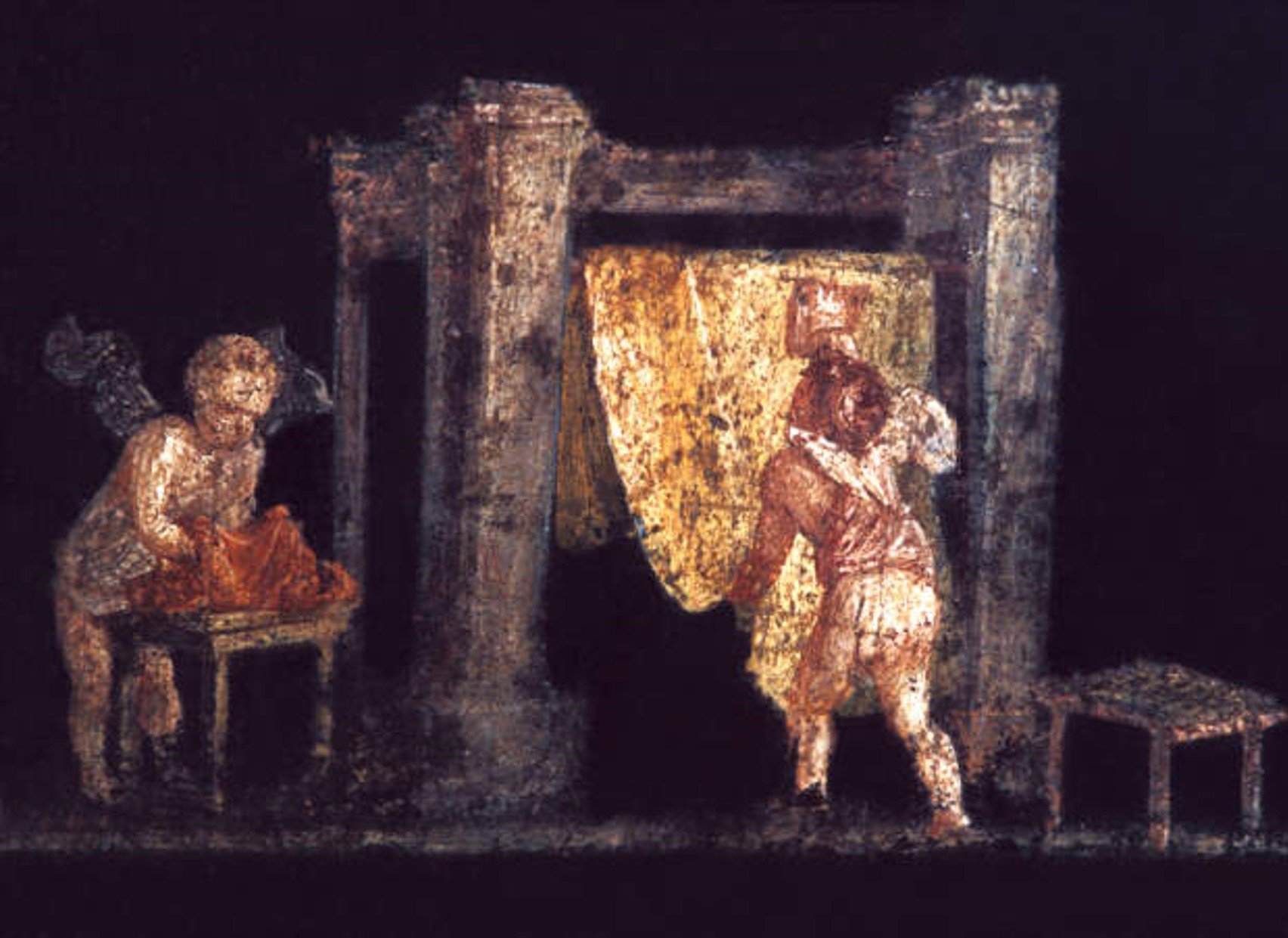
Putti hanging dyed cloth to dry (I think). From the Casa de Vettii in Pompeii, now at the Museo Archeologico Nazionale di Napoli.

Venerean Arts

Institute of Philosophy, Czech Academy of Sciences
November 29, 2022 by Sean Coughlin in Philosophy, Ancient Medicine

‘mulier recte olet ubi nihil olet’

I’ve not had much time to post recently. I’ve been working on starting up Alchemies of Scent and trying to finish a few articles and books. But I’m also getting into some material on perfumery and other arts associated with Aphrodite / Venus. I had some time to translate and find a nice photo, so I thought I would put it up.

In the Greco-Roman lineage of texts I work with, there are many references to arts and technology of elegance, luxury and playfulness. They include perfumery, dyeing, fine metal working, embroidery, garment making, garland weaving, and also singing and other arts associated with the symposium.

I’ve started referring to them as the arts of Venus, “the Venerean arts,” since Aphrodite / Venus seems to govern them in astrological texts. As a nice bonus, Eros and Psyche figure in the arts’ frescoes at the house of the Vettii in Pompeii, hinting at a connection beyond astrology.

Being a luxury art doesn’t usually carry positive connotations for the authors I study. Instead, they are associated with things these authors consider to be morally inferior or wrong: wealth, femininity, impermanence, vanity and untrustworthiness.

The association between these authors’ moral categories and the Venerean arts is likely one reason why these arts were attacked and mocked by so many Greek and Roman voices that have survived and by many people who have followed them.

For example, we’re told Solon proclaimed a law that forbade Athenian citizens from being perfumers [1]. Xenophon’s Socrates says men have no need of perfume beyond the scent of sweat and olive oil, while women have no need for any scent at all beyond what is natural [2]. Plautus, in his Ghost Story (the Mostellaria, perhaps an adaptation of an earlier Athenian play), has a character say, mulier recte olet ubi nihil olet —‘a woman smells best when she smells of nothing at all’ [3]. Seneca reports a saying that one can tell a scoundrel by the fact that he wears perfume [4]. Doctors like Athenaeus or Galen say that a luxurious lifestyle also involves unhealthy behaviours, where ‘unhealthy behaviours’ often map closely on to behaviours these same figures take to be morally wrong (the causal direction here is not always clear).

Such condemnations of the Venerean arts are pretty familiar from surviving philosophical and political writings of the period.

Despite these critiques, however, the markets continued and the arts themselves survived. Even if the promoters of Solon and Socrates would want to make it appear so, the interest in and demand for luxury goods seems not to have exclusively provoked moral concern. There are many other interesting aspects of such arts, including their place in the history of science.

Still, I think it’s interesting that so many critics of these arts survive and how loud they have been in Greco-Roman literature’s history. I’m curious why we don’t find more impartial or even positive discussions of them, as, e.g., in Theophrastus or Dioscorides. I’m also curious what the original context of the discusisons about luxury might have been, since it is not obvious, and it is perhaps even doubtful, that such critical views were held by everyone.

For now, though, I’m looking into the artists of elegance and luxury themselves: how were they seen and grouped together at different times and how did they see themselves?

One set of sources I’ve come across are 2nd century CE astrological writings—texts where Aphrodite is given provenance over certain arts and offices. The following two are in Greek language by authors from the eastern and southern Mediterranean.

Sources for Veneran Arts in Astrological Writings

Here is Vettius Valens, who was originally from Antioch and perhaps later worked in Egypt:

“Aphrodite is desire and love. She is a sign of motherhood and nurturing. She produces offices of priests, schoolmasters, those with a right to wear a gold ring, and those with the right to wear a crown; she produces cheerfulness, friendship, companionship, the acquisition of property, the purchase of ornaments, contracts on favourable terms, marriages, arts of elegance, fine voices, song writing, sweet melodies, shapeliness, painting, mixing of pigments in embroidery, dyeing, and perfumery, and the inventors or even masters of these crafts, craftsmanship or trade to do with working of emeralds, precious stones, and ivory; and along her boundaries and portions of the zodiac, she makes gold-spinners, gold workers, barbers, people fond of elegance, and people who love playfulness.”

Ἡ δὲ Ἀφροδίτη ἐστὶ μὲν ἐπιθυμία καὶ ἔρως, σημαίνει δὲ μητέρα καὶ τροφόν· ποιεῖ δὲ ἱερωσύνας, γυμνασιαρχίας, χρυσοφορίας, στεμματοφορίας, εὐφροσύνας, φιλίας, ὁμιλίας, ἐπικτήσεις ὑπαρχόντων, ἀγορασμοὺς κόσμου, συναλλαγὰς ἐπὶ τὸ ἀγαθόν, γάμους, τέχνας καθαρίους, εὐφωνίας, μουσουργίας, ἡδυμελείας, εὐμορφίας, ζωγραφίας, χρωμάτων κράσεις καὶ ποικιλτικήν, πορφυροβαφίαν καὶ μυρεψικήν, τούς τε τούτων προπάτορας ἢ καὶ κυρίους, τέχνας ἢ ἐμπορίας ἐργασίας σμαράγδου τε καὶ λιθείας, ἐλεφαντουργίας· οὓς δὲ χρυσονήτας, χρυσοκοσμήτας, κουρεῖς, φιλοκαθαρίους καὶ φιλοπαιγνίους αὐτοὺς ἀποτελεῖ παρὰ τὰ τῶν ζῳδίων αὐτῆς ὅρια καὶ τὰς μοίρας.

Vettius Valens, Anthologia 1.1.6 (3,16–26) (English)

And here is Ptolemy, from Alexandria:

“When Aphrodite causes someone’s profession, she makes them persons whose activities lie in the scents of flowers or of perfumes, in wines, pigments, dyes, spices, or adornments, as, for example, sellers of perfumes, weavers of garlands, innkeepers, wine-merchants, sellers of drugs, weavers, dealers in spices, painters, dyers, sellers of clothing.”

ὁ δὲ τῆς Ἀφροδίτης τὸ πράσσειν παρέχων ποιεῖ τοὺς παρ’ ὀσμαῖς ἀνθέων ἢ μύρων ἢ οἴνοις ἢ χρώμασιν ἢ βαφαῖς ἢ ἀρώμασιν ἢ κοσμίοις τὰς πράξεις ἔχοντας, οἷον μυροπώλας, στεφανοπλόκους, ἐκδοχέας, οἰνεμπόρους, φαρμακοπώλας, ὑφάντας, ἀρωματοπώλας, ζωγράφους, βαφέας, ἱματιοπώλας.

Ptolemy, Tetrabiblos 4.4.4

[1] Athen. Deipn. 15.34, 519 Kaibel (Greek | English)
[2] Xen. Symp. 2.3 (Greek | English)
[3] Plaut. Mostell. 1.3 273 (Latin | English)
[4] Sen. Ep. 86.11 (Latin | English)

November 29, 2022 /Sean Coughlin
Venerean arts, Vettius Valens, Ptolemy, Venus, Aphrodite, Athenaeus of Naucratis, Athenaeus of Attalia, Seneca, Xenophon, Plautus, Solon, Alexandria, luxury
Philosophy, Ancient Medicine
Comment

Pamphile changes into an owl while observed by Lucius and Photis. Illustration from Les Métamorphoses, ou l'Asne d'or de L. Apulée translated by de Montlyard, Paris, 1623, page 108. Image available from BNF.

The Metamorphosis of Pamphile

Institute of Philosophy, Czech Academy of Sciences
April 30, 2022 by Sean Coughlin in Ancient Medicine

Walpurgisnacht 2022. A mirror-story to Lucius’ metamorphosis.

“[Photis and I] spent a few nights in pleasure like this, until the day she ran to me, excited and trembling, to tell me that, because her mistress had not made any progress with her lovers by other means, she would turn herself into a bird at the first watch of the night and fly down to the object of her desire. I meanwhile was to get ready to observe such an event.

“After we had waited for the first watch of the night, Photis led me silent-footed to the upper bedchamber and suggested I look through the crack of the door to see what was happening.

“First, Pamphile completely undressed herself. Then, she opened a chest and took out a few small boxes. She removed the lid from one of them and poured out some perfume. She worked it for a while between her palms. Then she rubbed herself all over from the tips of her toes to the ends of her hair, and after whispering to her lamp a while in secret, her limbs began to tremble, quivering and shaking. As they began to swell, soft plumage and powerful wings burst out and took shape. Her nose hardened and curved, her toenails thickened into talons, and Pamphile became an owl. She let out screech, and after a few small attempts, she sprung from the ground and flew, her wings wide, out into sublime heights.”

Ad hunc modum transactis voluptarie paucis noctibus, quadam die percita Fotis ac satis trepida me accurrit indicatque dominam suam, quod nihil etiam tunc in suos amores ceteris artibus promoveret nocte proxima in avem sese plumaturam atque ad suum cupitum sic devolaturam; proin memet ad rei tantae speculam caute praepararem.

Iamque circa primam noctis vigiliam ad illud superius cubiculum suspenso et insono vestigio me perducit ipsa, perque rimam ostiorum quampiam iubet arbitrari quae sic gesta sunt.

Iam primum omnibus laciniis se devestit Pamphile et arcula quadam reclusa pyxides plusculas inde depromit, de quis unius operculo remoto atque indidem egesta unguedine diuque palmulis sui affricta ab imis unguibus sese totam adusque summos capillos perlinit, multumque cum lucerna secreto collocuta membra tremulo succussu quatit: quis leniter fluctuantibus promicant molles plumulae crescunt et fortes pinnulae, duratur nasus incurvus coguntur ungues adunci, fit bubo Pamphile. Sic edito stridore querulo, iam sui periclitabunda paulatini terra resultat, mox in altum sublimata forinsecus totis alis evolat.

Apuleius, Metamorphoses 3.21

April 30, 2022 /Sean Coughlin
witchcraft, perfume, Walpurgisnacht, Apuleius
Ancient Medicine
Comment

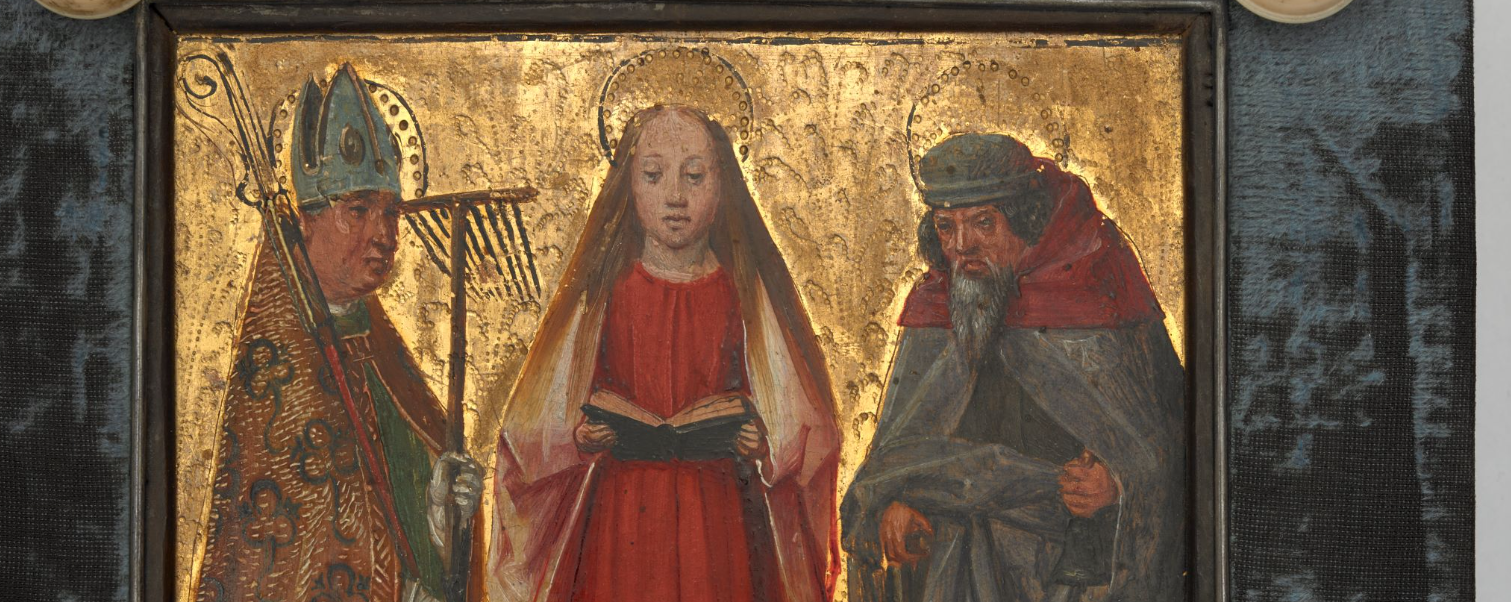
Likely St. Blaise, St. Agnes and St. Antony, at least according to this discussion on twitter. Blue silk binding with painting on wood. Egerton MS 809/1. 15th century. Front cover, inside. Via British Library.

Aetius of Amida on the Choking Cure of St. Blaise

Institute of Philosophy, Czech Academy of Sciences
February 03, 2022 by Sean Coughlin in Ancient Medicine

“[Treatment] for swallowing of a bone and for removing things that are stuck in the throat. Hold on to the patient with them sitting opposite you, and make them hold on to you. Say: ‘Come up, bone—whether you are a bone or a twig or anything else—just like Jesus Christ brought Lazarus up from the grave, and like Jonah was brought up out of the sea monster.’ Another. Cover the throat of the patient. Say: ‘Blaise, the martyr, the servant of god, says, ‘either rise up, bone, or go down.’”

Πρὸς ὀστοῦ κατάποσιν καὶ πρὸς ἀναβολὴν τῶν καταπειρομένων εἰς τὰ παρίσθμια. προσέχων τῷ πάσχοντι ἀνθρώπῳ ἄντικρυς καθεζομένῳ καὶ ποιήσας αὐτὸν προσέχειν σοι λέγε· ἄνελθε, ὀστοῦν, εἴτε ὀστοῦν ἢ κάρφος [<ϛ>] ἢ ἄλλο ὁτιοῦν, ὡς Ἰησοῦς Χριστὸς Λάζαρον ἀπὸ τοῦ τάφου ἀνήγαγε, καὶ ὡς Ἰωνᾶν ἐκ τοῦ κήτους. Ἄλλο. κατέχων τὸν λάρυγγα τοῦ πάσχοντος λέγε· Βλάσιος ὁ μάρτυς ὁ δοῦλος τοῦ θεοῦ λέγει· ἢ ἀνάβηθι, ὀστοῦν, ἢ κατάβηθι.

Aetius of Amida, Libri Medicinales 8.54

February 03, 2022 /Sean Coughlin
Aetius of Amida, spells, magic, religious therapy
Ancient Medicine
Comment

Above is Leiden Papyrus X at the Rijksmuseum van Oudheden. Third century. Image by Sailco via wikimedia commons cc-by-3.0.

A Myrrh and Iron Gall Ink from the Magical Greek Papyri

Institute of Philosophy, Czech Academy of Sciences
November 26, 2021 by Sean Coughlin in Ancient Medicine

A spell to make everyone love you, and one of the earliest recipes for iron gall ink. From Leiden Papyrus J 384, PGM 12 in Preisendanz’ collection of Magical Greek Papyri, perhaps 2nd or 3rd century CE.

“To be attractive and loveable forever. Take a root of pasithea or wormwood, and [on it] write this name in a holy way:

 
magic word
 

“Carry it and you will be attractive, loveable and extraordinary to those who look on you.

“The formula:

  • 1 drachma of myrrh

  • 4 drachmai of misy

  • 2 drachmai of vitriol

  • 2 drachmai of oak galls

  • 3 drachmai of gum arabic.”

προς επιχιρειαν[1] καὶ φιλεὶάν[2] δια παντος λαβων ριζαν πασιθεαν η αρτεμισιαν επιγραφε το □[3] τουτο αγνως [see image] και φορει και εση και επιχιρεις[4] και προσφιλης και θαυμαστος τοις ορωσι σοι.

ἡ ἀναγραφή· ζμύρνης δραχμὴ αʹ, μίσυος δραχμαὶ δʹ, χαλκάνθου δραχμαὶ βʹ, κηκίδων δραχμαὶ βʹ, κόμεως δραχμαὶ γʹ.

[1] ἐπιχάρειαν Pr. [2] φιλίαν Pr. [3] ὄνομα Pr. [4] ἐπίχαρις Pr.

P. Leid. J 384, col. 12, 24,13–16 Daniel = PGM XII 397–400 = old Leiden Papyrus V (English here)


Notes

For the first part of the text, I’ve transcribed Daniel’s edition (no accents for the most part or punctuation), but I’ve used Preisendanz’ edition for the formula. There’s some debate about what μίσυ (misy) and χάλκανθος (khalkanthos) refer to.

Misy. In Betz’ collection, Martin translates μίσυ as “truffle.” There is a kind of truffle called μίσυ mentioned in LSJ; but Preisendanz and Christiansen both suggest it refers to a substance found in mines, the misy mentioned by Dioscorides (5.100) and Pliny (34.121–122). Preisendanz translates as “Vitriolerz” (vol, 2, p.83), one term given in Pape, and which makes more sense. In a recent article, Thomas Christiansen (p. 184) suggests misy might be the decomposed iron sulfide contained in chalco-pyrites (CuFe2).

Khalkanthos. The word comes from χαλκός (copper) + ἄνθος (bloom). Pliny says it is prepared in Spain by collecting water from wells or mining pits, boiling it down, then putting it into a wooden reservoir and leaving cords to hang down into the water. Glass-like growths form on the cords and the are collected (34.123–124, English). He says it is known as atramentum sutorium in Latin, “shoemaker’s black,” and suggests the Greek term is evidence the substance is related to copper. Dioscorides also mentions there are different kinds of χάλκανθος, one of which, known as ἐφθόν (“boiled”) and prepared in Spain, was used to dye leather black. Christiansen (p. 182) points out this may indicate some confusion in the history of vitriols (sulfate compounds named after their glass-like appearance). After Razi, vitriols are distinguished into two kinds: blue and green. Blue vitriol corresponds roughly to copper (II) sulfate pentahydrate (CuSO4·5H2O) and green vitriol corresponds to iron (II) sulfate heptahydrate (FeSO4·7H2O). Before Razi, however, it seems they were not systematically distinguished either conceptually or physically. The substance is called “shoemaker’s black” because when combined with the tannin from oak galls used in tanning leather, the iron (II) would form a complex with the tannic acid, ferrous tannate, a black soluble pigment. When it dries, the complex reacts with oxygen in the air to form insoluble ferric tannate. This is the same reaction that makes iron gall inks so permanent. There’s a good wiki about this and lots online. I wrote about a different use of gall ink here: to write secret messages on eggs.

The first known occurence of a recipe for an iron gall ink is for an invisible ink. It’s from Philo of Byzantium, who writes about how to get secret messages out of a city under siege:

“The letters (sent by those under siege) are written in a new hat on the skin after crushing oak galls and soaking them in water. When dried, the writing becomes invisible, but if flower of copper is ground like ink in water and a sponge is soaked with it, when wiped with the sponge, they become visible.”

γράφονται δ' αἱ ἐπιστολαὶ εἰς καυσίαν καινὴν εἰς τὸν χρῶτα κηκῖδος θλασθείσης καὶ ὕδατι βραχείσης· ξηρανθέντα δὲ τὰ γράμματα ἄδηλα γίνεται, χαλκοῦ δὲ ἄνθους τριφθέντος ὥσπερ ἐν ὕδατι τὸ μέλαν καὶ ἐν τούτῳ σπόγγου βραχέντος, ὅταν ἀποσπογγισθῇ τούτῳ, φανερὰ γίνεται.

Philo of Byzantium, Belopoeica, ed. Diels and Schramm, 79

The AlchemEast team has written a great piece detailing their experiments replicating this recipe using blue and green vitriols.

Other observations

Myrrh. Christiansen thinks the myrrh here is not the raw resin, but ash from burnt resin. Burnt resins were used to make carbon inks, and this may be the case here; however, there is no mention in the recipe that the myrrh is burnt.

The Reaction. The reaction itself is pretty striking. Here's an example:


Oak gall and khalkanthos

 
November 26, 2021 /Sean Coughlin
magic, papyri, ink, oak gall
Ancient Medicine
1 Comment
Cambridge, sometime in February 2018.

Cambridge, sometime in February 2018.

Encouragement for the unwounded

Institute of Philosophy, Czech Academy of Sciences
November 03, 2021 by Sean Coughlin in Ancient Medicine

My friend died two weeks ago. It feels like yesterday and it feels like it didn’t happen. When I left at the end of August, she gave me Isherwood’s Goodbye to Berlin. The inscription said she hoped the title was inappropriate and that I would have not just one safe journey to Prague, but many. I have a postcard still to send her.

Below, a passage which she quoted in her book on the treatment of war wounds.

***

‘…Then the Macedonians turned the battle around against the barbarians and once they were defeated, they brought the city down on top of them. This was no help to Alexander, however. He was taken from the field along with the missile: the shaft of the arrow pierced his vital organs, and the arrow bound and fixed his breastplate to his body.

‘When they tried forcing it out from the root, as it were, of the wound, the iron would not yield to them. It was lodged in the solid part of his breast in front of the heart. They did not dare to saw off the part of the shaft that was projecting out for fear it would cause excruciating pain and a rush of internal bleeding if the bone were to be split by the force.

‘Having noticed the great difficulty and hesitation, Alexander himself tried to cut the arrow off close to his body using his dagger, but his hand was too weak and heavy with numbness due to the inflammation of the wound. So he encouraged them. He commanded the unwounded to take hold and not fear. He railed against those who were in tears with concern for him, while others he called out as deserters since they did not dare to help him. And to his companions he cried out: “Let no one be wretched on my account. It will not be believed that I do not fear death if you fear for my death.”’

ἐτρέψαντο μὲν οὖν τοὺς βαρβάρους οἱ Μακεδόνες, καὶ πεσοῦσιν αὐτοῖς ἐπικατέσκαψαν τὴν πόλιν. Ἀλεξάνδρῳ δ' οὐδὲν ἦν ὄφελος· <ἀν>ήρπαστο γὰρ μετὰ τοῦ βέλους, καὶ τὸν κάλαμον ἐν τοῖς σπλάγχνοις εἶχε, καὶ δεσμὸς ἦν αὐτῷ καὶ ἧλος τὸ τόξευμα τοῦ θώρακος πρὸς τὸ σῶμα. καὶ σπάσαι μὲν ὥσπερ ἐκ ῥίζης τοῦ τραύματος βιαζομένοις οὐχ ὑπήκουεν ὁ σίδηρος, ἕδραν ἔχων τὰ πρὸ τῆς καρδίας στερεὰ τοῦ στήθους· ἐκπρῖσαι δὲ τοῦ δόνακος οὐκ ἐθάρρουν τὸ προῦχον, ἀλλ' ἐφοβοῦντο, μήπως σπαραγμῷ σχιζόμενον τὸ ὀστέον ὑπερβολὰς ἀλγηδόνων παράσχῃ καὶ ῥῆξις αἵματος ἐκ βάθους γένηται. πολλὴν δ' ἀπορίαν καὶ διατριβὴν ὁρῶν αὐτὸς ἐπεχείρησεν ἐν χρῷ τοῦ σώματος ἀποτέμνειν τῷ ξιφιδίῳ τὸν οἰστόν· ἠτόνει δ' ἡ χεὶρ καὶ βάρος εἶχε ναρκῶδες ὑπὸ φλεγμονῆς τοῦ τραύματος. ἐκέλευεν οὖν ἅπτεσθαι καὶ μὴ δεδιέναι θαρρύνων τοὺς ἀτρώτους· καὶ τοῖς μὲν ἐλοιδορεῖτο κλαίουσι καὶ περιπαθοῦσι, τοὺς δὲ λιποτάκτας ἀπεκάλει, μὴ τολμῶντας αὐτῷ βοηθεῖν· ἐβόα δὲ πρὸς τοὺς ἑταίρους «μηδεὶς ἔστω μηδ' ὑπὲρ ἐμοῦ δειλός· ἀπιστοῦμαι μὴ φοβεῖσθαι θάνατον, εἰ τὸν ἐμὸν φοβεῖσθ' ὑμεῖς.»

Plutarch, On the Fortune of Alexander, Moralia 344F–345B

November 03, 2021 /Sean Coughlin
Alexander the Great, war, Death
Ancient Medicine
Comment
On to new seas. Aphrodite the Rescuer (Αφροδίτη Σώζουσα) and her crew. Fresco from a house in Pompeii, so around first century. Photo by Carole Raddato via Wikimedia Commons.

On to new seas. Aphrodite the Rescuer (Αφροδίτη Σώζουσα) and her crew. Fresco from a house in Pompeii, so around first century. Photo by Carole Raddato via Wikimedia Commons.

Pseudo-Alexander wonders why his friend Apollonius didn't ask him earlier to write a book

Institute of Philosophy | Czech Academy of Sciences
September 06, 2021 by Sean Coughlin in Ancient Medicine

I was recently moving to a new city, and I had promised myself that before I did I would finish a chapter I owed for a book (very late). This is basically the conversation that was going on in my head (I’m both people in this story):

“You asked me, Apollonius, best of Asclepiads, to give you a written version of my recent class lectures on fevers. That way, if you wanted to do some studying on fevers, you would have as it were a reminder of my lesson, especially now that I’ve decided to go abroad and will be far away from you, and you might not find anyone else who would so eagerly explain to you the secrets of medicine. I’m happy to do what you ask. In fact, I was prepared to produce a lesson for you had you asked for one, both lecture and notes, and not only on fevers, but on any other medical subject—just not now, when the other things I have to do before my trip are stressing me out and making it impossible to work on these kinds of things. But I would have done it before, namely when it was possible and I had time to write up the theory after your requested it. The study of fevers is, as you know, complex and difficult to study. Lots of time is required to get a hold on it and to write it down. And you agree that the work must be worthy of both you and me, otherwise it would be pointless for me to choose to write it up and you to choose to read it.

“In fact, in the end I had let go of the idea of doing it for these reasons, except that a certain saying of ancient men—a nice one—occurred to me and persuaded me that ‘one must do right by one’s friends, even if one must debase one’s art to meet their demands, and not hold back from this very thing.’ It then seemed right to me to put the present book together as a kind of introduction, and since I promise there will be another book on the whole theory of fevers at a suitable time later on, I offer you a reminder of true friendship by means of this discussion as deposit. And so let us comply with your request and say whatever the time allows us to say, not using the breadth of the art and our facility in discourse (if ever it existed), but making use rather of the brief time we have. But let’s be lenient with one another: you for <not> already asking me ages ago when it would have been easier to receive not an introduction but a long book on fevers; and me for not ever wanting to go against friends in any way.”

 ἤιτησας ἡμᾶς, Ἀσκληπιαδῶν ἄριστε, Ἀπολλώνιε, περὶ πυρετῶν σοι τοσαῦτα διὰ γραφῆς παραδοῦναι, ὅσα σχεδὸν πὰρ ἡμῖν φοιτῶντι διὰ γλώττης παρεδηλώσαμεν, ἵν' ὥσπερ ὑπόμνημα τῆς ἡμῶν εἴη σοι διδασκαλίας, βουλομένῳ περὶ πυρετῶν θεωρεῖν, καὶ μάλιστα νυνί, ὅτε καὶ ἀποδημεῖν ἡμεῖς ἐβουλευσάμεθα, καὶ μακρὰν ἀφ' ὑμῶν γενέσθαι, σὺ δὲ οὐκέτ' ἴσως ἕξεις τὸν οὕτω σοι προθύμως τὰ τῆς ἰατρικῆς διασαφήσοντα ὄργια. ἐγὼ μὲν οὖν ἕπεσθαί σοι ῥᾴδιος, ἐφ' ἃ κελεύεις αὐτός. καὶ μὴ ὅτι περὶ πυρετῶν, ἀλλὰ καὶ περὶ παντὸς ἄλλου θεωρήματος ἰατρικοῦ ἕτοιμος ἂν ἦν, σοῦ χάριν καὶ γλώττῃ καὶ γράμμασι διδασκαλίαν ποιήσασθαι, εἴγε μὴ νῦν, ὅτε πρὸς ἀλλ' ἄττα, τῆς ἐξόδου βιαζομένης, ἡμεῖς ἐπειγόμεθα, μὴ συγχωροῦντα τὴν περὶ τὰ τοιαῦτα σπουδήν, ἀλλὰ πρὸ καιροῦ, ὅτε δηλονότι οἷόν τε ἦν καὶ χρόνον ἡμῖν ἐγγενέσθαι μετὰ τὴν αἴτησιν πρὸς τὴν τοῦ θεωρήματος ξυγγραφήν, τὸ περὶ τούτων ὤφθης αἰτούμενος. πολυσχιδὴς γάρ, ὡς οἶδας, καὶ δυσθεώρητος ἡ περὶ πυρετῶν θεωρία καὶ πολλοῦ δεομένη χρόνου πρὸς κατάληψίν τε καὶ ξυγγραφήν· δεῖν δὲ καὶ αὐτὸς ἂν ξυμφαίης σαυτοῦ τε καὶ ἡμῶν αὐτῶν ἄξιον εἶναι τὸ σπουδαζόμενον, εἰ μὴ μάτην αὐτὸς μὲν γράφειν, σὺ δὲ ἀναγινώσκειν αἱρούμεθα.

καὶ εἴασα ἂν τελέως τοὐγχείρημα διὰ ταῦτα, εἰ μή τις λόγος παλαιῶν ἀνδρῶν καὶ καλῶς ἔχων ἐπῆλθε πείθων με, ὡς ἀνάγκη φιλίαις εἴκειν, κἂν δέῃ συγκατιέναι τὴν τέχνην, ἐπὶ ταῖς ἀξιώσεσι, μηδ' αὐτοῦ δὴ τούτου γε φείδεσθαι. ἀμέλει καὶ ἔδοξέ μοι, ὥσπερ ἐν εἰσαγωγῆς τρόπῳ, τὸ παρὸν συντάξασθαι σύγγραμμα, καὶ ἄλλο ἐπαγγελλόμενον περὶ τῆς ὅλης τῶν πυρετῶν θεωρίας, ἐν ἁρμόζοντι δῆθεν ἐσόμενον χρόνῳ, νυνὶ τουτί σοι ὡς ἐν ὑποθήκης ἐκδοῦναι λόγῳ, ἀκριβοῦς φιλίας ὑπόμνημα. καὶ δὴ λέγωμέν σοι πειθόμενοι, ἃ ἂν ὁ καιρὸς διδῷ, μὴ τῷ τῆς τέχνης πλάτει, καὶ τῇ ἡμετέρᾳ περὶ τὸ λέγειν, εἴ τίς ἐστιν, εὐπορίᾳ, τοῦ χρόνου δὲ μᾶλλον χρησάμενοι τῇ βραχύτητι. ἀμφοτέροις δὲ παρ' ἀμφοτέρων ἔσται συγγνώμη, σοὶ μὲν ἤδη πάλαι αἰτήσαντι, ὅτε μὴ εἰσαγωγήν, ἀλλὰ βίβλον μακρὰν <περὶ> πυρετῶν εἰληφέναι ῥᾴδιον ἦν, ἐμοὶ δὲ φίλοις ἐφ' ὁποιῳδηποτοῦν οὐκ ἀντιβαίνειν ἐθέλοντι.

Pseudo-Alexander of Aphrodisias, Fevers 1, 81–82 Ideler =1,1–2,12 Tassinari

September 06, 2021 /Sean Coughlin
pseudo-Alexander, fever, moving, back to school
Ancient Medicine
Comment
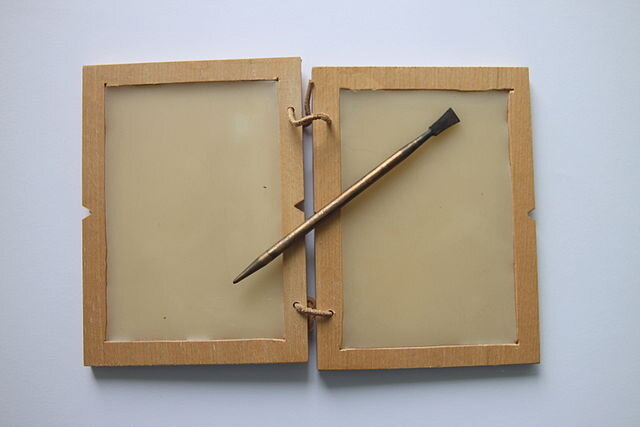
Writing tablet. Wiki says ‘Roman period’. Image by Peter van der Sluijs via wikimedia commons.

Writing tablet. Wiki says ‘Roman period’. Image by Peter van der Sluijs via wikimedia commons.

Literary Barbarism

Humboldt-Universität zu Berlin
August 13, 2021 by Sean Coughlin in Ancient Medicine, Philosophy

“For I do not think, as some of our contemporaries urge, that everyone ought to atticize in language, even if they happen to be doctors, philosophers, geometers, musicians, or lawyers, or none of these, but generally wealthy people or merely people of means. On the contrary—I don’t think it is a good thing to blame or censure anyone for solecising. It’s better to solecise and barbarize in words than in life.”

οὐ γὰρ δὴ τοῦτ' ἀξιοῦμεν ἡμεῖς, ὅπερ ἔνιοι τῶν νῦν κελεύουσιν, ἅπαντας ἀττικίζειν τῇ φωνῇ, κἂν ἰατροὶ τυγχάνωσιν ὄντες ἢ φιλόσοφοι καὶ γεωμετρικοὶ καὶ μουσικοὶ καὶ νομικοὶ κἂν μηδὲν τούτων ἀλλ' ἁπλῶς ἤτοι πλουτοῦντές τινες ἢ μόνον εὔποροι· τοὐναντίον γὰρ ἀπαξιῶ μηδενὶ μέμφεσθαι τῶν σολοικιζόντων τῇ φωνῇ μηδ' ἐπιτιμᾶν· ἄμεινον γάρ ἐστι τῇ φωνῇ μᾶλλον ἢ τῷ βίῳ σολοικίζειν τε καὶ βαρβαρίζειν.

Galen, On the Order of My Own Books 5 (19.60–61 K.)

August 13, 2021 /Sean Coughlin
Galen, bad style
Ancient Medicine, Philosophy
Comment
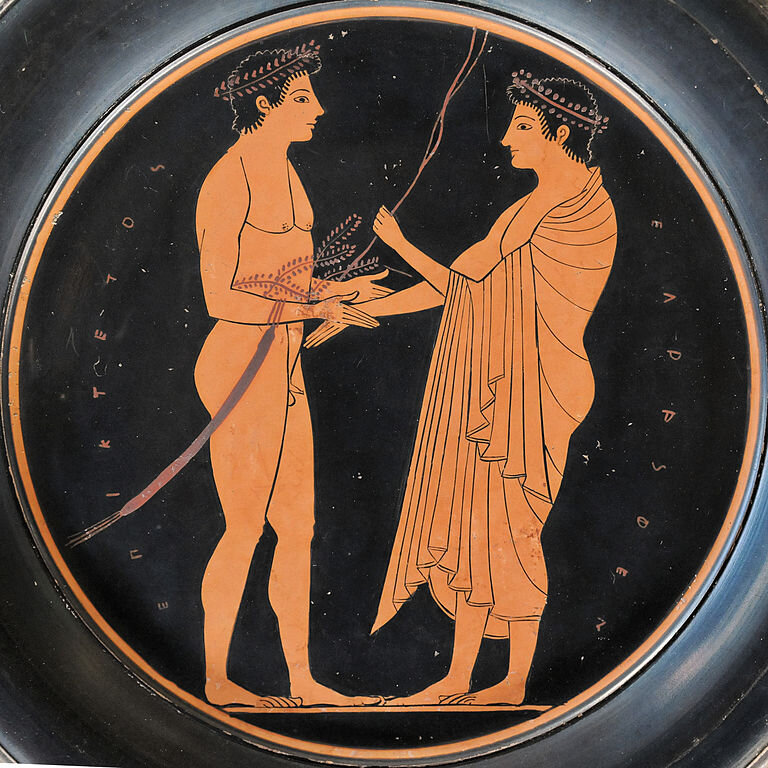
From the wiki: “Palaestra scene, tondo of an Attic red-figure plate by Epictetos, ca. 520 BC–510 BC, from Vulci.” Louvre. Image by Marie-Lan Nguyen via Wikimedia Commons.

From the wiki: “Palaestra scene, tondo of an Attic red-figure plate by Epictetos, ca. 520 BC–510 BC, from Vulci.” Louvre. Image by Marie-Lan Nguyen via Wikimedia Commons.

Galen on whether healthy living belongs to medicine or physical training

Humboldt-Universität zu Berlin
August 06, 2021 by Sean Coughlin in Ancient Medicine

“That’s why it amazes me when I hear athletes’ trainers these days arguing that healthy living is a part of their own art. In fact, it’s not a part of true physical training at all; rather, it’s the other way around: physical training is a part of healthy living. So why should we dispute about their false art, which is not at all a part of the art concerning the body and which sells a practice that’s held in contempt not only by Plato and Hippocrates, but also by all the other doctors and philosophers?”

ᾗ καὶ θαυμάζειν ἐπέρχεταί μοι τῶν νῦν τοὺς ἀθλητὰς γυμναζόντων, ὅταν ἀμφισβητούντων ἀκούσω μέρος εἶναι τῆς ἑαυτῶν τέχνης τὸ ὑγιεινόν. ὅπου γὰρ οὐδὲ τῆς ὄντως γυμναστικῆς μέρος ἐστὶν ἀλλ' ἔμπαλιν ἐκείνη μέρος ὑγιεινοῦ, τί χρὴ περὶ τῆς τούτων κακοτεχνίας ἀμφιβάλλειν, ἣ μήτε μέρος ἐστὶν ὅλως τῆς περὶ τὸ σῶμα τέχνης ἐπιτηδεύματός τε προέστηκεν οὐχ ὑπὸ Πλάτωνος μόνον ἢ Ἱπποκράτους, ἀλλὰ καὶ τῶν ἄλλων ἁπάντων ἰατρῶν τε καὶ φιλοσόφων ἀτιμαζομένου;

Galen, Thrasybulus: whether healthy living belongs to medicine or to gymnastics 47 (5.898 K. = 99,26-100,9 Helmreich)

August 06, 2021 /Sean Coughlin
hygiene, Exercise, Galen
Ancient Medicine
Comment
Mosaic from the Bath of Caracalla. 3rd or 4th century CE. Gregoriano Profano Museum at the Vatican. Image via the Vatican Museums.

Mosaic from the Bath of Caracalla. 3rd or 4th century CE. Gregoriano Profano Museum at the Vatican. Image via the Vatican Museums.

Bedside manner in Rome: some sayings attributed to the physician, Quintus

Humboldt-Universität zu Berlin
July 30, 2021 by Sean Coughlin in Ancient Medicine

“We still have to go through the subject of morning and evening massage—but oh my god not in the way Quintus did. They say that when a personal trainer asked him what virtue an oil massage has, he replied, ‘getting their clothes off.’ Those words—the ones I just used—they say are a direct quote of the trainer’s question and Quintus’ answer. There’s a similar saying attributed to Quintus that’s been going around, this one about urine: that ‘learning about it is a fuller’s job.’ Then there’s the one about hot, cold, dry and wet: that ‘those are words for bathhouse attendants.’ Now, I find it hard to believe even Thessalus, never mind Quintus, would say anything like these things. They’re all just stupid jokes, in no way appropriate for a man so educated in a serious art.”

Λείπεται οὖν ἔτι περὶ τῶν ἑωθινῶν τε καὶ κατὰ τὴν ἑσπέραν τρίψεων διελθεῖν, οὐ μὰ Δία οὕτως, ὥς φασιν ἀποκρίνασθαι Κόιντον ἐρομένῳ τινὶ γυμναστῇ, τίνα δύναμιν ἔχει τὸ ὑποσυγχρίεσθαι, φάμενον ἀφανίζειν τὰ ἱμάτια. τούτοις γὰρ τοῖς ὀνόμασιν, οἷς ἐγὼ νῦν ἐχρησάμην, ἐρέσθαι τε λέγουσι τὸν γυμναστὴν ἀποκρίνασθαί τε τὸν Κόιντον. ὅμοιόν τι τοῦ Κοίντου περιφέρεται ἀπόφθεγμα τό τε περὶ τῶν οὔρων, ὡς γναφέως ἐστὶ καταμανθάνειν αὐτά, καὶ τὸ περὶ θερμοῦ, ψυχροῦ, ξηροῦ καὶ ὑγροῦ, διότι βαλανέων ἐστὶν ὀνόματα ταῦτα. ἃ ἐγὼ μὲν οὐκ ἂν πεισθείην, μὴ ὅτι Κόιντον, ἀλλ' οὐδὲ τῶν ἀπὸ Θεσσαλοῦ τινα φθέγξασθαι· βωμολοχικὰ γὰρ ἅπαντ' ἐστὶ τὰ τοιαῦτα κομψεύματα καὶ οὐδαμῶς ἀνδρὶ προσήκοντα σεμνῆς οὕτω τέχνης ἐπιστήμονι.

Galen, On Matters of Health 3.13, (6.228 K. = 100,27–101,5 Koch)

July 30, 2021 /Sean Coughlin
Galen, Quintus, oils, apophthegmata
Ancient Medicine
Comment
  • Newer
  • Older
 

CATEGORIES

  • Ancient Medicine
  • Botany
  • Events
  • Philosophy

SEARCH


RECENT POSTS

Featured
Mar 16, 2026
Ancient Medicine
“It is not as if the womb creeps out of its lair like a wild animal” — Soranus on the ancients on scented materials and women's medicine
Mar 16, 2026
Ancient Medicine
Mar 16, 2026
Ancient Medicine
Dec 31, 2025
Botany, Philosophy
Concerning a Variant in the de Fuentes Manuscript
Dec 31, 2025
Botany, Philosophy
Dec 31, 2025
Botany, Philosophy
Dec 25, 2025
Ancient Medicine
How to smell nice: Galen's advice for doctors
Dec 25, 2025
Ancient Medicine
Dec 25, 2025
Ancient Medicine
Dec 23, 2025
Ancient Medicine
More on how not to talk to patients
Dec 23, 2025
Ancient Medicine
Dec 23, 2025
Ancient Medicine
Dec 13, 2025
Ancient Medicine
"Patroclus died as well" (How Not to Talk to Patients)
Dec 13, 2025
Ancient Medicine
Dec 13, 2025
Ancient Medicine