Ancient Medicine

  • Home
  • About
  • Contact

Frontispiece to the 1580 edition of Jean Bodin’s On the Demon-Mania of Witches. Image via wikimedia commons.

Fire and water: Jean Bodin’s use of ancient medicine to justify the murder of women for crimes of witchcraft

April 30, 2021 by Sean Coughlin in Ancient Medicine, Philosophy

Walpurgisnacht, 2021

I despise Jean Bodin (c.1530–1596) more than just about any other philosopher. I usually like to stay impartial, focusing my energy instead on trying to understand why someone held certain beliefs or made a particular argument rather than thinking about what that person might have been like. Not with Bodin.

Bodin had people tortured and burned alive for witchcraft (he presided over trials as a judge and especially sought out women as victims). He wrote a work to strengthen the legitimacy of witch trials, trials which almost everyone agreed relied on evidence that would be inadmissible or at least dubious in normal circumstances. And he relentlessly attacked anyone who tried to argue against the state-sanctioned murder of women, people like Johann Weyer (1515–1588), a Dutch doctor and student of Agrippa, who argued (following a long pagan and Christian tradition) that crimes such as those in Bodin’s fantasies were not humanly possible, or at least that there were far more plausible explanations for them (Weyer says the Malleus Maleficarum, the Hammer of the Witches, another dark chapter of humanity, written by the inquisitor Heinrich Kramer around 1486 and later also attributed to Jacob Sprenger, is basically a work of “silly and often godless absurdities”).

In fact, Bodin literally stopped the press on his own book, On the Demon-Mania of Witches (De la démonomanie des sorciers, 1580), when he received a copy of Weyer’s book, On Witches (De lamiis, 1577; lamiae is an old name that was appropriated for the early modern incarnation of the witch) so that he could add an appendix attacking Weyer’s humanist arguments against burning people alive for crimes like flying through the air or fucking Satan.

I wanted to reflect a bit on this text for Walpurgisnacht, since I find Bodin’s arguments— both in their rhetoric (“Weyer is either ignorant or evil, and he’s been to university, so he is not ignorant”) and in their speciousness (“women can’t be melancholic because Hippocrates says so, therefore the only remaining possibility is that they are witches”)—sound a lot like the fanatical rhetoric I’ve come across more and more since the start of this century. Sometimes it feels as if, like global warming, it keeps getting worse.

This fanaticism is one of the qualities of his work that makes it extremely difficult for me to consider him as just another “man of his time.” He may be indistinguishable from his contemporaries as a believer in demons and witchcraft. But why does this matter? Belief in witchcraft doesn’t make you a loathsome piece of shit. Appealing to that belief when burning people alive and saying it is for their own good does. Mind you, not everyone at the time did this, and believe it or not, it wasn’t only because these non-murderers were either witches or afraid of them. It strikes me as far too apologist a position to take to say he was not alone in holding beliefs we find unlikely to be true. Try to understand his arguments, even if they are difficult, but don’t think a common belief in demons or witchcraft is reason enough to explain them.

There’s this point in his appendix against Johann Weyer where he calls Weyer a fanatic. It’s as if Bodin knows his own position is fanatical and so he makes sure to accuse his opponent of it first. His reasons couldn’t be less convincing. He thinks Weyer is a fanatic because Weyer says women tried as witches were more likely to be melancholic than in league with Satan. Weyer is a medical doctor. His opinion is the considered opinion of one who has trained professionally for a lifetime. Bodin, however, thinks that to refute Weyer, it’s enough to quote Hippocrates and Galen, as if some 1000-year-old shit he read in Greek class makes him an expert. Weyer may have been wrong, but a contemporary doctor is a better judge of this than a theologian and jurist.

Weyer wasn’t alone in thinking a non-demonic explanation might be in order. In Bodin’s own France, Montaigne was wondering the same thing:

“‘Tis now some years ago that I travelled through the territories of a sovereign prince, who, in my favour, and to abate my incredulity, did me the honour to let me see, in his own presence, and in a private place, ten or twelve prisoners of this kind, and amongst others, an old woman, a real witch in foulness and deformity, who long had been famous in that profession. I saw both proofs and free confessions, and I know not what insensible mark upon the miserable creature: I examined and talked with her and the rest as much and as long as I would, and gave the best and soundest attention I could, and I am not a man to suffer my judgment to be made captive by prepossession. In the end, and in all conscience, I should rather have prescribed them hellebore than hemlock;

Captisque res magis mentibus, quam consceleratis similis visa;

[‘The thing seemed to resemble minds possessed rather than guilty.’ Livy, viii, 18.]

“Justice has its corrections proper for such maladies. As to the oppositions and arguments that worthy men have made to me, both there, and often in other places, I have met with none that have convinced me, and that have not admitted a more likely solution than their conclusions. It is true, indeed, that the proofs and reasons that are founded upon experience and fact, I do not go about to untie, neither have they any end; I often cut them, as Alexander did the Gordian knot. After all, ‘tis setting a man’s conjectures at a very high price upon them to cause a man to be roasted alive.”

Michel de Montaigne, “Of Cripples” (Des boyteux), Essays III 11 (first published 1580), trans. Charles Cotton

Unlike Weyer or Montaigne, I’m skeptical that something disturbed in the mind of the accused was ever behind accusations of witchcraft. I think another observation of Montaigne is more likely, where he says “[t]he witches of my neighbourhood run the hazard of their lives upon the report of every new author who seeks to give body to their dreams.” The fantasies were probably not in the minds of the victims.

I agree with them, however, that Bodin’s unshakeable and certain belief, and the belief of fanatics like him, in shit like flying through the fucking air to copulate with devils and destroying some crops along the way was completely unwarranted even by the standards of knowledge professed by “all the ancient philosophers and doctors” whom Bodin pretends to admire. And honestly, even if they did fly through the air, isn’t this all a misdirection? At what point was the severity and inhumanity of the punishment simply allowed to slip in there unargued?

I’m going on too long. Here’s a translation of a part of Bodin’s attack against Weyer. I transcribed the text as well, but I’m sure I’ve made mistakes in the transcription. Best to use the new critical edition. The original is here. At this point, Bodin brings in his reading of Hippocrates, Galen and Aristotle to explain why the doctor, Johann Weyer, is wrong about medical topics. Bodin’s implication is that Weyer knows these things but is lying because he is on the devil’s side. I’m not kidding.

One might keep in the back of one’s mind that Bodin himself could be dissembling: he might not believe the witch stuff either, but think it is politically expedient, maybe to preserve certain political alliances, or to bolster the legitimacy of a mechanism for terrorizing people for political ends. But to be honest, I do not know enough about Bodin or the political situation in 16th century Europe to be able to say much about the why of his statements. I just know I hate the man.

I based my translation on the one found in Monter’s European Witchcraft (online here), which is what I use when I teach this.

There’s one more thing: Bodin mentions a trial of Jeanne Harvilliers. This is a reference to an earlier part of the book. Bodin was one of the judges in her trial: he questioned her, tortured her, and sentenced her to death for having sexual intercourse with the devil. She’s known as the “witch of Ribemont” (la sorcière de Ribemont). A television movie was made about this in the 70s. The Wikipedia entry on it contains a philologically interesting quotation about her last words. I’ll post about it next week.


Jean Bodin, “Refutation of the Opinions of Johann Weyer”, On the Demon-Mania of Witches, 1580, fol. 225v-227v

[Johann] Weyer agrees that witches are in communication and pacts with devils, and that they do many wicked things with the help of the devil. Nevertheless, in his book On Witches (De lamiis), at one point he says that no compact exists, at another that one could not prove it exists, at another that the confessions of witches are not to be believed, at another that they trick themselves into thinking that they have done what they say and that they are possessed by the melancholic disease. This is the disguise that ignorant people or sorcerers have used in order to help their familiars escape and increase the reign of Satan.

Until now, those who have said it was melancholia may not have believed that demons exist, nor, perhaps, that any angels exist, nor even any god. But Weyer confesses that there is a god (as also the devils confess and tremble beneath his power as we read in scripture). He also confesses throughout his writings that there are good and bad spirits that conspire and make pacts with men. One must not, therefore, attribute the transportation, bad deeds and strange actions of witches to melancholia. Much less should one make women melancholics. For antiquity has noted a peculiar fact: that no woman ever died of melancholia nor any man of extreme joy, but on the contrary many women have died of extreme joy.

And because Weyer is a doctor, he cannot ignore that the humour of women is directly contrary to the dryness of melancholia from which the madness arises, whether it comes from dry, yellow bile or from melancholic fluid, as doctors agree. For both arise from excessive heat and dryness as Galen says in On Black Bile (*melan=black, chole=bile). Women, on the other hand, are naturally cold and wet, as the same author says, and all the Greeks, Latin and Arabs agree on this very point. For this reason, Galen also says that a man, having a hot and dry mixture, when in a hot and dry region, he can fall into the melancholic disease.

At any rate, Olaus the Great, Caspar Peucer, Saxo Grammaticus and Weyer himself agree with all the Inquisitors of witches in Germany that below the arctic region where the sea is frozen, in Germany and the mountains of the Alps and of Savoy – all these regions are full of witches. It is also certain that northern peoples have as little melancholia as the people of Africa have phlegm. For one sees that all northern people are white, with green eyes, blond hair, and slender, the face red, joyous and talkative, things totally contrary to the melancholic humour.

In addition, Hippocrates in the first book of the Epidemics and Galen in the same book holds that women are generally healthier than men because of their menstrual flow which protects them from a thousand diseases. Never, says Hippocrates, have women suffered gout, ulcerations of the lungs, adds Galen (in the book On Venesection), epilepsy, apoplexis, phrenesis, lethargy, convulsions, or tremblings while they have their “flows”, or, to put it better, their menstruation and flows. And although Hippocrates says that seizures (including those caused by demonic possession, which is called the sacred disease) are natural, nevertheless he maintains that these happen only to the phlegmatic and not at all to the bilious—something Johann Weyer, being a doctor, cannot ignore.

So, we have shown that women are normally more often demoniacal than men, and that witches are often transported in body, and also often ravished in ecstasy, their souls being separated from their bodies, by means of something diabolical, leaving the body insensible and stupid.

It is even more ridiculous to say that the illness of witches comes from melancholia, seeing that illnesses arising from melancholia are always dangerous. Nevertheless, one sees witches who have practiced this occupation for 40 or 50 years, and from the age of 12, like Jeanne Harvilliers, who was burned alive on the 29 April 1578*, and Magdalena de la Cruz, Abbess of Cordoba in Spain, 1545, having had ordinary acquaintance and sexual intercourse with the devil, which lasted 40 years in the first case, and 30 in the other. It is necessary, therefore, that Weyer admit that it is a notable incongruity in him as a doctor, and an ignorance far too gross (but it is not ignorance) to attribute melancholic diseases to women, which are as little compatible with them as the praiseworthy affections of a temperate melancholic humour, affections which make men wise, serious, contemplative (as all the ancient philosophers and doctors have remarked) — qualities as little compatible with women as fire with water. And Solomon himself, who also clearly recognized the humour of women (that man of the world) said that among a thousand men he saw one that was wise, but among women he did not see a single one. Let us put aside, therefore, the fanatical error of those who make women melancholics.

What’s more, Weyer—seeing that his cloak of melancholia was removed by demonstration and self-evident truth with respect to divine and human law, and by so many stories from all the peoples of the earth, and by so many confessions, some voluntary, some forced, and so many judgments, convictions, condemnations, and executions performed for 3,000 years in every country in the world—he offered a ruse much too gross to prevent sorcerers from being put to death, saying that the devil seduces the witches and makes them believe that they are doing what he does himself.

In doing this, he pretends that he is very much against Satan; however, he saves the sorcerers, which is plainly just to mock Satan with words, but in reality establish his grandeur and his power. For he knows well that the magistrates do not have any jurisdiction nor power to seize the devils. This will not only absolve witches, but also all the murderers, thieves, and perpetrators of incest or parricide, who are compelled by the enemy of the human race to carry out their deeds. Then he offers high praise to the tax of the Papal Camera, which condemns repentant witches to pay two ducats for a pardon; and in another place he says that he maintains not only that witches should not be punished with death by the law of god, but also that there is no mention of witches in holy scripture by which he could be easily convinced. Here I call on god and his law as witness, and 1000 passages from the Bible to convince this man.

Car Wier (I. lib.2.c.4. et 8. et 34. et lib.4 c.14. et lib.5.cap.9 de Praestigiis, et Saepe alibi.) est d'accord que les Sorcieres ont communication, et paction avec les Diables, et qu'elles font beaucoup de meschancetés à layde du Diable, et neantmoins au livre de lamiis, il dict tantost qu'il ny a point de paction, et tanost qu'on ne sçauroit le prouver, tantost qu'il ne faut pas croire la confession des Sorcieres, et qu'elles s'abusent de penser faire ce qu'elles disent, et que c'est la maladie melancholique qui les tient. Voila la couverture que les ignorans, ou les Sorciers ont prise pour faire evader leurs semblables et accroistre le regne de Sathan. Par cy devant ceux qui ont dict que c'estoit la melancholie, ne pensoyent pas qu'il y eust des Demons, ny peut estre qu'il eust des anges, ny Dieu quelconque. Mais Wier confesse qu'il y a un Dieu (commes les Diables le confessent aussi, et tremblent soubz sa puissance, ainsi que nous lisons en l'escripture (Epistola Jacobi c.2)) il confesse aussi par tous ces escripts qu'il y à de bons, et malins esprits qui ont intelligence, et paction avec les hommes. Il ne falloit donc pas attribuer les transports des Sorciers, leurs malefices, et actions estranges à la melancholie, et beaucoup moins faire les femmes melancholiques, veu que l'antiquité à remarqué pour chose estrange, que jamais femme ne mourut de melancholie, ny l'homme de joye extreme, ains au contraire plusieurs (Pline liv. 7. Valere Mox. Solin.) femmes meurent de joye extreme, et puisque Wier est medecin il ne peut ignorer, que l'humeur de la femme ne soit directemeut contraire à la melancholie aduste, dont la fureur procede, soit qu'elle vienne à bile flana adusta, aut à succo melancholico, comme les medecins demeurent d'accord. Car l'un et l'autre procede d'une chaleur, et secheresse excessive comme dict Galen au livre de atra bile. Or les femmes naturellment sont froides et humides comme dict le mesme autheur, et tous les Grecs, Latins, et Arabes, s'accordent en ce point icy. Et pour cette cause Galen (in liv. de atra bile) dit aussi que l'homme estant d'un temperament chaut, et sec, en region chaude et seche, et en esté tombe en la maladie melancholique, et neantmoins Olavs le grand, Gaspar Peucerus, Saxo Grammatic, et Wier mesmes est d'accord avec tous les inquisiteurs des Sorcier d'Allemaigne que souz la region arctique, ou la mer glace, et en Allemaigne et aux mons des alpes, et de Savoye tout est plein de Sorcieres. Or est il certain que les peuples de Septentrion tiennent aussi peu de la melancholie, comme les peuples d'Afrique de la pituité. Car on voit tous les peuples de Septentrion blancs, les yeux vers, les cheveux blondz, et desliez, la face vermeille, joyeux et babilardz, chose du tout contraire à l'humeur melancholique. D'avantage Hippocratte au premier livre des maladies populaires, et Galen au mesme livre tiennent que les femmes generallement sont plus saines que les hommes, pour les flueurs menstruales, qui les garantissent de mille maladies. Jamais, dict Hippocrate, les femmes n'ont la goute, ny ulceratione de poulmons, dict Galen (in libro de Vena Sectione), ny d'epilepsies, ny d'apoplexies, ny de frenesies, ny de lethargies, ny de covulsions, ny de tremblement tant qu'elles ont leurs flueurs, ou pour mieux dire leurs menstruës, et flueurs. Et combien que Hippocrate (in libro de Mobrbo Sacro) dict que le mal-caduc, et de ceux qui estoyent assiegés des Demons, qu'on appelloit maladie sacree, est naturelle: neantmoins il soustient, que cela n'advient sinon aux pituiteux, et non point aux bilieux: ce que Jean Wier estant medecin, ne pouvoit ignorer. Or nous avons monstré que les femmes ordinairement sont demoniaques plustost que les hommes, et que les Sorcieres sont transportees souvent en corps, et souvent aussi ravies en ectase, estant l'ame separee due corps, par moyens diaboliques, demeurant le corps insensible, et stupide. Encores est il plus ridicule de dire, que la maladie des Sorcieres provient de melancholie, veu que les maladies procedans de la melancholie, sont tousiours dangereuses (Galen, in lib. de atra bile). Neantmoins on void des Sorcieres, qui ont fait ce mestier quarante, ou cinquante ans, et de l'aage de douze ans, comme Jeanne Haruilier, qui fut bruslee vive le vigntneufiesm Avrile, mil cinq cens septante huict (1578), et Magdaleine de la Croix, Abbesse de Cordouë en Espaigne, mil cinq cens quarante cinq (1545), avoyent eu accointance ordinaire, et copulation avec le Diable, qui dura quarante ans à l'une, et trente à l'autre. Il faut donc que Wier confesse que c'est une incongruité notable à luy qui est Medecin, et ignorance par trop grossiere: (mais ce n'est pas ignorance) d'attribuer aux femmes les maladies melancholiques, qui leur conviennent aussi peu que les effects loüables de l'humeur melancholique temperé, qui rend l'homme sage, posé, contemplatif, (comme tous les anciens Philosophes et Medecine on remarqué (Aristot. in Proble. sectio. 30.princip.)) qui sont qualités aussi peu compatible avec la femme, que le feu avec l'eau. Et mesmes Salomon qui cognoissoit aussi bien l'humeur des femmes, que homme du monde, dit qu'il à veu de mil (in proverbiis.) hommes un sage, mais de femmes qu'il n'en à pas veu une seule. Laissons donc l'erreur fanatique de ceux qui font les femmes malancholiques. Aussi Wier voyant que son voile de melancholie estoit descouvert par la demonstration et verité apparente partant de loix divines et humaines, par tant d'histoires de tous les peuples de la terre, par tant de confessions les unes volontaires, les autre forcees, part tant jugemens, de convictions, de condamnations, d'executions faites depuis trois mille ans en tous les pays du monde, il c'est advisé d'une ruse trop grossiere, pour empecher qu'on face mourir les Sorciers, disant (9.cap.4 et ca.ult. de Lamiis) que le Diable seduict les Sorcieres, et leur faict croire qu'elles font ce que luy mesme faict. Et en ce faisant il fait semblant, qu'il est bien fort contraire à Sathan, et ce pendant il sauve les Sorciers: qui est en bons termes se jouer avec Sathan de parolles, et en effect establir sa grandeur, et sa puissance. Car il sçait bien que les magistrats n'ont point de Jurisdiction ny de main mise sur les Diables. Que n'est pas seulement absoudre les Sorciers, ains aussi tous les meurtriers, voleurs, incestueux, et parricides, qui sont poussés par l'ennemy du genre humain à faire ce qu'ils font. Puis il loue grandement (4.cap.24. de Lamiis) la taxe de la chambre du Pape, qui condamne les Sorcieres repenties à deux ducats pour le paron: et en autre (5.lib.2.c.335 de Praestig.) lieu il dit que s'il soustenoit que non seulement les Sorcieres ne doyvent estre punies à mort par la Loy de Dieu, ains aussi qu'il n'est faicte aucune mention des Sorcieres en la S. Escripture, qu'il ne peut estre conveincu facilement. Icy j'appelle Dieu, et sa loy en tesmoignage, et mille passages (6. Exod.ca.7. et 8. et 9. et 20. Deutero. ca.18 et 4. Reg. c.9. et 21. et 23. et. 2.Parali.33. et Jefa.ca.34 et Jesa. ca. 34. et 8. et 47. Daniel.cap.2. Miche.c.3. et cap.5. Ezechiel ca.13. Num.ca.23. Hierem. ca. 19. et 23. et 27. et 50. et Acto. cap.16. Nahum. c.3.) de la Bible pour convaincre cest homme.

April 30, 2021 /Sean Coughlin
witchcraft, Jean Bodin, Johann Weyer, Galen, Hippocrates, melancholy, humours, demons, Walpurgisnacht
Ancient Medicine, Philosophy
Comment

Plato’s Academy. Roman mosaic, 1st c. CE, house of T. Siminius Stephanus in Pompeii. Now at the Museo Nazionale Archeologico in Naples. Image by Jebulon via Wikimedia Commons.

Aristotle's Library

Humboldt-Universität zu Berlin
April 23, 2021 by Sean Coughlin in Philosophy

Here’s the story of what happened to Aristotle’s library after he died. From Strabo:

“From Skepsis came the Socratic philosophers Erastos, Koriskos and Neleus, Koriskos’ son , a man who was a student of both Aristotle and Theophrastos and who inherited the library of Theophrastos, which also included that of Aristotle; in fact, Aristotle had left his library to Theophrastos, to whom he also left his school, being the first person I’m aware of who collected books and who taught the Egyptian kings to arrange a library.

“Theophrastos left it to Neleus and having brought it to Skepsis, he left it to his descendants, common people who kept the books locked up without having stored them carefully. When, however, they became aware of how eagerly the Attalid kings to whom the city belonged were seeking books to add to the collection of the library in Pergamom, they concealed them underground in a kind of ditch. At some point after a long time, when they had become ruined by moisture and bookworms, his descendants sold the books of Aristotle and Theophrastos to Apellikon of Teos for a large amount of silver. Apellikon, however, was a lover of books more than a lover of wisdom, and that’s why when he sought to restore what had been eaten, he made new copies of the writing without filling things in very well and he published the books full of errors.

“The result of all this way that the ancient Peripatetics, those after Theophrastos, who basically didn’t have any books except for a few mainly exoteric ones, could not philosophize about anything in a practical way, but could only speak theses into perfume bottles (as it were); those who, on the other hand, came after the books re-appeared, they could philosophize and aristotelize better than the others, but were nevertheless compelled to say most things were likelihoods because of the great number of errors [in the texts].

“Rome contributed a lot to this too. For right after the death of Apellikon, Sulla carried off Apellikon’s library having seized Athens; and when it arrived in Rome, the grammarian Tyrannion—a fan of Aristotle—got hold of it by flattering the librarian; certain booksellers did, too, who used bad copyists and did not collate the texts, which happens in other cases, too, when books are copied for sale, both here and in Alexandria. But that’s enough about this.”

ἐκ δὲ τῆς Σκήψεως οἵ τε Σωκρατικοὶ γεγόνασιν Ἔραστος καὶ Κορίσκος καὶ ὁ τοῦ Κορίσκου υἱὸς Νηλεύς, ἀνὴρ καὶ Ἀριστοτέλους ἠκροαμένος καὶ Θεοφράστου, διαδεδεγμένος δὲ τὴν βιβλιοθήκην τοῦ Θεοφράστου, ἐν ᾗ ἦν καὶ ἡ τοῦ Ἀριστοτέλους· ὁ γοῦν Ἀριστοτέλης τὴν ἑαυτοῦ Θεοφράστῳ παρέδωκεν, ᾧπερ καὶ τὴν σχολὴν ἀπέλιπε, πρῶτος ὧν ἴσμεν συναγαγὼν βιβλία καὶ διδάξας τοὺς ἐν Αἰγύπτῳ βασιλέας βιβλιοθήκης σύνταξιν.

Θεόφραστος δὲ Νηλεῖ παρέδωκεν· ὁ δʼ εἰς Σκῆψιν κομίσας τοῖς μετʼ αὐτὸν παρέδωκεν, ἰδιώταις ἀνθρώποις, οἳ κατάκλειστα εἶχον τὰ βιβλία οὐδʼ ἐπιμελῶς κείμενα· ἐπειδὴ δὲ ᾔσθοντο τὴν σπουδὴν τῶν Ἀτταλικῶν βασιλέων ὑφʼ οἷς ἦν ἡ πόλις, ζητούντων βιβλία εἰς τὴν κατασκευὴν τῆς ἐν Περγάμῳ βιβλιοθήκης, κατὰ γῆς ἔκρυψαν ἐν διώρυγί τινι· ὑπὸ δὲ νοτίας καὶ σητῶν κακωθέντα ὀψέ ποτε ἀπέδοντο οἱ ἀπὸ τοῦ γένους Ἀπελλικῶντι τῷ Τηίῳ πολλῶν ἀργυρίων τά τε Ἀριστοτέλους καὶ τὰ τοῦ Θεοφράστου βιβλία· ἦν δὲ ὁ Ἀπελλικῶν φιλόβιβλος μᾶλλον ἢ φιλόσοφος· διὸ καὶ ζητῶν ἐπανόρθωσιν τῶν διαβρωμάτων εἰς ἀντίγραφα καινὰ μετήνεγκε τὴν γραφὴν ἀναπληρῶν οὐκ εὖ, καὶ ἐξέδωκεν ἁμαρτάδων πλήρη τὰ βιβλία.

συνέβη δὲ τοῖς ἐκ τῶν περιπάτων τοῖς μὲν πάλαι τοῖς μετὰ Θεόφραστον οὐκ ἔχουσιν ὅλως τὰ βιβλία πλὴν ὀλίγων, καὶ μάλιστα τῶν ἐξωτερικῶν, μηδὲν ἔχειν φιλοσοφεῖν πραγματικῶς, ἀλλὰ θέσεις ληκυθίζειν· τοῖς δʼ ὕστερον, ἀφʼ οὗ τὰ βιβλία ταῦτα προῆλθεν, ἄμεινον μὲν ἐκείνων φιλοσοφεῖν καὶ ἀριστοτελίζειν, ἀναγκάζεσθαι μέντοι τὰ πολλὰ εἰκότα λέγειν διὰ τὸ πλῆθος τῶν ἁμαρτιῶν.

πολὺ δὲ εἰς τοῦτο καὶ ἡ Ῥώμη προσελάβετο· εὐθὺς γὰρ μετὰ τὴν Ἀπελλικῶντος τελευτὴν Σύλλας ἦρε τὴν Ἀπελλικῶντος βιβλιοθήκην ὁ τὰς Ἀθήνας ἑλών, δεῦρο δὲ κομισθεῖσαν Τυραννίων τε ὁ γραμματικὸς διεχειρίσατο φιλαριστοτέλης ὤν, θεραπεύσας τὸν ἐπὶ τῆς βιβλιοθήκης, καὶ βιβλιοπῶλαί τινες γραφεῦσι φαύλοις χρώμενοι καὶ οὐκ ἀντιβάλλοντες, ὅπερ καὶ ἐπὶ τῶν ἄλλων συμβαίνει τῶν εἰς πρᾶσιν γραφομένων βιβλίων καὶ ἐνθάδε καὶ ἐν Ἀλεξανδρείᾳ. περὶ μὲν οὖν τούτων ἀπόχρη.

Strabo, Geographica, 13.1.54

April 23, 2021 /Sean Coughlin
Aristotle, Theophrastus, Pergamom, Sulla, lost books
Philosophy
Comment
Rooster mosaic, Baths of Diocletian in Rome, 3rd/4th century. Image by Carole Raddato via Wikimedia Commons.

Rooster mosaic, Baths of Diocletian in Rome, 3rd/4th century. Image by Carole Raddato via Wikimedia Commons.

Sleepwalking

April 16, 2021 by Sean Coughlin in Philosophy

From Michael of Ephesus’ commentary on Aristotle’s Generation of Animals.The discussion occurs during a comment on GA 5.1 779a11–25. The lemma printed is a11–12: “infants do not laugh when they are awake, but they cry and laugh when they are asleep [καὶ ἐγρηγορότα μὲν οὐ γελᾷ τὰ παιδία, καθεύδοντα δὲ καὶ δακρύει καὶ γελᾷ]”. Aristotle likens it to sleepwalking (a14–16: “just as those who get up while still sleeping do many things without dreaming [καθάπερ τοῖς ἀνισταμένοις καθεύδουσι καὶ πολλὰ πράττουσιν ἄνευ τοῦ ἐνυπνιάζειν]”). Michael tells us that something similar happened to his roommate.

“The fact that children are asleep during these kinds of activities is clear. For when they wake up later on, if they are asked, they say they did not know at all either that they were awake or what they did—like what happened to my friend as well. For an acquaintance of mine was a doctor by trade, and while I was reading and he was sleeping* (it was the seventh hour of the day**), he got up, went into the room where we keep the chickens,*** opened the door without doing much else, and having returned again he lay back down and went to sleep. Afterwards, when he had woken up, I asked him, ‘what was the necessity or the reason for which you woke up and opened the door then went back to sleep again?’ And he answered that he didn’t know, ‘for I was not conscious that I woke up let alone that I opened the door.’”

ὅτι δὲ κοιμῶνται ἐν ταῖς τοιαύταις πράξεσι, δῆλον· ὕστερον γὰρ ἐπειδὰν ἐγρηγορήσωσιν, ἐρωτώμενοι λέγουσι μηδὲν εἰδέναι, εἰ ὅλως ἠγέρθησαν ἢ ἔπραξάν τι, οἷόν τι συμπέπτωκε καὶ ἐμῷ φίλῳ. ἦν γὰρ ἐμὸς συνήθης τις τὴν τέχνην ἰατρός, καὶ ἐμοῦ ἀναγινώσκοντος, ἐκείνου δὲ κοιμωμένου (ἦν δὲ ὥρα ἑβδόμη τῆς ἡμέρας) ἐγερθεὶς καὶ ἀπελθὼν ἐν τῷ οἰκήματι, ἐν ᾧ εἴχομεν ἀποκεκλεισμένας τὰς ἀλεκτορίδας, ἤνοιξε τὴν θύραν μηδέν τι πλέον πράξας καὶ στραφεὶς πάλιν ἀνέπεσε καὶ ἐκοιμᾶτο· μετὰ δὲ ταῦτα ἐγερθεὶς καὶ ὑπ' ἐμοῦ ἐρωτηθεὶς ‘τίς ἡ ἀνάγκη καὶ ἡ αἰτία δι' ἣν ἐγερθεὶς ἤνοιξας τὴν θύραν, εἶτα πάλιν κατέδαρθες.’ ἐκεῖνος ἀπεκρίνατο μηδὲν εἰδέναι· ‘οὔτε γὰρ εἰ ὅλως ἠγέρθην σύνοιδα οὔτε πολλῷ μᾶλλον, εἰ τὴν θύραν ἀνέῳξα’.

Michael of Ephesus, On Aristotle’s Generation of Animals, CAG 14.3, 215,27–216,7 Hayduck

*Some people think Michael may have been a doctor. This passage suggests to me he was not, at least not when he wrote this.

**A reference to a period of rest in the middle of the day (i.e., the seventh hour after sunrise). The sixth (ἕκτη) hour is traditionally one of rest and in the canonical hours of prayer. Perhaps this is why Michael was reading and his friend, a professional, was sleeping. Note: Galen mentions the seventh hour in San. Tu. 6.333.1K (τὸ δέ τι καθ' ἑαυτὸν ἀναγινώσκων εἰς ἑβδόμην ὥραν παρέτεινε) as a time when a doctor named Antiochus might meet with friends or do some reading. I’m not too sure about the history though—need to follow up on it.

***Michael kept chickens.

April 16, 2021 /Sean Coughlin
Michael of Ephesus, Generation of Animals, dreams, biology
Philosophy
Comment
Still life with eggs, mid-first century CE, from the house of Julia Felix in Pompeii. Photo by Yann Forget via wikimedia commons.

Still life with eggs, mid-first century CE, from the house of Julia Felix in Pompeii. Photo by Yann Forget via wikimedia commons.

Eggs and Invisible Ink

Humboldt-Universität zu Berlin
April 02, 2021 by Sean Coughlin in Ancient Medicine, Philosophy

How did Giambattista della Porta end up being associated with an ancient way of hiding secret messages inside of boiled eggs?

I recently stumbled across a trick for hiding secret messages inside of eggs. It’s in the 10th-century compendium known as the Geoponica or Farm Work:

“To make inscriptions on eggs. From Africanus. Grind up oak gall and alum with vinegar until it reaches the thickness of black ink. Use it to write whatever you want on the egg. Once the writing has dried in the sun, place the egg into a sharp brine. Once it has dried, boil it, and when you have peeled it, you will find the inscription.”

Ὠὰ κατάγραπτα ποιῆσαι. Ἀφρικανοῦ. Κικίδος καὶ στυπτηρίας μετὰ ὄξους τρίψας, ἕως γένηται πάχος μέλανος, ἐπίγραψον ἐξ αὐτοῦ ὃ θέλεις τῷ ὠῷ, καὶ ψυγείσης τῆς γραφῆς ἐν ἡλίῳ κατάθες τὸ ὠὸν εἰς ἅλμην δριμεῖαν, καὶ ψύξας ἕψησον, καὶ λεπίσας εὑρήσεις τὴν ἐπιγραφήν.

Geoponica 14.10 (roughly 10th century, originally 3rd century CE)

The compiler of the Geoponica attributes the recipe to someone named Africanus. Scholars typically identify him with Julius Africanus, a Libyan philosopher of the second and third century CE. Africanus was a Christian (before it was popular), spent time in and around Judaea and Rome, exchanged letters with Origen, and wrote a book called Kestoi—an encyclopedic mix of rhetoric, natural philosophy and what he called ‘forbidden investigations’ (ἱστορίαι ἀπόρρητοι).

From the Kestoi (if that’s where it originally was) the recipe would have found its way into a country-knowledge Compendium of Farming Practices (Συναγωγὴ γεωργικῶν ἐπιτηδευμάτων) by Vindonius Anatolius sometime in the 4th century CE; and from there into a 6th-century work called Selections on Farming (περὶ γεωργίας ἐκλογαί) compiled by Cassianus Bassus, now lost, but which was a major source for the Geoponica. That’s the standard story anyway.

But if you try to find anything about Africanus’ recipe on the internet, you’ll notice three things: first, no one can get it to work; second; it’s nearly always missing one of its ingredients, namely oak gall; and third, it’s never attributed to Africanus, but to Giambattista della Porta, the 16th century Italian polymath and author of the Magia Naturalis or Natural Magic.

The story associating della Porta with the recipe usually goes something like this: Giambattista della Porta (or Giovanni Porta in some versions) and his friends were having trouble with the Church and they needed a way to get messages to those of them imprisoned by the Inquisition. To do this, della Porta invented a technique for writing messages where no one would ever expect: on the inside of hardboiled eggs. Here are a few re-tellings: 1, 2, 3, 4.

The story is popular enough that it even made it into della Porta’s Wikipedia page.

From the English Wikipedia entry for Giambattista della Porta, 27 March 2021.

From the English Wikipedia entry for Giambattista della Porta, 27 March 2021.

Now, the story isn’t completely wrong. In chapter four of book sixteen of the Magia Naturalis, della Porta does write about secret messages in eggs. And at the beginning of the chapter, he writes:

“…eggs are not stopped by the Papal Inquisition and no fraud is suspected to be in them…”

…pontificalium suffragiorium comittiis ova non incipiuntur nec aliquid fraudis in eis suspicatur…

della Porta, Magia Naturalis 16.4 (Latin 1590, English 1658).

So, the inquisition thing is pretty much right, although whether he’s being serious is an open question.

A quick check of the chapter, however, reveals one big difference: della Porta does not take credit for the recipe. He attributes it to Africanus. Even more importantly he says he couldn’t get it to work:

“Africanus teaches thus: ‘grind oak galls and alum with vinegar, until they have the viscosity of ink. With it, inscribe whatever your want on the egg and once the writing has been dried by the sun, place the egg in sharp brine, and having dried it, cook it, peel, and you will find the inscription.’ I put it in vinegar and nothing happened, unless by ‘brine’, he meant sharp lye, what’s normally called capitellum*.”

Africanus ita docet. Gallas et alumen cum aceto terito, donec atramenti spissitudinem habeant, ex hoc quicquid libuerit ouo inscribito, et postquam scriptum Sole desiccatum fuerit, ouum in muriam acrem demittito, et resiccatum coquito, et decorticato, et reperies inscriptionem. Ego in acetum imposui, et nihil evenit, si per muriam non intelligat acre lixiviu, vulgo capitello dictum.**

della Porta, Magia Naturalis 16.4 (Latin 1590, English 1658)

*capitellum: a mixture of quicklime and oak ashes. See Magia Naturalis 9.3 where it is used in a black hair dye (English).

**Della Porta’s text is nearly a word for word translation of the Greek from the Geoponica, and it is also similar, but not identical, to Cornarius’ 1538 Latin translation.

Despite his failure in replicating it, della Porta found Africanus’ recipe tempting enough that he devised another method to try to get it to work. This one is almost never found online, so I’ll append it at the end. To summarize, he says one should first boil the egg, coat it in wax, and then inscribe the message in the wax through to the shell (like when doing etching); next, he says to put the egg in a solution of alum and gall (for how long is unclear), followed by a solution of sharp vinegar (again unclear), after which the egg is dried and the shell removed to find the message in saffron-coloured writing (and even this technique resembles another attributed to Africanus in the Geoponica).

I began to wonder how the mistaken attribution first came about, so I clicked on the footnote at the end of the story on Wikipedia, assuming I’d find something. And I did find something, just not what I expected.

Oak galls. Easter 2021.

Oak galls. Easter 2021.

The footnote pointed to page 227 of a 2015 book called Philalethe Reveal'd Vol. 2 B/W, the text of which was almost identical to the Wikipedia story and didn’t include any references. I checked other languages to see if I could find better sources. I checked French, Italian, Spanish and German versions of the article, but the story didn’t show up in any other languages at all.

This made me even more confused. Surely this story didn’t just appear in a 2015 book. And why was it only in English?

Wikipedia is great because it preserves the entire edit history for every article on the site. I wanted to find out when the story about the egg was added to see if it might give me some clues to other possible sources.

The story turns out to have been added on 23 December 2012—three years before the book in the footnote was published. But whoever it was who added the story (looks to have been someone interested in British art and museum collections in London) didn’t give a reference.

It was orphaned until 2015, when someone made a note that it needed a citation; the request remained unfulfilled until February 2017, when the reference to the 2015 book was added.

That meant the story was on Wikipedia for five years before the reference was added—long enough for this beautiful example of circular referencing to appear: the book, Philalethe Reveal’d (ironic) copied the story from the Wiki, was published, and was then cited as an authority for the Wikipedia story it nicked. It also meant this trail had come to an end.

I had to start from somewhere else; and since many of the websites I looked into besides Wikipedia mentioned a 2014 book on invisible inks by Kristie Macrakis, a professor at Georgia Tech, I started from there.

Macrakis’ version of the story resembles the Wikipedia version, but with a bit more flair. The book also came out two years after the story appeared in the Wiki, so Macrakis’ version could have been a descendent. I think, however, there’s reason to think that her version and the Wiki one are more distantly related. While both versions of the recipe leave ingredients out, they leave out different ingredients. The Wiki leaves out vinegar. Macrakis leaves out oak gall.

As some people on the internet have pointed out, it’s hard to understand how this recipe could work without a pigment (here’s a comment from a thread on reddit; and here’s a post by Craig Matsuoka in a magician’s forum, which was also published in the October 2002 volume of Genii magazine—Matsuoka and his interlocutor Stephen Minch correctly point out that della Porta is debunking Africanus, although they don’t follow it up). I think this insight is more likely to have been inspired by reading the Wiki (or its ancestor) than by reading della Porta, but it seems right. Alum on its own wouldn’t stain anything.

At any rate, it’s not much of a surprise that Macrakis and colour chemist Jason Lye report they couldn’t get the recipe to work. In an appendix (page 311), she appeals to anyone who’s gotten it to work to get in touch with them. On her website she also offers a $200 prize to anyone who can replicate it (Jason Lye also posted a video of one attempt).

I did find someone who mentioned a video on the internet purporting to do the trick with just alum and vinegar. I managed to find a creepy video from 2007—a pretty early date—which I think is the one. If it’s authentic, well, cool. But it’s likely a clever fake.

Old ways to play with your food. New York Times, 29 May 1965, page 14.

Macrakis however gives an even earlier source for the vinegar and alum recipe, well before Wikipedia: a New York Times article from 1965, in which it’s reported that the United States Department of Agriculture recommends parents encourage their kids to eat more eggs by teaching them to write secret messages on the inside using a ‘magic ink’ made of vinegar and alum. 

No doubt building on the popularity of ‘60s spy toys, they told kids to mix one ounce of alum with one cup of vinegar, then use the colorless magic ink to write a message on the shell of an uncooked egg. Once it was dry, one only had to boil the egg for 15 minutes, and—so the USDA promised—whatever secret was written on the shell would show up inside on the white of the boiled egg.

I have found a few leads that may be the USDA’s ultimate source, some dating back to the turn of the 20th century, and I’m sure there are others as well. All of these sources are missing the oak gall and none of them mention della Porta. How the one dropped out and the other dropped in is still a mystery…

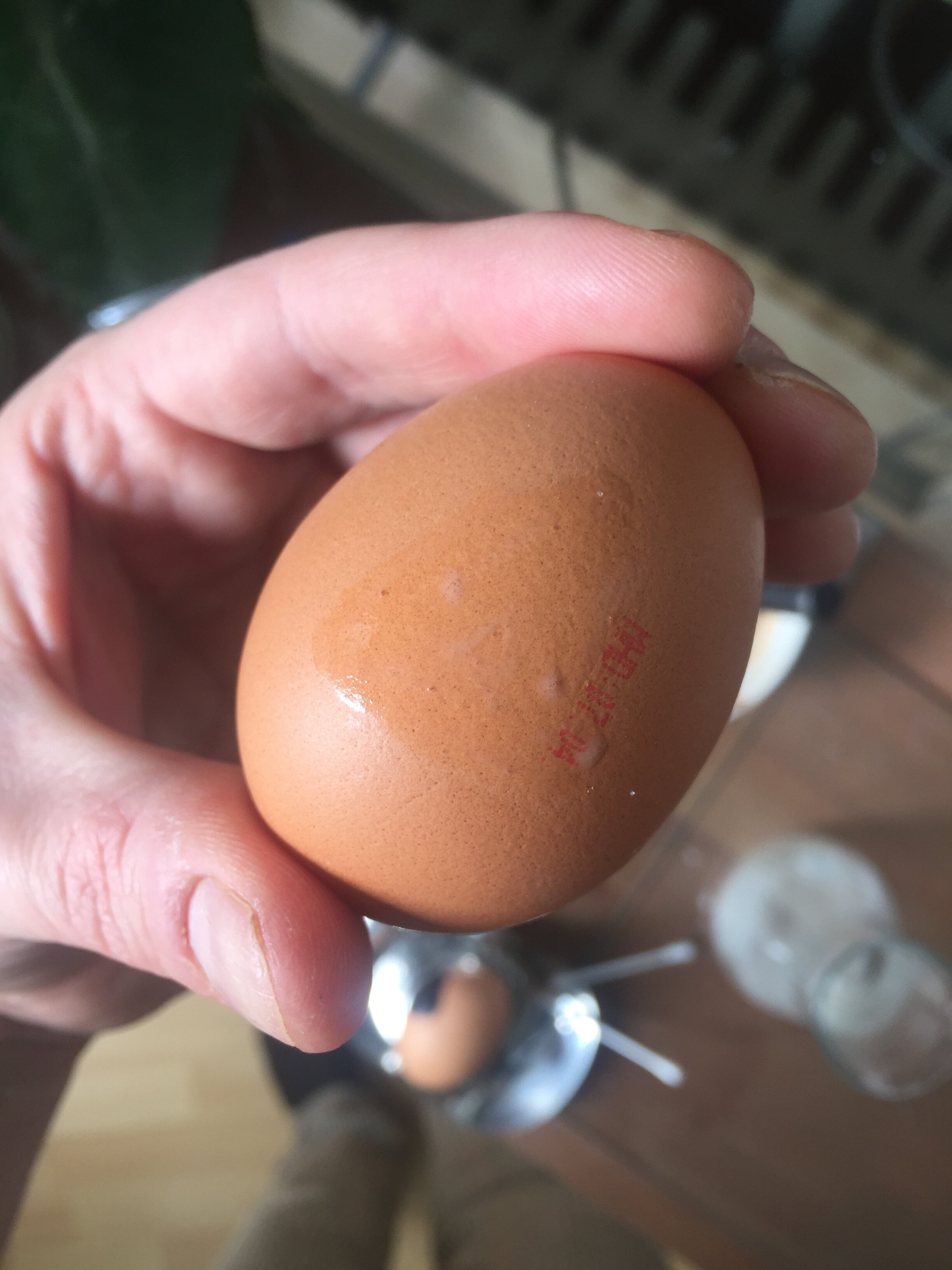
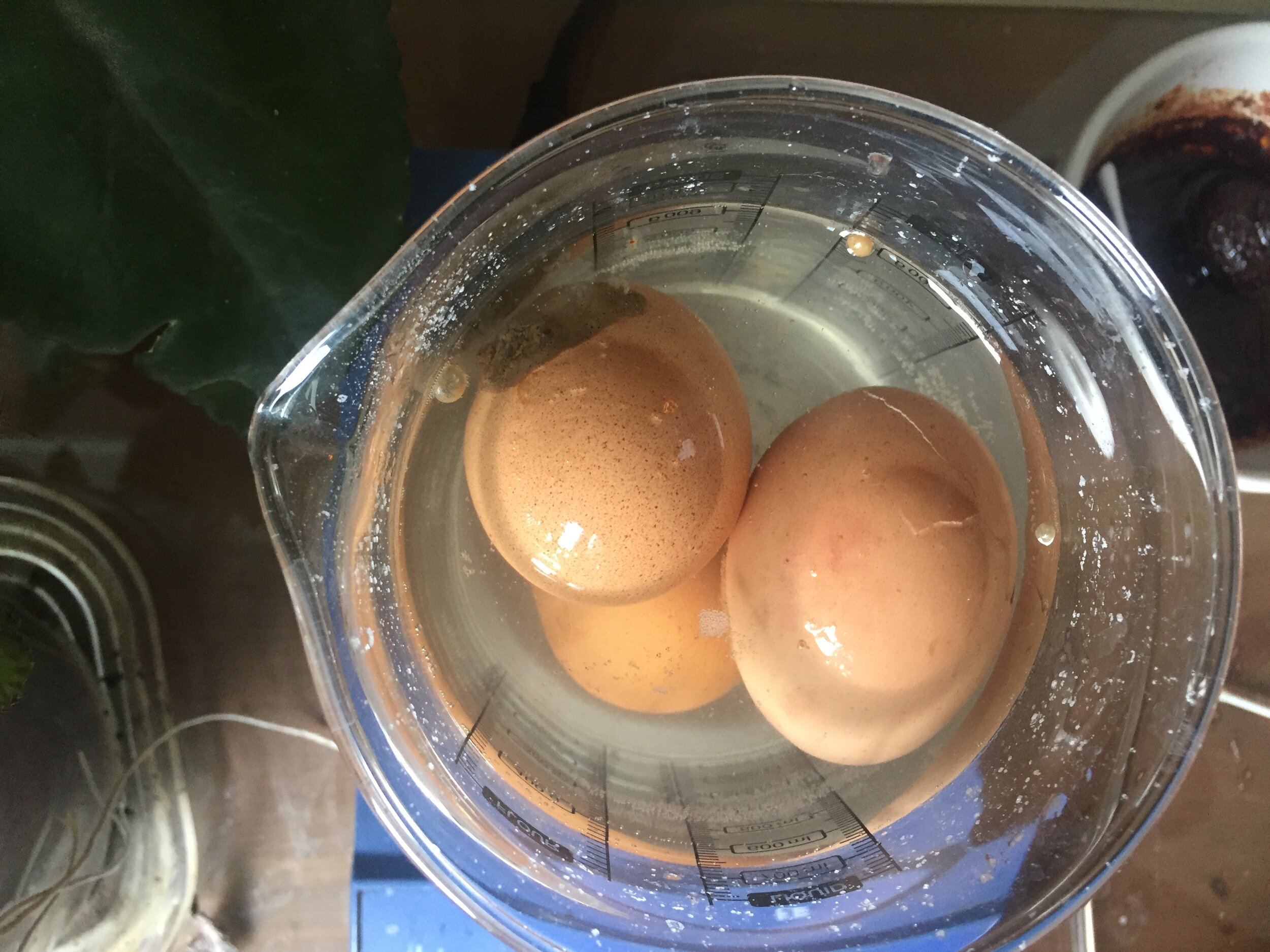
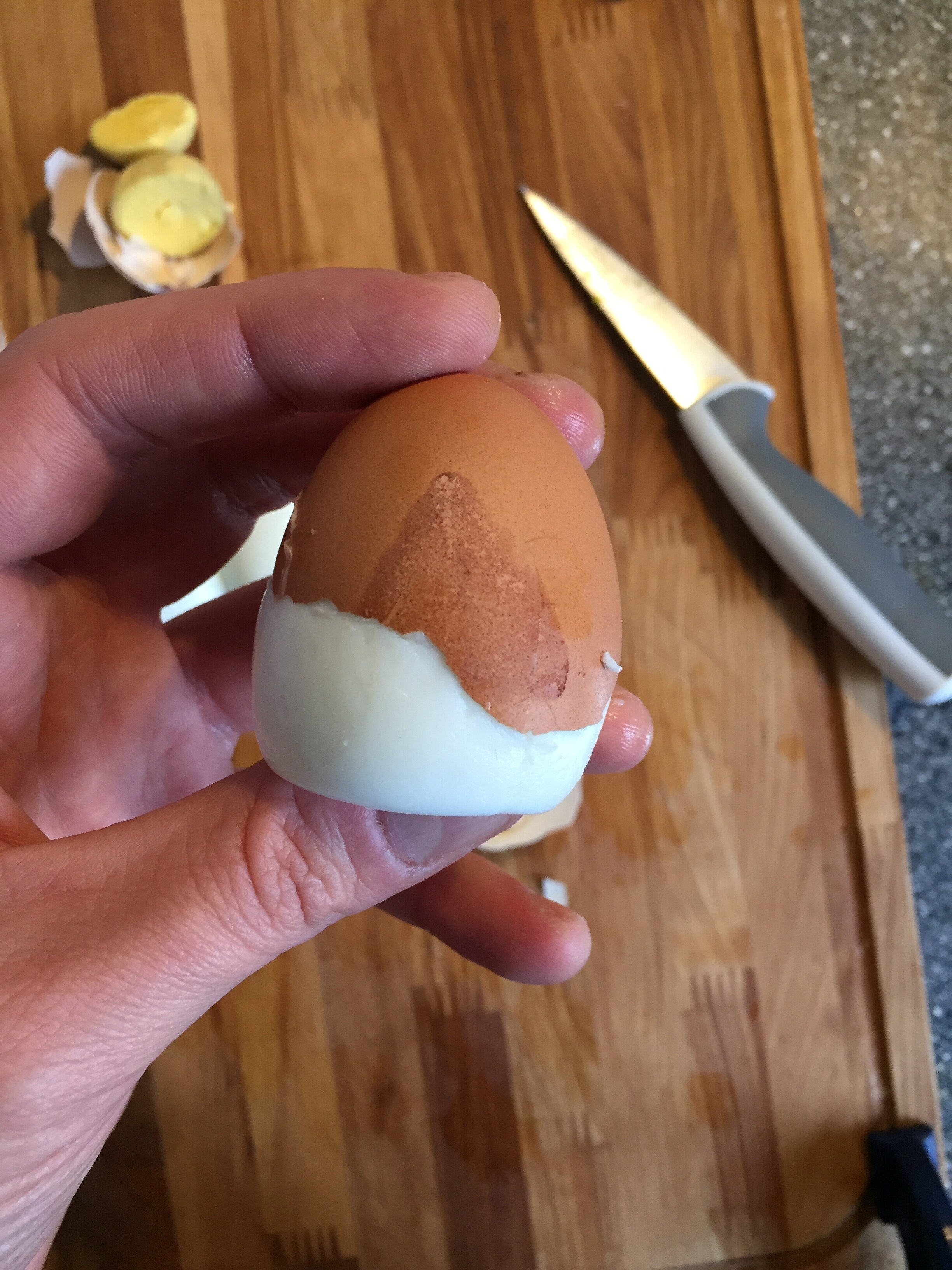
For now, here are Africanus’ and della Porta’s recipes for writing messages in eggs. I also tried to reproduce Africanus’ version, with and without oak gall (well, a tannin anyway). It didn’t work.

Julius Africanus’ recipe for leaving a secret message in an egg

“To make inscriptions on eggs. From Africanus.

“Grind up oak gall and alum with vinegar until it reaches the thickness of black ink. Use it to write whatever you want on the egg. Once the writing has dried in the sun, place the egg into a sharp brine. Once it has dried, boil it, and when you have peeled it, you will find the inscription.

“If you coat the egg all over with wax and inscribe it until the shell appears through the letters, then leave it to soak in vinegar overnight, on the next day, after removing the wax, you will find that the vinegar has made the outline of the letters transparent.”

Ὠὰ κατάγραπτα ποιῆσαι. Ἀφρικανοῦ.

Κικίδος καὶ στυπτηρίας μετὰ ὄξους τρίψας, ἕως γένηται πάχος μέλανος, ἐπίγραψον ἐξ αὐτοῦ ὃ θέλεις τῷ ὠῷ, καὶ ψυγείσης τῆς γραφῆς ἐν ἡλίῳ κατάθες τὸ ὠὸν εἰς ἅλμην δριμεῖαν, καὶ ψύξας ἕψησον, καὶ λεπίσας εὑρήσεις τὴν ἐπιγραφήν. Εἰ δὲ κηρῷ περιπλάσας τὸ ὠὸν ἐπιγράψεις ἄχρις ἂν φανῇ τὸ ἔλυτρον τοῖς γράμμασιν, εἶτα ἐάσεις ὄξει βρέχεσθαι τὴν νύκτα, τῇ ἑξῆς περιελὼν τὸν κηρόν, εὑρήσεις τῶν γραμμάτων τὸν τύπον ὑπὸ τοῦ ὄξους γενόμενον διαφανῆ.

Geoponica 14.10 (roughly 10th century, recipe originally 3rd century CE, probably)

Giambattista della Porta’s recipe for leaving a secret message in an egg

“If you want to make yellow letters appear on an egg white (it will work better when the egg is cooked): Boil an egg hard, roll it in wax, and engrave the letters on the wax with an iron point so that the marks go through. Place it into a solution of powdered alum and oak galls. Then put it into sharp vinegar and they will penetrate. And taking off the shell, you will see them on the white of the egg. Africanus instructs as follows: ‘grind oak galls and alum with vinegar, until they have the viscosity of ink. With it, inscribe whatever your want on the egg and once the writing has been dried by the sun, place the egg in sharp brine, and having dried it, cook it, peel, and you will find the inscription.’ I put it in vinegar and nothing happened, unless by ‘brine’, he meant sharp lye, what’s normally called capitellum.”

 Si vis autem ut litera supra albumen videantur croceae et rectius, ubi ovum excoctum fuerit: Coque ovum donec durescat et cera obline et insculpe literas stylo, ut liturae dehiscent, imponatur in humore, id est, ex gallis cum alumine tritis. Inde acri aceto impones et eae fient pentrabiles, quas cortice, detecto videbis in albumine ovi. Africanus ita docet. Gallas et alumen cum aceto terito, donec atramenti spissitudinem habeant, ex hoc quicquid libuerit ouo inscribito, et postquam scriptum Sole desiccatum fuerit, ouum in muriam acrem demittito, et resiccatum coquito, et decorticato, et reperies inscriptionem. Ego in acetum imposui, et nihil evenit, si per muriam non intelligat acre lixiviu, vulgo capitello dictum.

Giambattista della Porta, Magia Naturalis 16.4, 1590 (English, 1658)

View fullsize The Ingredients
The Ingredients
View fullsize Mixing the Ink and Inscribing
Mixing the Ink and Inscribing
View fullsize Control: Painting with Alum + Vinegar
Control: Painting with Alum + Vinegar
View fullsize Drying in the Sunshine
Drying in the Sunshine
View fullsize Placing the Eggs in Sharp Brine
Placing the Eggs in Sharp Brine
View fullsize Re-Drying
Re-Drying
View fullsize Boiling the Eggs
Boiling the Eggs
View fullsize The First Disappointment
The First Disappointment
View fullsize Inside of the Shell
Inside of the Shell
View fullsize Half Shell
Half Shell
View fullsize Results Summary
Results Summary
View fullsize Taking Control
Taking Control
View fullsize Letting it Dry
Letting it Dry
View fullsize Ink on Albumin
Ink on Albumin
View fullsize To be continued
To be continued
April 02, 2021 /Sean Coughlin
eggs, seasonal food, Geoponica, Julius Africanus, Giambattista della Porta, Wikipedia, experimental philology
Ancient Medicine, Philosophy
3 Comments

Eau essence de vie et de lumière by René Bord (1930–2020). 1995. Intaglio on copper and aquatint. Image from Bibliothèque municipale de Lyon.

Socrates’ Meteorology II

Humboldt-Universität zu Berlin
March 12, 2021 by Sean Coughlin in Philosophy

Xenophon, a source between Aristophanes and Plato, on Socrates’ meteorological reputation.

Weather Gods

“The conversations [at the party] were so good that the Syracusan [entertainer] noticed everyone was ignoring his dinner show and enjoying one another. Feeling a bit jealous, he said to Socrates:

‘Hey Socrates, aren’t you the one they call The Thinker?’

‘Isn’t that better,’ he said, ‘than being called thoughtless?’

‘Sure, if you weren’t supposed to be a thinker of ta meteora.’

‘Do you know,’ Socrates said, ‘anything more meteorological than the gods?’

‘For heaven’s sake, obviously not,’ he said, ‘but they’re not what people say you’re concerned with. They say you’re concerned with the most unbeneficial things.’

‘Well even if that were so,’ he said, ‘I’d still be concerned with gods. When it rains from above, they are beneficial, as when they give light from above. If it’s an awkward pun*,’ he said, ‘it’s your fault for giving me trouble.’”

τοιούτων δὲ λόγων ὄντων ὡς ἑώρα ὁ Συρακόσιος τῶν μὲν αὑτοῦ ἐπιδειγμάτων ἀμελοῦντας, ἀλλήλοις δὲ ἡδομένους, φθονῶν τῷ Σωκράτει εἶπεν:

ἆρα σύ, ὦ Σώκρατες, ὁ φροντιστὴς ἐπικαλούμενος;

οὐκοῦν κάλλιον, ἔφη, ἢ εἰ ἀφρόντιστος ἐκαλούμην;

εἰ μή γε ἐδόκεις τῶν μετεώρων φροντιστὴς εἶναι.

οἶσθα οὖν, ἔφη ὁ Σωκράτης, μετεωρότερόν τι τῶν θεῶν;

ἀλλ᾽ οὐ μὰ Δί᾽, ἔφη, οὐ τούτων σε λέγουσιν ἐπιμελεῖσθαι, ἀλλὰ τῶν ἀνωφελεστάτων.

οὐκοῦν καὶ οὕτως ἄν, ἔφη, θεῶν ἐπιμελοίμην: ἄνωθεν μέν γε ὕοντες ὠφελοῦσιν, ἄνωθεν δὲ φῶς παρέχουσιν. εἰ δὲ ψυχρὰ λέγω, σὺ αἴτιος, ἔφη, πράγματά μοι παρέχων.

Xenophon, Symposium 6.6–7

*lit. “if I’m saying frigid things”, but he’s referring to a pun he’s making: anôphelestata (most unbeneficial) like anô ôphelestata (very beneficial things from above), so anôthen ôphelousin: “from above, when it rains, they are beneficial.”

March 12, 2021 /Sean Coughlin
socrates, meteorology, Xenophon, dinner parties
Philosophy
Comment
Relief featuring a carpenter’s workshop with tools. Flavian era, second half of first century. At the Capitoline Museums. Image by Marie-Lan Nguyen via wikimedia commons.

Relief featuring a carpenter’s workshop with tools. Flavian era, second half of first century. At the Capitoline Museums. Image by Marie-Lan Nguyen via wikimedia commons.

Aristotle on Art and Nature: Tools

Humboldt-Universität zu Berlin
February 26, 2021 by Sean Coughlin in Ancient Medicine, Philosophy

“For just as sophisticated doctors and nearly everyone concerned with physical training agree that those who are to be good doctors or physical trainers need experience about nature, so too good legislators need experience of nature, perhaps even more than the former. For the former are craftsmen of only the body’s excellence; the latter who are craftsmen of the excellence of the soul and who profess to teach about the flourishing and failure of the state have in fact an even greater need of philosophy.

“For in all the other craftsmen’s arts the best tools have been discovered from nature, as in carpentry the level, straight-edge and compass (the ones, I take it, that are grasped through water and light and the rays of sunshine), relative to which when we are making a judgment we test what is adequately straight and smooth to our sensation; likewise the politician also needs to have some guidelines from nature and the truth itself relative to which he will distinguish what is just, what is noble and what is useful.”

ὥσπερ γὰρ τῶν ἰατρῶν ὅσοι κομψοὶ καὶ τῶν περὶ τὴν γυμναστικὴν οἱ πλεῖστοι σχεδὸν ὁμολογοῦσιν ὅτι δεῖ τοὺς μέλλοντας ἀγαθοὺς ἰατροὺς ἔσεσθαι καὶ γυμναστὰς περὶ φύσεως ἐμπείρους εἶναι, οὕτω καὶ τοὺς ἀγαθοὺς νομοθέτας ἐμπείρους εἶναι δεῖ τῆς φύσεως, καὶ πολύ γε μᾶλλον ἐκείνων. οἱ μὲν γὰρ τῆς τοῦ σώματος ἀρετῆς εἰσι δημιουργοὶ μόνον, οἱ δὲ περὶ τὰς τῆς ψυχῆς ἀρετὰς ὄντες καὶ περὶ πόλεως εὐδαιμονίας καὶ κακοδαιμονίας διδάξειν προσποιούμενοι πολὺ δὴ μᾶλλον προσδέονται φιλοσοφίας.

καθάπερ γὰρ ἐν ταῖς ἄλλαις τέχναις ταῖς δημιουργικαῖς ἀπὸ τῆς φύσεως εὕρηται τὰ βέλτιστα τῶν ὀργάνων, οἷον ἐν τεκτονικῇ στάθμη καὶ κανὼν καὶ τόρνος † * τὰ μὲν ὕδατι καὶ φωτὶ καὶ ταῖς αὐγαῖς τῶν ἀκτίνων ληφθέντων, πρὸς ἃ κρίνοντες τὸ κατὰ τὴν αἴσθησιν ἱκανῶς εὐθὺ καὶ λεῖον βασανίζομεν, ὁμοίως δὲ καὶ τὸν πολιτικὸν ἔχειν τινὰς ὅρους δεῖ ἀπὸ τῆς φύσεως αὐτῆς καὶ τῆς ἀληθείας, πρὸς οὓς κρινεῖ τί δίκαιον καὶ τί καλόν καὶ τί συμφέρον.

*Pistelli marks this passage with a crux; other editors have tried various solutions, none very satisfying. I’ve looked at the mss. available online, but they all preserve the same text. In their reconstruction of the Protrepticus, Doug and Monte think a line is missing (p.52 of the pdf here). Ronja is working on some compelling solutions to explain what’s going on philosophically. I think it might be an interpolation, τὰ μὲν … ληφθέντων being originally a marginal note: maybe Aristotle (or Iamblichus) didn’t bother giving examples of the kinds of tools “discovered from nature” and so someone early in the tradition wrote in some examples of the kinds of things he might have had in mind and this was later brought into the text.

Aristotle ap. Iamblichus, Protrepticus 10, 54,12–55,3 Pistelli


February 26, 2021 /Sean Coughlin
art and nature, Aristotle, Iamblichus, Doctors, art
Ancient Medicine, Philosophy
Comment
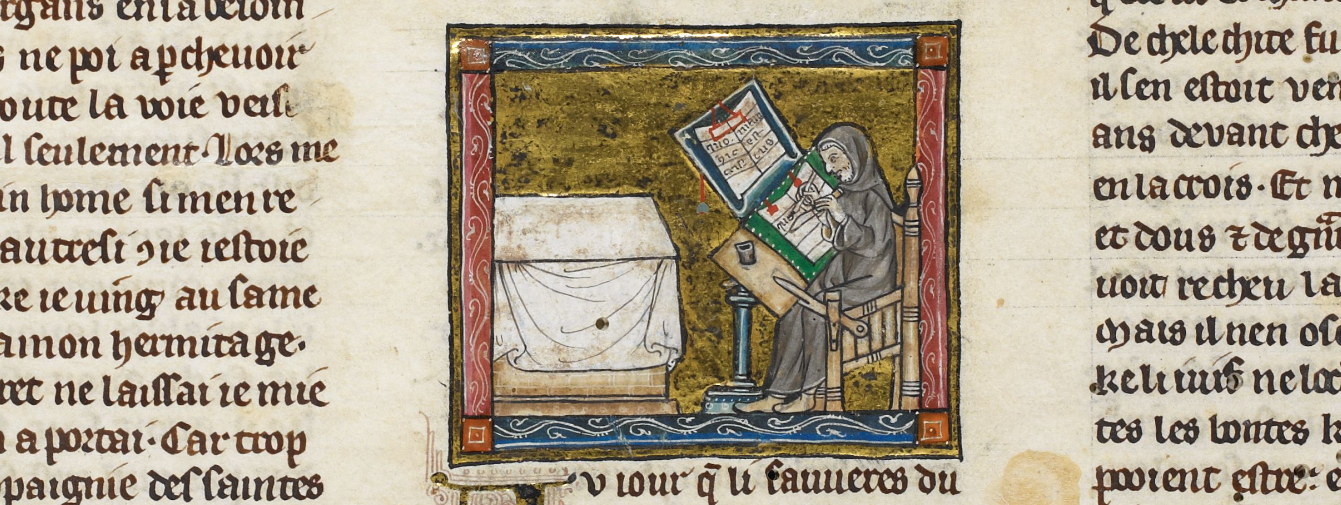
A hermit at work on a manuscript, from the Estoire del St. Graal, mid 14th century. British Library Royal MS 14 E III, fol. 6v.  Image via the British Library.

A hermit at work on a manuscript, from the Estoire del St. Graal, mid 14th century. British Library Royal MS 14 E III, fol. 6v. Image via the British Library.

A Mytilenean Peripatetic School? Galen on Primigenes of Mytilene

Humboldt-Universität zu Berlin
February 19, 2021 by Sean Coughlin in Philosophy

Here’s another text where Galen talks about a Peripatetic philosopher from Mytilene, Lesbos (Aristotle of Mytilene, possibly a teacher of Alexander of Aphrodisias, is here). This one’s name is Primigenes and Galen claims he gets a fever every time he misses his bath. He also tells us Primigenes is constantly reading and writing and doesn’t sweat very much. We’re left to infer he doesn’t get much exercise because he’s always at home doing philosophy. Seems to be a common trope that the kind of philosophy they do is rather solitary (compare with Apuleius when he describes his fish dissections following Aristotle at Apologia 25–28).

I haven’t found Primigenes mentioned anywhere else. Galen seems to have met with him when he was younger, so he would have lived in the mid-to-late second century. He also says Primigenes was second to none among the Peripatetics, which is pretty much the same thing he says about Aristotle of Mytilene. I wonder if this is just something Galen says about people he knows (you know, to make himself seem important) or if it implies the latter was dead by the time he met Primigenes. Could be both, I suppose.

“Experience certainly shows that in some cases people are harmed and benefited by the same things, in others by opposites. I know some people for example become sick right away when they don’t exercise for three days; others never exercise and always stay healthy; and of them some never bathe, while others immediately become feverish when they do not bathe, like Primigenes of Mytilene.

“Well then, it seems that this is how things are even to those who assemble the medical art by experience alone—except none of them has written down indications (like they do in the case of diseases) to which we might pay attention and discover the kind of daily routine each person needs. For it is possible in a few cases to discover what is referred to by the Empiricists as ‘precise syndromes’, as in peripneumonia and pleuritis; most diseases however involve a conjectural diagnosis, since they do not arise from an assemblage of defined symptoms, but require someone who knows the disposition of the body precisely and is competent enough to discover all the particulars that are in harmony with it. I discovered the following guided by reason itself when I was still a young man, from which it’s clear that long experience without reason is not able to discover such things.

“In the case of Primigenes, hearing that he always became feverish when he didn’t bathe, I reasoned that smoky residues were being generated in him which needed to be transpired but that because his skin was too thick to allow them to be evacuated and so caused them all to gather beneath the skin, they generated heat. That’s why baths are extremely useful for natures like his, not only for evacuating the smoky residue, but also for moisturizing with fresh water. I therefore thought it was a good idea to examine fully the quality of whatever kind of heat it was by placing my hand flat on Primigenes’ chest. As it was discovered to be acrid and biting (similar to eating a large quantity of onions), I was even more convinced that I had discovered the cause of what was happening. I asked whether he became sweaty when he didn’t bathe and when he said he did not, I was sure I had a firm grasp of his disposition. And yet I have also known others who likewise had a biting heat but did not become feverish because of a single missed bath since the residue in their case was evacuated by sweating. For Primigenes, in addition to his natural constitution, his typical daily routine was also responsible for him becoming feverish when he missed a single bath, as he spent most of the day at home where he was continually writing or reading because of his devotion to Peripatetic speculation—of those in his time he was second to none in the field.”

ἥ γε μὴν πεῖρα δείκνυσιν ὑπό τε τῶν αὐτῶν ἐνίους βλαπτομένους τε καὶ ὠφελουμένους, ὑπό τε τῶν ἐναντίων ὡσαύτως. οἶδα γοῦν τινας, οἳ τρεῖς ἡμέρας ἀγύμναστοι μείναντες εὐθέως νοσοῦσιν, ἀγυμνάστους τε ἑτέρους ἀεὶ διατελοῦντας, ὑγιαίνοντας δέ, καὶ τούτων ἐνίους μὲν ἀλούτους, ἐνίους δέ, εἰ μὴ λούσαιντο, πυρέττοντας αὐτίκα, καθάπερ ὁ Μιτυληναῖος Πριμιγένης.

ὅτι μὲν οὖν οὕτω φαίνεται ταῦτα γινόμενα, καὶ οἱ τῇ πείρᾳ μόνῃ τὴν τέχνην ἀθροίζοντες ἴσασιν. οὐ μὴν ἔγραψέ γέ τις αὐτῶν γνωρίσματα, καθάπερ ἐπὶ τῶν νοσημάτων, οἷς προσέχοντες εὑρήσομεν, ὁποίας ἕκαστος δεῖται διαίτης. ἐπ' ὀλίγων γὰρ ἔστιν εὑρεῖν τὰς καλουμένας ὑπὸ τῶν ἐμπειρικῶν συνδρομὰς ἠκριβωμένας, ὡς ἐν περιπνευμονίᾳ καὶ πλευρίτιδι· τὰ δὲ πλεῖστα νοσήματα στοχαστικὴν ἔχει τὴν διάγνωσιν, ὡς οὐκ ἐξ ἀθροίσματος ὡρισμένων συμπτωμάτων γινομένην, ἀλλ' ἀνδρὸς δεομένην ἀκριβῶς μὲν ἐπισταμένου τὴν διάθεσιν τοῦ σώματος, εὑρίσκειν δ' ἱκανοῦ τὰ κατὰ μέρος ἅπαντα τὰ τῇ τοιαύτῃ συμφωνοῦντα. τὸ γοῦν προκείμενον αὐτῷ τῷ λόγῳ ποδηγηθέντες ἡμεῖς εὕρομεν ἔτι νέοι τὴν ἡλικίαν ὄντες. ᾧ καὶ δῆλον, ὡς ἡ μακρὰ πεῖρα χωρὶς λόγου τὰ τοιαῦθ' εὑρίσκειν ἀδυνατεῖ.

ἐπὶ γοῦν τοῦ Πριμιγένους ἀκούσας, ὅτι πάντως πυρέττοι μὴ λουσάμενος, ἐλογισάμην αὐτῷ καπνώδη περιττώματα γεννᾶσθαι διαπνεῖσθαι δεόμενα, πυκνοτέρου δὲ τοῦ δέρματος ὄντος ἢ ὡς ἐπιτρέπειν αὐτοῖς κενοῦσθαι πᾶσιν ἀθροιζομένοις ὑπὸ τῷ δέρματι θερμασίαν γεννᾶν. διὸ καὶ τὰ λουτρὰ χρησιμώτατα ταῖς τοιαύταις φύσεσιν, οὐ μόνον τῷ κενοῦν τὸ καπνῶδες, ἀλλὰ καὶ τῷ τέγγειν ὑγρότητι γλυκείᾳ. καταμαθεῖν οὖν ἔδοξέ μοι πλατεῖαν ἐπιβαλόντι τὴν χεῖρα τῷ θώρακι τοῦ Πριμιγένους, ὁποία τίς ἐστιν ἡ τῆς θερμασίας ποιότης. ὡς δὲ δριμεῖα καὶ δακνώδης εὑρέθη παραπλησίως τοῖς κρόμμυα προσενηνεγμένοις δαψιλῆ, πολὺ δὴ μᾶλλον ἔτι τὴν αἰτίαν τοῦ γινομένου καλῶς εὑρῆσθαί μοι πεισθείς, ἐπυθόμην, εἴ τινες ἱδρῶτες αὐτῷ γίνοιντο χωρὶς τοῦ λουτροῦ, καὶ φάντος μὴ γίνεσθαι, βεβαιοτέραν γνῶσιν ἐπείσθην ἔχειν τῆς διαθέσεως αὐτοῦ. καὶ μὴν δὴ καὶ ἄλλους τινὰς εἶδον, ὁμοίως μὲν ἐκείνῳ δακνῶδες ἔχοντας τὸ θερμόν, οὐ μὴν ἐπ' ἀλουσίᾳ γε μιᾷ πυρέττοντας, ἐπειδὴ δι' ἱδρώτων αὐτοῖς ἐκενοῦτο τὸ περίττωμα. τῷ Πριμιγένει δὲ πρὸς τῇ φυσικῇ κατασκευῇ καὶ ὁ τρόπος τῆς διαίτης αἴτιος ἦν τοῦ πυρέττειν ἐπ' ἀλουσίᾳ μιᾷ, διατρίβοντι τὸ πλεῖστον τῆς ἡμέρας ἐπὶ τῆς οἰκίας, ἐν ᾗ γράφων ἢ ἀναγινώσκων διετέλει διὰ τὸ προσκεῖσθαι θεωρίᾳ Περιπατητικῇ, καθ' ἣν οὐδενὸς ἦν δεύτερος τῶν κατ' αὐτόν.

Galen, On Matters of Health 5.11.6–20 (6.364–367 K. = 160,24–163,4 Koch)

February 19, 2021 /Sean Coughlin
Mytilene, Mytilenean School, Primigenes, Galen, Peripatetics
Philosophy
Comment
Luttrell Psalter, mid-14th century. British Library Add MS 42130, fol. 57r. Image via the British Library.

Luttrell Psalter, mid-14th century. British Library Add MS 42130, fol. 57r. Image via the British Library.

Galen on the Death of Aristotle of Mytilene

Humboldt-Universität zu Berlin
January 22, 2021 by Sean Coughlin in Ancient Medicine, Philosophy

Not much is known about Aristotle of Mytilene, a peripatetic from Lesbos. Galen talked to some of the people who were there when he died, which suggests he and Galen were rough contemporaries. This probably puts this Aristotle in the second half of the second century C.E. Moraux (1967) has suggested Aristotle of Mytilene was the teacher of Alexander of Aphrodisias. Galen’s testimony suggests it is at least temporally possible.

“Aristotle of Mytilene, a man who ranked first in Peripatetic speculation, when he was struck by a disease that could be cured by a cold drink, because he had never taken such a drink before, fended off those counseling him to drink it, saying he knew that he would surely suffer a seizure if he drank something cold. For he said he saw this happen to someone else who had a similar bodily condition and temperament to himself and who had become habituated to drinking hot drinks. If he were habituated to drinking [cold] drinks, as some people are, he would certainly not have been afraid of taking it. But since he was also affected by this illness, the attending doctors together compelled him to take it. That is, as I learned, how he died. Those who were there at his end asked me: since I have risked administering cold to some patients when other doctors were cautious—to some patients [I did it] during the entire course of their illness, to others at some appropriate moment—would I have risked doing it in his case, too, or was the man right to keep his sights on his own nature? To them I replied that he was right to keep it in his sights.”

Ἀριστοτέλης γοῦν ὁ Μιτυληναῖος, ἀνὴρ πρωτεύσας ἐν τῇ Περιπατητικῇ θεωρίᾳ, νοσήματι περιπεσὼν ὑπὸ ψυχροῦ πόσεως ὠφεληθῆναι δυνάμενῳ, διότι μηδέποτε τοιοῦτον προσενήνεγκτο πόμα, διεκώλυσε τοὺς συμβουλεύοντας αὐτῷ πιεῖν, ἐπίστασθαι σαφῶς εἰπών, ὅτι σπασθήσοιτο γευσάμενος ψυχροῦ· καὶ γὰρ ἐπ' ἄλλου τοῦτ' ἔφασκεν ἑωρακέναι τήν τε τοῦ σώματος ἕξιν καὶ κρᾶσιν ὁμοίαν ἑαυτῷ καὶ τὸ τῆς θερμοποσίας ἔθος ἐσχηκότος· ‖ εἰ δ' ἦν ἔθος ὥσπερ ἐνίοις πόματος τοιούτου, μάλιστα μὲν ἂν οὐδ' αὐτὸς ἔδεισεν αὐτοῦ τὴν προσφοράν· εἰ δὲ καὶ τοῦτ' ἔπαθεν, ἠνάγκασαν οἱ παρόντες ἰατροὶ πάντως αὐτόν. ἐκεῖνος μὲν οὖν οὕτως ἀπέθανεν, ὡς ἐπυθόμην· ἐρομένων δέ με τῶν παραγενομένων αὐτῷ τελευτῶντι, πότερον, ὡς ἐπ' ἄλλων ἐτόλμησα τοῖς μὲν δι' ὅλης τῆς νόσου, τοῖς δ' ἔν τινι καιρῷ δοῦναι ψυχρὸν εὐλαβουμένων τῶν ἰατρῶν, οὕτως <ἂν> ἐτόλμησα καὶ ἐπ' ἐκείνου ἢ καλῶς ἐστοχάσατο τῆς ἑαυτοῦ φύσεως ὁ ἀνήρ, ἀπεκρινάμην αὐτοῖς ἀκριβῶς αὐτὸν ἐστοχάσθαι.

Galen, De consuetudnibus 1, 4,16–6,6 Schmutte (CMG Suppl. III)

January 22, 2021 /Sean Coughlin
Island Vacations, Mytilene, Aristotle of Mytilene, Alexander of Aphrodisias, Peripatetics, Galen
Ancient Medicine, Philosophy
Comment
Réalité de l'espace by René Bord. 1996. Intaglio&nbsp;on copper and aquatint. Image from Bibliothèque municipale de Lyon.

Réalité de l'espace by René Bord. 1996. Intaglio on copper and aquatint. Image from Bibliothèque municipale de Lyon.

Aristophanes and Plato on Socrates’ Meteorology

Humboldt-Universität zu Berlin
October 19, 2020 by Sean Coughlin in Philosophy

Socrates inquiring about the heavens in the Clouds and the Phaedo.

Higher Thinking

Strepsiades: Hey, Socrates! Hey, little Socrates!

Socrates: Why are you calling on me, ephemeral creature?

Strepsiades: First, could I ask you to tell me what it is you’re doing?

Socrates: I am air-climbing and thinking about the sun.

Strepsiades: Well, in that case, why are you thinking over the gods from a basket instead of from the ground?

Socrates: Because I’d never properly discover the celestial bodies (τὰ μετέωρα πράγματα = things above the ground) if I did not suspend my mind and mix my subtle thought into the kindred air. If I were grounded and I examined the higher things from below, I would never make any discoveries. Obviously, the earth draws by force my thinking-juices towards itself. The watercress experiences this same thing…

Strepsiades: What are you saying? Thinking draws juice into the watercress? Come on now, come down to me from there, little Socrates, so that you can teach me I’ve come to learn.

{Στ.} ὦ Σώκρατες.
ὦ Σωκρατίδιον.
{Σω} τί με καλεῖς, ὦ 'φήμερε;
{Στ.} πρῶτον μὲν ὅτι δρᾷς, ἀντιβολῶ, κάτειπέ μοι.
{Σω.} ἀεροβατῶ καὶ περιφρονῶ τὸν ἥλιον.
{Στ.} ἔπειτ' ἀπὸ ταρροῦ τοὺς θεοὺς ὑπερφρονεῖς,
ἀλλ' οὐκ ἀπὸ τῆς γῆς, εἴπερ;
{Σω.} οὐ γὰρ ἄν ποτε
ἐξηῦρον ὀρθῶς τὰ μετέωρα πράγματα
εἰ μὴ κρεμάσας τὸ νόημα καὶ τὴν φροντίδα,
λεπτὴν καταμείξας εἰς τὸν ὅμοιον ἀέρα.
εἰ δ' ὢν χαμαὶ τἄνω κάτωθεν ἐσκόπουν,
οὐκ ἄν ποθ' ηὗρον· οὐ γὰρ ἀλλ' ἡ γῆ βίᾳ
ἕλκει πρὸς αὑτὴν τὴν ἰκμάδα τῆς φροντίδος.
πάσχει δὲ ταὐτὸ τοῦτο καὶ τὰ κάρδαμα.
{Στ.} πῶς φῄς;
ἡ φροντὶς ἕλκει τὴν ἰκμάδ' εἰς τὰ κάρδαμα;
ἴθι νυν κατάβηθ', ὦ Σωκρατίδιον, ὡς ἐμέ,
ἵνα με διδάξῃς ὧνπερ ἕνεκ' ἐλήλυθα.

Aristophanes, Clouds 221–238

Fish out of Water

“Furthermore,” he said, “[the earth] is something immense and we who inhabit the lands between the pillars of Herakles and the Phasis river are living in some small part around the sea like ants or frogs around a pound, and many others in foreign lands live in many other such places.

“For around the earth in all directions there are many hollows of all sorts of shapes and sizes into which water, mist and air flow together into a stream; but the pure earth itself is situated in the pure heaven where the stars exist, which many of those accustomed to discussing such things call, ‘aether’; of which these (sc. water, mist, air) are sediment and forever flow into the hollows of the earth.

“Now we are unaware that we live in the hollows, and we think we live above upon the surface of the earth—as if someone living in the middle of the ocean’s depths thought they lived on the surface of the sea, and seeing the sun and the other stars through the water they thought the sea to be heaven, but because of slowness and weakness, they never reached the sea’s upper limit, nor raising their head out of the sea and emerging into this region here have they seen how much purer and more beautiful it happens to be than the place in which they live, nor have they heard about it from anyone else.

“We experience this same thing. For living in a certain hollow of the earth we think we inhabit its upper part; and we call the air ‘heaven,’ as if it were the heaven through which the stars travel; and it is the same, that because of weakness and slowness we are unable to travel to the farthest air: if anyone went to its extremes, or having grown wings flew up to it and raised their head out, then they would see—just as fish raising their heads out of the water see things here, they too would see the things there—and if their nature were strong enough to contemplate them, they would recognize that there is the true heaven and the true light and the true earth.

“For the earth, the stones and the whole region here are corrupted and corroded, just as things in the sea are by the salt water—and nothing worth mentioning grows in the sea, nor is anything there, in a word, perfect, but there are caverns and sand, and endless mud and slime wherever there is also earth, and there is nothing worth comparing to the beauty of things around us. The things up there, in turn, seem to be yet even more superior than the things around us.”

ἔτι τοίνυν, ἔφη, πάμμεγά τι εἶναι αὐτό, καὶ ἡμᾶς οἰκεῖν τοὺς μέχρι Ἡρακλείων στηλῶν ἀπὸ Φάσιδος ἐν σμικρῷ τινι μορίῳ, ὥσπερ περὶ τέλμα μύρμηκας ἢ βατράχους περὶ τὴν θάλατταν οἰκοῦντας, καὶ ἄλλους ἄλλοθι πολλοὺς ἐν πολλοῖσι τοιούτοις τόποις οἰκεῖν.

εἶναι γὰρ πανταχῇ περὶ τὴν γῆν πολλὰ κοῖλα καὶ παντοδαπὰ καὶ τὰς ἰδέας καὶ τὰ μεγέθη, εἰς ἃ συνερρυηκέναι τό τε ὕδωρ καὶ τὴν ὁμίχλην καὶ τὸν ἀέρα: αὐτὴν δὲ τὴν γῆν καθαρὰν ἐν καθαρῷ κεῖσθαι τῷ οὐρανῷ ἐν ᾧπέρ ἐστι τὰ ἄστρα, ὃν δὴ αἰθέρα ὀνομάζειν τοὺς πολλοὺς τῶν περὶ τὰ τοιαῦτα εἰωθότων λέγειν: οὗ δὴ ὑποστάθμην ταῦτα εἶναι καὶ συρρεῖν ἀεὶ εἰς τὰ κοῖλα τῆς γῆς.

ἡμᾶς οὖν οἰκοῦντας ἐν τοῖς κοίλοις αὐτῆς λεληθέναι καὶ οἴεσθαι ἄνω ἐπὶ τῆς γῆς οἰκεῖν, ὥσπερ ἂν εἴ τις ἐν μέσῳ τῷ πυθμένι τοῦ πελάγους οἰκῶν οἴοιτό τε ἐπὶ τῆς θαλάττης οἰκεῖν καὶ διὰ τοῦ ὕδατος ὁρῶν τὸν ἥλιον καὶ τὰ ἄλλα ἄστρα τὴν θάλατταν ἡγοῖτο οὐρανὸν εἶναι, διὰ δὲ βραδυτῆτά τε καὶ ἀσθένειαν μηδεπώποτε ἐπὶ τὰ ἄκρα τῆς θαλάττης ἀφιγμένος μηδὲ ἑωρακὼς εἴη, ἐκδὺς καὶ ἀνακύψας ἐκ τῆς θαλάττης εἰς τὸν ἐνθάδε τόπον, ὅσῳ καθαρώτερος καὶ καλλίων τυγχάνει ὢν τοῦ παρὰ σφίσι, μηδὲ ἄλλου ἀκηκοὼς εἴη τοῦ ἑωρακότος.

ταὐτὸν δὴ τοῦτο καὶ ἡμᾶς πεπονθέναι: οἰκοῦντας γὰρ ἔν τινι κοίλῳ τῆς γῆς οἴεσθαι ἐπάνω αὐτῆς οἰκεῖν, καὶ τὸν ἀέρα οὐρανὸν καλεῖν, ὡς διὰ τούτου οὐρανοῦ ὄντος τὰ ἄστρα χωροῦντα: τὸ δὲ εἶναι ταὐτόν, ὑπ’ ἀσθενείας καὶ βραδυτῆτος οὐχ οἵους τε εἶναι ἡμᾶς διεξελθεῖν ἐπ ἔσχατον τὸν ἀέρα: ἐπεί, εἴ τις αὐτοῦ ἐπ’ ἄκρα ἔλθοι ἢ πτηνὸς γενόμενος ἀνάπτοιτο, κατιδεῖν ἂν ἀνακύψαντα, ὥσπερ ἐνθάδε οἱ ἐκ τῆς θαλάττης ἰχθύες ἀνακύπτοντες ὁρῶσι τὰ ἐνθάδε, οὕτως ἄν τινα καὶ τὰ ἐκεῖ κατιδεῖν, καὶ εἰ ἡ φύσις ἱκανὴ εἴη ἀνασχέσθαι θεωροῦσα, γνῶναι ἂν ὅτι ἐκεῖνός ἐστιν ὁ ἀληθῶς οὐρανὸς καὶ τὸ ἀληθινὸν φῶς καὶ ἡ ὡς ἀληθῶς γῆ.

ἥδε μὲν γὰρ ἡ γῆ καὶ οἱ λίθοι καὶ ἅπας ὁ τόπος ὁ ἐνθάδε διεφθαρμένα ἐστὶν καὶ καταβεβρωμένα, ὥσπερ τὰ ἐν τῇ θαλάττῃ ὑπὸ τῆς ἅλμης, καὶ οὔτε φύεται ἄξιον λόγου οὐδὲν ἐν τῇ θαλάττῃ, οὔτε τέλειον ὡς ἔπος εἰπεῖν οὐδέν ἐστι, σήραγγες δὲ καὶ ἄμμος καὶ πηλὸς ἀμήχανος καὶ βόρβοροί εἰσιν, ὅπου ἂν καὶ ἡ γῆ ᾖ, καὶ πρὸς τὰ παρ’ ἡμῖν κάλλη κρίνεσθαι οὐδ’ ὁπωστιοῦν ἄξια. ἐκεῖνα δὲ αὖ τῶν παρ’ ἡμῖν πολὺ ἂν ἔτι πλέον φανείη διαφέρειν.

Plato, Phaedo 109A–110A

October 19, 2020 /Sean Coughlin
socrates, plato, aristophanes, true earth, clouds, phaedo, astronomy, meteorology
Philosophy
Comment
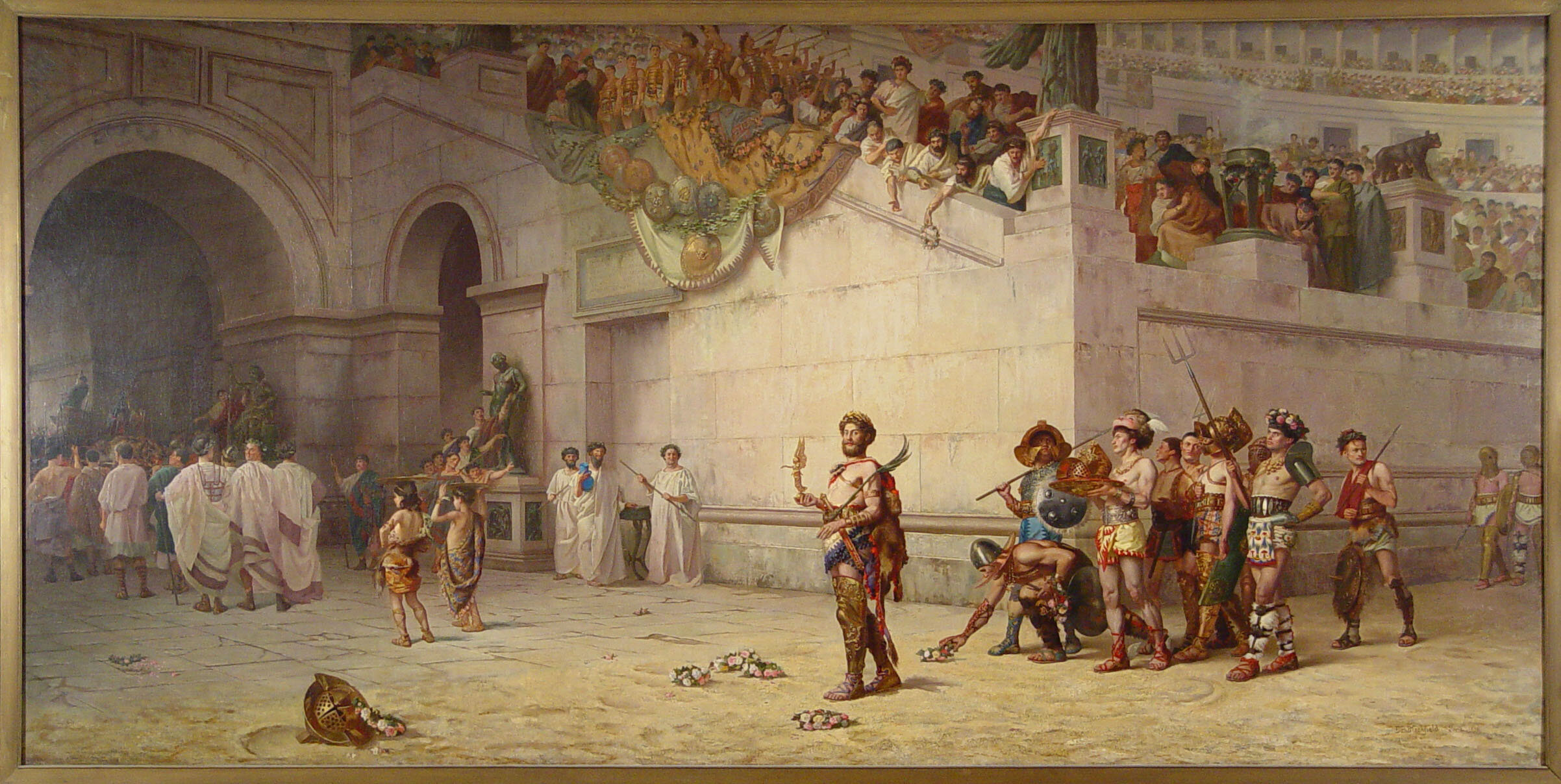
The Emperor Commodus Leaving the Arena at the Head of the Gladiators by Edwin Howland Blashfield (not sure of the year). Sloane Collection, Hermitage Museum and Gardens, Norfolk, VA. Via Wikimedia Commons.

The Emperor Commodus Leaving the Arena at the Head of the Gladiators by Edwin Howland Blashfield (not sure of the year). Sloane Collection, Hermitage Museum and Gardens, Norfolk, VA. Via Wikimedia Commons.

Body and Soul

Humboldt-Universität zu Berlin
October 06, 2020 by Sean Coughlin in Philosophy, Ancient Medicine

“The fact that our thoughts depend on our bodies and that they are not in themselves unaffected since they derive from our body’s changes—this becomes altogether clear in the case of those who are drunk and those who are sick. For it is extremely obvious that their thoughts are distorted by the affections of their body. And in fact the opposite becomes clear too when the body is affected along with the affections of the soul in cases of love and fear, pain and pleasure.”

Ὅτι αἱ διάνοιαι ἕπονται τοῖς σώμασι, καὶ οὐκ εἰσὶν αὐταὶ καθ' ἑαυτὰς ἀπαθεῖς οὖσαι τῶν τοῦ σώματος κινήσεων. τοῦτο δὲ δῆλον πάνυ γίνεται ἔν τε ταῖς μέθαις καὶ ἐν ταῖς ἀρρωστίαις· πολὺ γὰρ ἐξαλλάττουσαι φαίνονται αἱ διάνοιαι ὑπὸ τῶν τοῦ σώματος παθημάτων. καὶ τοὐναντίον δὴ τοῖς τῆς ψυχῆς παθήμασι τὸ σῶμα συμπάσχον φανερὸν γίνεται περί τε τοὺς ἔρωτας καὶ τοὺς φόβους τε καὶ τὰς λύπας καὶ τὰς ἡδονάς.

Pseudo-Aristotle, Physiognomics 1, 805a1-8

October 06, 2020 /Sean Coughlin
Medicine of the mind, Pseudo-Aristotle, physiognomics, politics, soul, body
Philosophy, Ancient Medicine
Comment
  • Newer
  • Older
 

CATEGORIES

  • Ancient Medicine
  • Botany
  • Events
  • Philosophy

SEARCH


RECENT POSTS

Featured
Dec 31, 2025
Botany, Philosophy
Concerning a Variant in the de Fuentes Manuscript
Dec 31, 2025
Botany, Philosophy
Dec 31, 2025
Botany, Philosophy
Dec 25, 2025
Ancient Medicine
How to smell nice: Galen's advice for doctors
Dec 25, 2025
Ancient Medicine
Dec 25, 2025
Ancient Medicine
Dec 23, 2025
Ancient Medicine
More on how not to talk to patients
Dec 23, 2025
Ancient Medicine
Dec 23, 2025
Ancient Medicine
Dec 13, 2025
Ancient Medicine
"Patroclus died as well" (How Not to Talk to Patients)
Dec 13, 2025
Ancient Medicine
Dec 13, 2025
Ancient Medicine
Sep 18, 2023
Ancient Medicine
Galen, Simple Drugs, Book 11, Preface (II)
Sep 18, 2023
Ancient Medicine
Sep 18, 2023
Ancient Medicine